
Mapa mental
Close Relationships
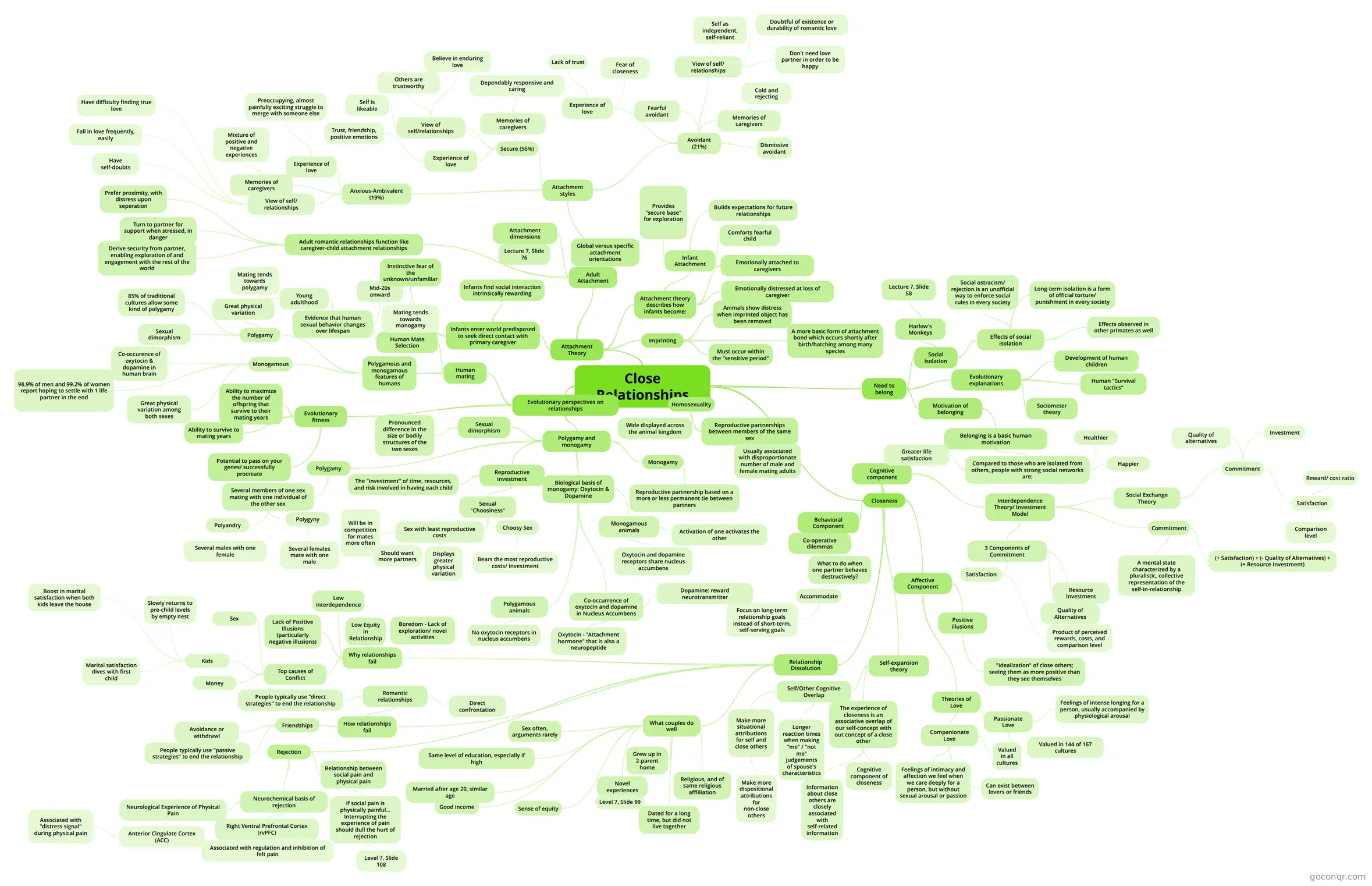
Mind map: close relationships
Contenido del mapa
Close Relationships
Evolutionary perspectives on relationships
- Evolutionary fitness
- Potential to pass on your genes/ successfully procreate
- Ability to survive to mating years
- Ability to maximize the number of offspring that survive to their mating years
- Polygamy and monogamy
- Reproductive investment
- Sexual "Choosiness"
- Choosy Sex
- Bears the most reproductive costs/ investment
- Sex with least reproductive costs
- Should want more partners
- Will be in competition for mates more often
- Displays greater physical variation
- Choosy Sex
- The "investment" of time, resources, and risk involved in having each child
- Sexual "Choosiness"
- Sexual dimorphism
- Pronounced difference in the size or bodily structures of the two sexes
- Biological basis of monogamy: Oxytocin & Dopamine
- Co-occurrence of oxytocin and dopamine in Nucleus Accumbens
- Dopamine: reward neurotransmitter
- Oxytocin - "Attachment hormone" that is also a neuropeptide
- Monogamous animals
- Oxytocin and dopamine receptors share nucleus accumbens
- Activation of one activates the other
- Polygamous animals
- No oxytocin receptors in nucleus accumbens
- Co-occurrence of oxytocin and dopamine in Nucleus Accumbens
- Polygamy
- Several members of one sex mating with one individual of the other sex
- Polygyny
- Several females mate with one male
- Polyandry
- Several males with one female
- Polygyny
- Several members of one sex mating with one individual of the other sex
- Monogamy
- Reproductive partnership based on a more or less permanent tie between partners
- Reproductive investment
- Homosexuality
- Reproductive partnerships between members of the same sex
- Wide displayed across the animal kingdom
- Usually associated with disproportionate number of male and female mating adults
- Reproductive partnerships between members of the same sex
- Human mating
- Polygamous and monogamous features of humans
- Polygamy
- Sexual dimorphism
- Great physical variation
- 85% of traditional cultures allow some kind of polygamy
- Monogamous
- Co-occurence of oxytocin & dopamine in human brain
- Great physical variation among both sexes
- 98.9% of men and 99.2% of women report hoping to settle with 1 life partner in the end
- Polygamy
- Human Mate Selection
- Evidence that human sexual behavior changes over lifespan
- Young adulthood
- Mating tends towards polygamy
- Mid-20s onward
- Mating tends towards monogamy
- Young adulthood
- Evidence that human sexual behavior changes over lifespan
- Polygamous and monogamous features of humans
- Evolutionary fitness
Need to belong
- Motivation of belonging
- Belonging is a basic human motivation
- Compared to those who are isolated from others, people with strong social networks are:
- Happier
- Healthier
- Greater life satisfaction
- Compared to those who are isolated from others, people with strong social networks are:
- Belonging is a basic human motivation
- Evolutionary explanations
- Sociometer theory
- Human "Survival tactics"
- Development of human children
- Social isolation
- Effects of social isolation
- Long-term isolation is a form of official torture/ punishment in every society
- Social ostracism/ rejection is an unofficial way to enforce social rules in every society
- Effects observed in other primates as well
- Harlow's Monkeys
- Lecture 7, Slide 58
- Effects of social isolation
- Motivation of belonging
Attachment Theory
- Imprinting
- A more basic form of attachment bond which occurs shortly after birth/hatching among many species
- Must occur within the "sensitive period"
- Animals show distress when imprinted object has been removed
- Adult Attachment
- Attachment styles
- Secure (56%)
- Experience of love
- Trust, friendship, positive emotions
- View of self/relationships
- Believe in enduring love
- Others are trustworthy
- Self is likeable
- Memories of caregivers
- Dependably responsive and caring
- Experience of love
- Anxious-Ambivalent (19%)
- Experience of love
- Preoccupying, almost painfully exciting struggle to merge with someone else
- View of self/ relationships
- Fall in love frequently, easily
- Have difficulty finding true love
- Have self-doubts
- Memories of caregivers
- Mixture of positive and negative experiences
- Experience of love
- Avoidant (21%)
- Fearful avoidant
- Dismissive avoidant
- Experience of love
- Fear of closeness
- Lack of trust
- View of self/ relationships
- Doubtful of existence or durability of romantic love
- Don't need love partner in order to be happy
- Self as independent, self-reliant
- Memories of caregivers
- Cold and rejecting
- Secure (56%)
- Attachment dimensions
- Lecture 7, Slide 76
- Global versus specific attachment orientations
- Adult romantic relationships function like caregiver-child attachment relationships
- Prefer proximity, with distress upon seperation
- Turn to partner for support when stressed, in danger
- Derive security from partner, enabling exploration of and engagement with the rest of the world
- Attachment styles
- Attachment theory describes how infants become:
- Emotionally attached to caregivers
- Emotionally distressed at loss of caregiver
- Infant Attachment
- Comforts fearful child
- Builds expectations for future relationships
- Provides "secure base" for exploration
- Infants enter world predisposed to seek direct contact with primary caregiver
- Infants find social interaction intrinsically rewarding
- Instinctive fear of the unknown/unfamiliar
- Imprinting
Closeness
- Cognitive component
- Self-expansion theory
- The experience of closeness is an associative overlap of our self-concept with out concept of a close other
- Information about close others are closely associated with self-related information
- Cognitive component of closeness
- Self/Other Cognitive Overlap
- Longer reaction times when making "me" / "not me" judgements of spouse's characteristics
- Make more situational attributions for self and close others
- Make more dispositional attributions for non-close others
- The experience of closeness is an associative overlap of our self-concept with out concept of a close other
- Interdependence Theory/ Investment Model
- Social Exchange Theory
- Commitment
- Satisfaction
- Reward/ cost ratio
- Comparison level
- Quality of alternatives
- Investment
- Satisfaction
- Commitment
- Commitment
- A mental state characterized by a pluralistic, collective representation of the self-in-relationship
- (+ Satisfaction) + (- Quality of Alternatives) + (+ Resource Investment)
- 3 Components of Commitment
- Satisfaction
- Product of perceived rewards, costs, and comparison level
- Quality of Alternatives
- Resource Investment
- Satisfaction
- Social Exchange Theory
- Self-expansion theory
- Affective Component
- Theories of Love
- Companionate Love
- Feelings of intimacy and affection we feel when we care deeply for a person, but without sexual arousal or passion
- Can exist between lovers or friends
- Valued in all cultures
- Passionate Love
- Feelings of intense longing for a person, usually accompanied by physiological arousal
- Valued in 144 of 167 cultures
- Companionate Love
- Positive illusions
- "Idealization" of close others; seeing them as more positive than they see themselves
- Theories of Love
- Behavioral Component
- Co-operative dilemmas
- What to do when one partner behaves destructively?
- Accommodate
- Focus on long-term relationship goals instead of short-term, self-serving goals
- Accommodate
- What to do when one partner behaves destructively?
- Co-operative dilemmas
- Relationship Dissolution
- What couples do well
- Novel experiences
- Level 7, Slide 99
- Married after age 20, similar age
- Grew up in 2-parent home
- Dated for a long time, but did not live together
- Same level of education, especially if high
- Good income
- Religious, and of same religious affliliation
- Sense of equity
- Sex often, arguments rarely
- Novel experiences
- Why relationships fail
- Low Equity in Relationship
- Lack of Positive Illusions (particularly negative illusions)
- Low interdependence
- Boredom - Lack of exploration/ novel activities
- Top causes of Conflict
- Sex
- Money
- Kids
- Marital satisfaction dives with first child
- Slowly returns to pre-child levels by empty nest
- Boost in marital satisfaction when both kids leave the house
- How relationships fail
- Friendships
- People typically use "passive strategies" to end the relationship
- Avoidance or withdrawl
- Romantic relationships
- People typically use "direct strategies" to end the relationship
- Direct confrontation
- Friendships
- Rejection
- Neurochemical basis of rejection
- Neurological Experience of Physical Pain
- Anterior Cingulate Cortex (ACC)
- Associated with "distress signal" during physical pain
- Anterior Cingulate Cortex (ACC)
- Right Ventral Prefrontal Cortex (rvPFC)
- Associated with regulation and inhibition of felt pain
- Neurological Experience of Physical Pain
- Relationship between social pain and physical pain
- If social pain is physically painful... Interrupting the experience of pain should dull the hurt of rejection
- Level 7, Slide 108
- If social pain is physically painful... Interrupting the experience of pain should dull the hurt of rejection
- Neurochemical basis of rejection
- What couples do well
- Cognitive component
Información
- Descripción
- Mapa Mental sobre Close Relationships, creado por grant.samantha el 07/12/2013.
- Creado por
- grant.samantha
- Visitas
- 28
- Valoración