
Mapa mental
pathogenesis of cholera
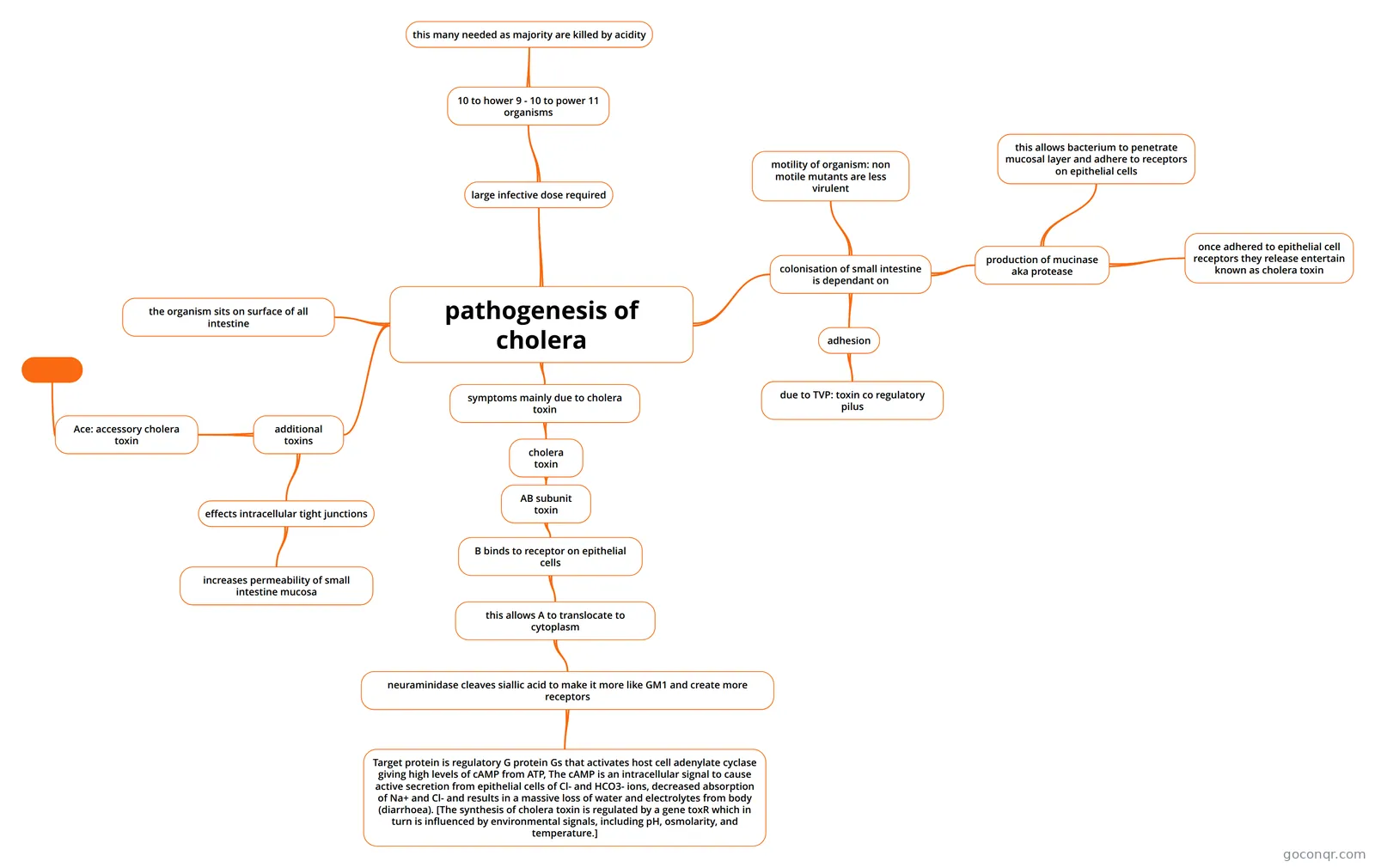
Mind map: pathogenesis of cholera
Contenido del mapa
pathogenesis of cholera
large infective dose required
- 10 to hower 9 - 10 to power 11 organisms
- this many needed as majority are killed by acidity
- 10 to hower 9 - 10 to power 11 organisms
colonisation of small intestine is dependant on
- motility of organism: non motile mutants are less virulent
- production of mucinase aka protease
- this allows bacterium to penetrate mucosal layer and adhere to receptors on epithelial cells
- once adhered to epithelial cell receptors they release entertain known as cholera toxin
- adhesion
- due to TVP: toxin co regulatory pilus
symptoms mainly due to cholera toxin
- cholera toxin
- AB subunit toxin
- B binds to receptor on epithelial cells
- this allows A to translocate to cytoplasm
- neuraminidase cleaves siallic acid to make it more like GM1 and create more receptors
- Target protein is regulatory G protein Gs that activates host cell adenylate cyclase giving high levels of cAMP from ATP, The cAMP is an intracellular signal to cause active secretion from epithelial cells of Cl- and HCO3- ions, decreased absorption of Na+ and Cl- and results in a massive loss of water and electrolytes from body (diarrhoea). [The synthesis of cholera toxin is regulated by a gene toxR which in turn is influenced by environmental signals, including pH, osmolarity, and temperature.]
- neuraminidase cleaves siallic acid to make it more like GM1 and create more receptors
- this allows A to translocate to cytoplasm
- B binds to receptor on epithelial cells
- AB subunit toxin
- cholera toxin
the organism sits on surface of all intestine
additional toxins
- effects intracellular tight junctions
- increases permeability of small intestine mucosa
- Ace: accessory cholera toxin
- effects intracellular tight junctions
Información
- Descripción
- Mapa Mental sobre pathogenesis of cholera, creado por danielle cox el 25/04/2016.
- Creado por
- danielle cox
- Visitas
- 0
- Valoración