
Mapa mental
Competition Law
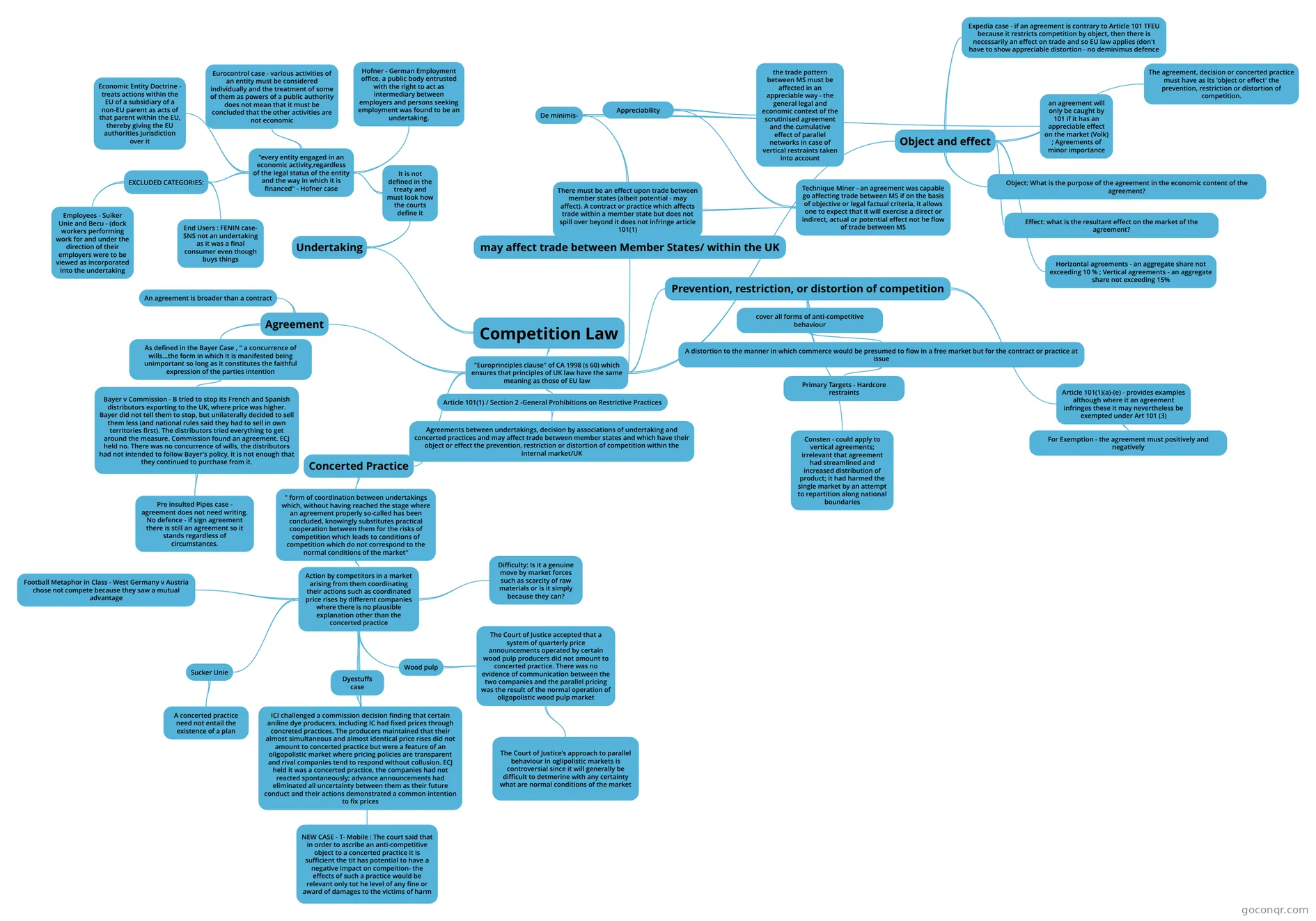
Mind map: Competition law
Contenido del mapa
Competition Law
"Europrinciples clause" of CA 1998 (s 60) which ensures that principles of UK law have the same meaning as those of EU law
- Agreement
- As defined in the Bayer Case , " a concurrence of wills...the form in which it is manifested being unimportant so long as it constitutes the faithful expression of the parties intention
- Bayer v Commission - B tried to stop its French and Spanish distributors exporting to the UK, where price was higher. Bayer did not tell them to stop, but unilaterally decided to sell them less (and national rules said they had to sell in own territories first). The distributors tried everything to get around the measure. Commission found an agreement. ECJ held no. There was no concurrence of wills, the distributors had not intended to follow Bayer's policy, it is not enough that they continued to purchase from it.
- Pre insulted Pipes case - agreement does not need writing. No defence - if sign agreement there is still an agreement so it stands regardless of circumstances.
- Bayer v Commission - B tried to stop its French and Spanish distributors exporting to the UK, where price was higher. Bayer did not tell them to stop, but unilaterally decided to sell them less (and national rules said they had to sell in own territories first). The distributors tried everything to get around the measure. Commission found an agreement. ECJ held no. There was no concurrence of wills, the distributors had not intended to follow Bayer's policy, it is not enough that they continued to purchase from it.
- An agreement is broader than a contract
- As defined in the Bayer Case , " a concurrence of wills...the form in which it is manifested being unimportant so long as it constitutes the faithful expression of the parties intention
- Concerted Practice
- " form of coordination between undertakings which, without having reached the stage where an agreement properly so-called has been concluded, knowingly substitutes practical cooperation between them for the risks of competition which leads to conditions of competition which do not correspond to the normal conditions of the market"
- Action by competitors in a market arising from them coordinating their actions such as coordinated price rises by different companies where there is no plausible explanation other than the concerted practice
- Sucker Unie
- A concerted practice need not entail the existence of a plan
- Dyestuffs case
- ICI challenged a commission decision finding that certain aniline dye producers, including IC had fixed prices through concreted practices. The producers maintained that their almost simultaneous and almost identical price rises did not amount to concerted practice but were a feature of an oligopolistic market where pricing policies are transparent and rival companies tend to respond without collusion. ECJ held it was a concerted practice, the companies had not reacted spontaneously; advance announcements had eliminated all uncertainty between them as their future conduct and their actions demonstrated a common intention to fix prices
- Wood pulp
- The Court of Justice accepted that a system of quarterly price announcements operated by certain wood pulp producers did not amount to concerted practice. There was no evidence of communication between the two companies and the parallel pricing was the result of the normal operation of oligopolistic wood pulp market
- The Court of Justice's approach to parallel behaviour in oglipolistic markets is controversial since it will generally be difficult to detmerine with any certainty what are normal conditions of the market
- The Court of Justice accepted that a system of quarterly price announcements operated by certain wood pulp producers did not amount to concerted practice. There was no evidence of communication between the two companies and the parallel pricing was the result of the normal operation of oligopolistic wood pulp market
- Difficulty: Is it a genuine move by market forces such as scarcity of raw materials or is it simply because they can?
- Football Metaphor in Class - West Germany v Austria chose not compete because they saw a mutual advantage
- NEW CASE - T- Mobile : The court said that in order to ascribe an anti-competitive object to a concerted practice it is sufficient the tit has potential to have a negative impact on compeition- the effects of such a practice would be relevant only tot he level of any fine or award of damages to the victims of harm
- Sucker Unie
- Action by competitors in a market arising from them coordinating their actions such as coordinated price rises by different companies where there is no plausible explanation other than the concerted practice
- " form of coordination between undertakings which, without having reached the stage where an agreement properly so-called has been concluded, knowingly substitutes practical cooperation between them for the risks of competition which leads to conditions of competition which do not correspond to the normal conditions of the market"
- may affect trade between Member States/ within the UK
- There must be an effect upon trade between member states (albeit potential - may affect). A contract or practice which affects trade within a member state but does not spill over beyond it does not infringe article 101(1)
- Technique Miner - an agreement was capable go affecting trade between MS if on the basis of objective or legal factual criteria, it allows one to expect that it will exercise a direct or indirect, actual or potential effect not he flow of trade between MS
- Appreciability
- the trade pattern between MS must be affected in an appreciable way - the general legal and economic context of the scrutinised agreement and the cumulative effect of parallel networks in case of vertical restraints taken into account
- Appreciability
- De minimis-
- an agreement will only be caught by 101 if it has an appreciable effect on the market (Volk) ; Agreements of minor importance
- Technique Miner - an agreement was capable go affecting trade between MS if on the basis of objective or legal factual criteria, it allows one to expect that it will exercise a direct or indirect, actual or potential effect not he flow of trade between MS
- There must be an effect upon trade between member states (albeit potential - may affect). A contract or practice which affects trade within a member state but does not spill over beyond it does not infringe article 101(1)
- Object and effect
- The agreement, decision or concerted practice must have as its 'object or effect' the prevention, restriction or distortion of competition.
- Object: What is the purpose of the agreement in the economic content of the agreement?
- Effect: what is the resultant effect on the market of the agreement?
- Expedia case - if an agreement is contrary to Article 101 TFEU because it restricts competition by object, then there is necessarily an effect on trade and so EU law applies (don't have to show appreciable distortion - no deminimus defence
- Horizontal agreements - an aggregate share not exceeding 10 % ; Vertical agreements - an aggregate share not exceeding 15%
- Prevention, restriction, or distortion of competition
- cover all forms of anti-competitive behaviour
- A distortion to the manner in which commerce would be presumed to flow in a free market but for the contract or practice at issue
- Primary Targets - Hardcore restraints
- A distortion to the manner in which commerce would be presumed to flow in a free market but for the contract or practice at issue
- Article 101(1)(a)-(e) - provides examples although where it an agreement infringes these it may nevertheless be exempted under Art 101 (3)
- For Exemption - the agreement must positively and negatively
- Consten - could apply to vertical agreements; irrelevant that agreement had streamlined and increased distribution of product; it had harmed the single market by an attempt to repartition along national boundaries
- cover all forms of anti-competitive behaviour
- Article 101(1) / Section 2 -General Prohibitions on Restrictive Practices
- Agreements between undertakings, decision by associations of undertaking and concerted practices and may affect trade between member states and which have their object or effect the prevention, restriction or distortion of competition within the internal market/UK
- Agreement
Undertaking
- It is not defined in the treaty and must look how the courts define it
- "every entity engaged in an economic activity,regardless of the legal status of the entity and the way in which it is financed" - Hofner case
- Hofner - German Employment office, a public body entrusted with the right to act as intermediary between employers and persons seeking employment was found to be an undertaking.
- Eurocontrol case - various activities of an entity must be considered individually and the treatment of some of them as powers of a public authority does not mean that it must be concluded that the other activities are not economic
- Economic Entity Doctrine - treats actions within the EU of a subsidiary of a non-EU parent as acts of that parent within the EU, thereby giving the EU authorities jurisdiction over it
- EXCLUDED CATEGORIES:
- Employees - Suiker Unie and Becu - (dock workers performing work for and under the direction of their employers were to be viewed as incorporated into the undertaking
- End Users : FENIN case- SNS not an undertaking as it was a final consumer even though buys things
- "every entity engaged in an economic activity,regardless of the legal status of the entity and the way in which it is financed" - Hofner case
- It is not defined in the treaty and must look how the courts define it
Información
- Descripción
- Mapa Mental sobre Competition Law, creado por Kaitlyn Denham el 26/04/2016.
- Creado por
- Kaitlyn Denham
- Visitas
- 0
- Valoración