
Competition Law
34 resources created by 26 users
This Competition Law page on GoConqr gathers community-made mind maps, flashcards and flowcharts on Article 101, abuse of a dominant position, merger control and public enforcement. It's built for university students and professional candidates working through the rules, and for teachers after ready-made material. There are over 30 resources here, including more than 20 mind maps and 10 flashcards, all made by GoConqr users. Pick a map to see how a topic fits together, then test yourself with the flashcards.
Top Competition Law resources
-
17 cards(Cases) Competition Law II Hilti AG v Commission (Case T-30/89A) [1990] ECR II-163 Hilti
-
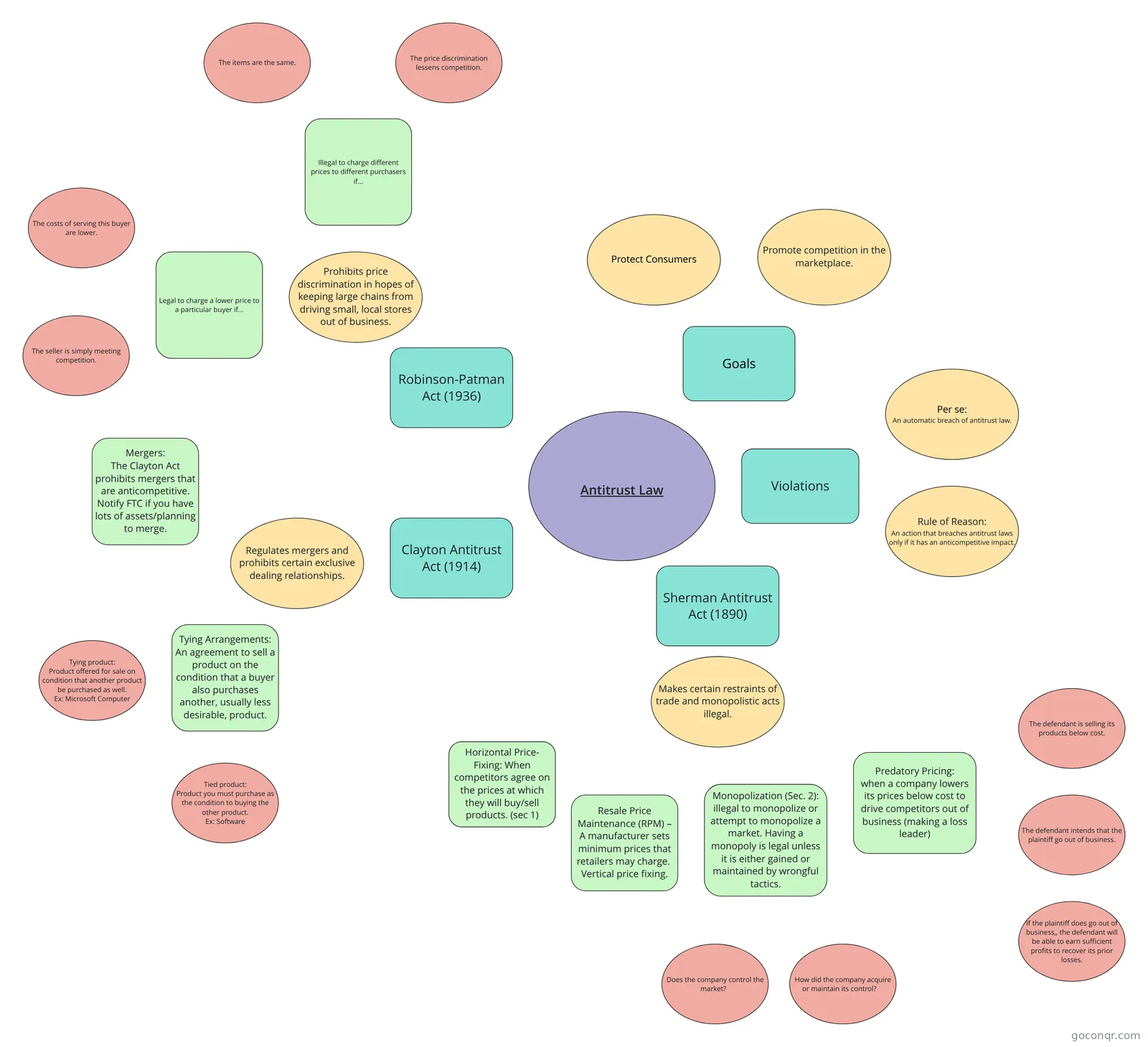 Flowchart Chapter 24-2: Antitrust More final prep!
-
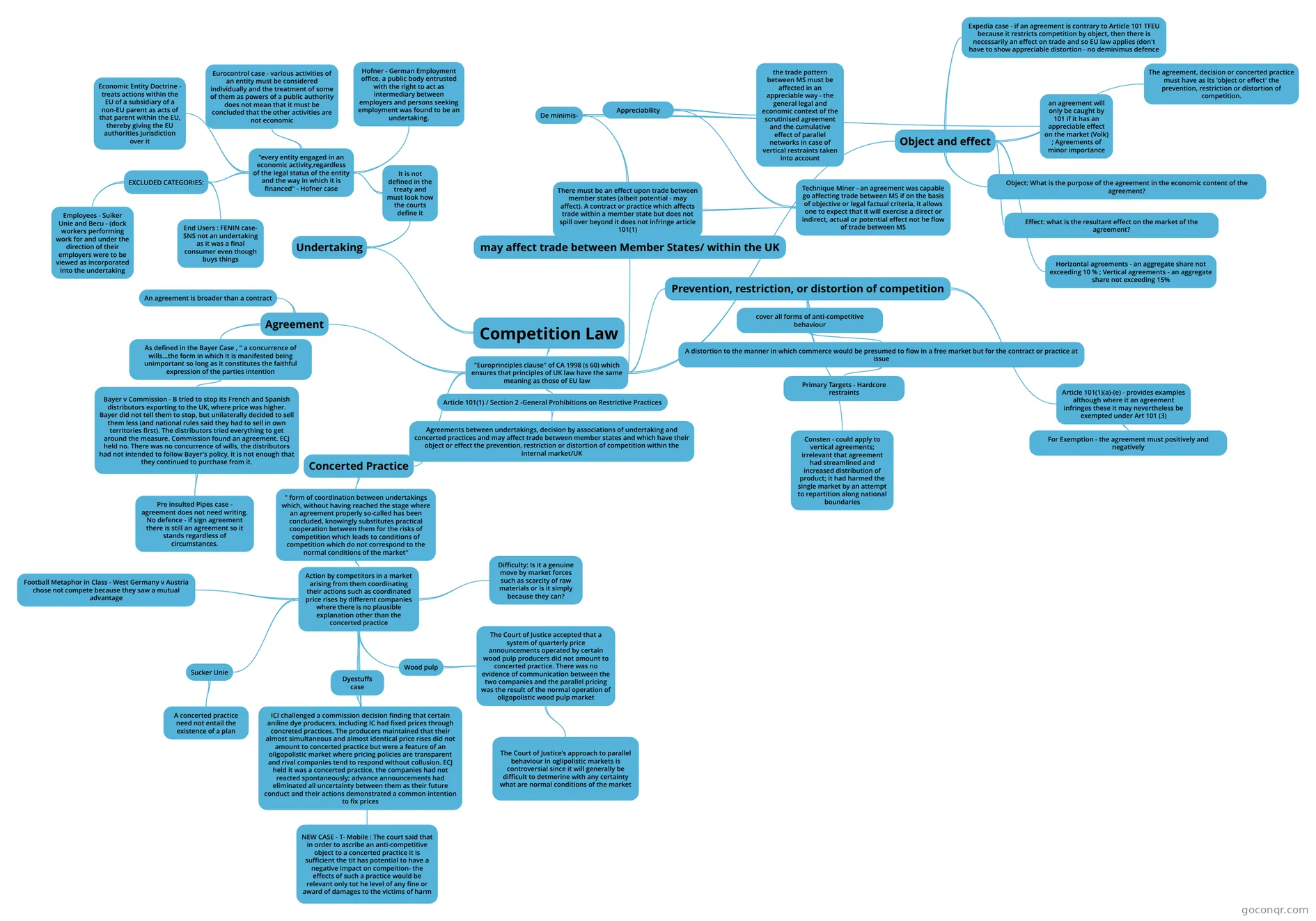 Mind map Competition Law
-
Mind map Competition
-
Mind map VABE Exemption
-
31 cardsCompetition Law II What must be established for there to have been an infringement on art 102?
-
Mind map Competition Law
-
19 cardsTABL1710 Business Law chap 8 : Competition Law Key concepts in competition law 1.‘Competition’ and ‘market’ 2. The source of competition law 3. Administra...
Mind maps
See all 21 mind maps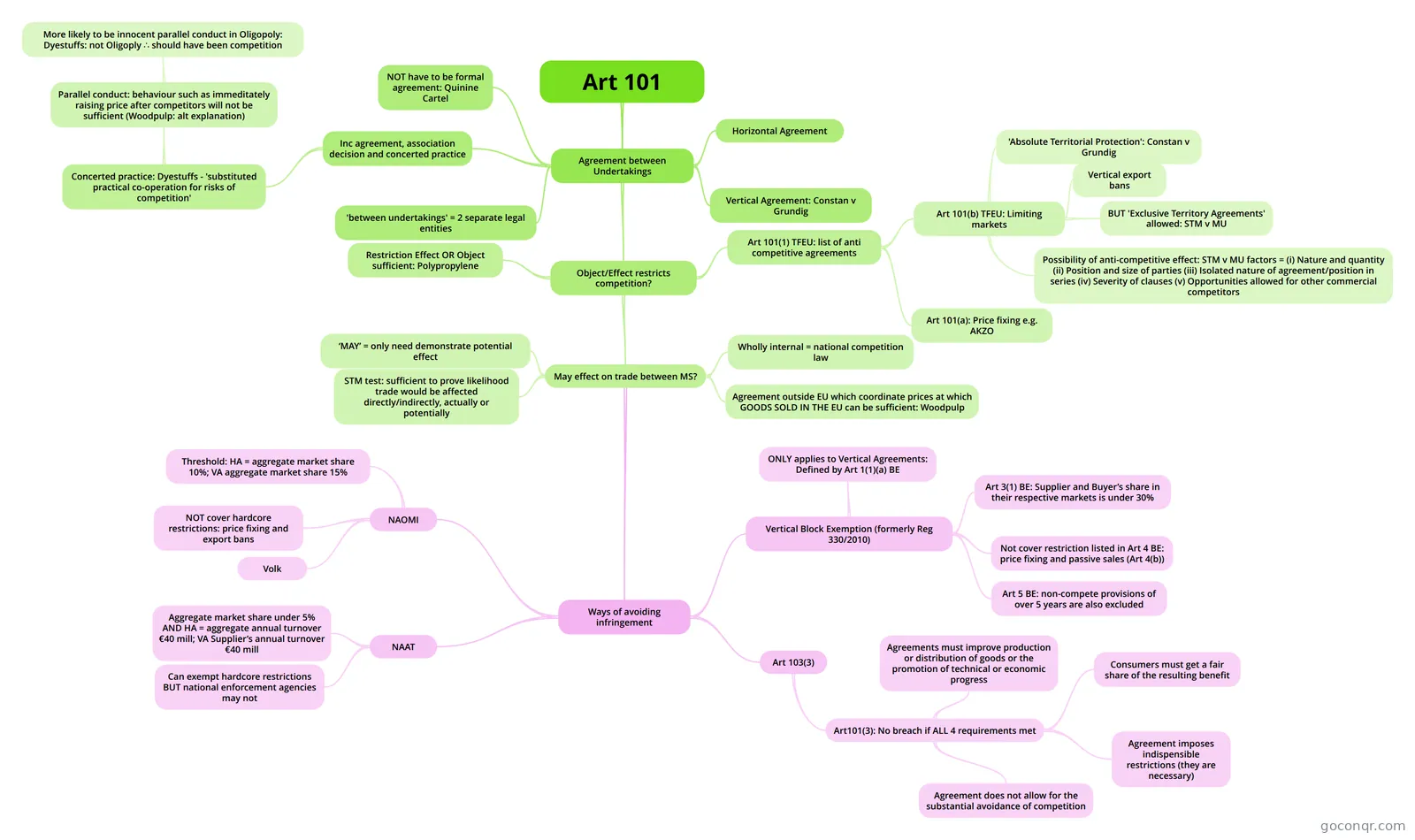
Flashcards
See all 10 flashcards-
17 cards(Cases) Competition Law II Hilti AG v Commission (Case T-30/89A) [1990] ECR II-163 Hilti
-
31 cardsCompetition Law II What must be established for there to have been an infringement on art 102?
-
19 cardsTABL1710 Business Law chap 8 : Competition Law Key concepts in competition law 1.‘Competition’ and ‘market’ 2. The source of competition law 3. Administra...
-
23 cardsCOM Protection Competitors Art 102
-
39 cardsTopic 3
-
7 cardsCompetition law Why Competition law
-
16 cardsCompetition Issues
-
15 cardsL3 - Antitrust law What are the basic features of legal rule?
Flowcharts
Notes
Topics in Competition Law
More Commercial and company law topics
About Competition Law
GoConqr OriginalWhat the page covers
The resources follow the main strands of competition law. Several mind maps deal with anti-competitive agreements. The map titled Art 101 asks whether an agreement restricts competition by object or effect, whether it may affect trade between Member States, and how to avoid infringement. The VABE Exemption map picks up from there: check whether Article 101 applies, whether a de minimis exemption helps, and whether the agreement improves production or distribution.
Dominance, mergers and enforcement
For dominance, the Dominant position flashcards begin with the relevant market, then move to product substitutability on the demand and supply sides, dominance itself and the consequences of abuse. The Abuse of a Dominant Position mind map sits alongside them. The Competition Issues flashcards cover merger control, including the one-stop-shop and the duty to notify, while the Merger Regulation thresholds flowchart gives a visual check. A Public enforcement map rounds out the picture.
Cases and wider material
The case decks, such as the (Cases) Competition Law II flashcards, list authorities like Hilti, United Brands and Continental Can. There are also maps on horizontal and vertical agreements, franchising, trademark delimitation agreements and distribution. The flowchart on antitrust introduces the rule of reason and the goals of protecting consumers and promoting competition.
A sensible order
- Start with one of the general Competition Law mind maps to get the outline.
- Move to Art 101 and then VABE Exemption.
- Work through dominance and the abuse map.
- Look at mergers and public enforcement.
- Finish with the case flashcards to fix the authorities in mind.
Using maps and flashcards together
Read a map first, then cover it and try to rebuild the branches from memory. Use the flashcards to check terms and cases you missed. This page has no quizzes yet, so flashcards are your self-test. Where this unit sits: it belongs to the strand Technology, E-commerce and Competition in Commercial and company law. Teachers can set a map as a starting point for a class. Open one that suits you and see where your gaps are.
Frequently asked questions
Where should I start on this Competition Law page?
Begin with one of the general Competition Law mind maps for an overview. Then take the Art 101 map, followed by the VABE Exemption map, since the exemption builds on whether Article 101 applies. After that, move on to dominance and mergers at your own pace.
Which topics do the mind maps cover?
The mind maps cover anti-competitive agreements under Article 101, the VABE exemption, abuse of a dominant position, restrictive horizontal practices, horizontal and vertical agreements, franchising, trademark delimitation agreements, distribution, mergers and joint ventures, and public enforcement.
Are there quizzes on this page?
Not at the moment. The page offers over 20 mind maps, 10 flashcards and some flowcharts. The flashcard decks on dominant position, merger control and case law work well as self-testing, and you can make your own quiz once you have a free account.
Are the resources free to use?
Yes. Every resource listed here is free to open and study, with no account needed. They were made by GoConqr users, not by GoConqr itself, so it is worth checking them against your own course materials.
Who are these resources for?
They are aimed mainly at university students and professional candidates studying competition law, with teachers able to use them as ready-made material. The content ranges from Article 101 and dominance to merger thresholds and case authorities.
Which resources help with case law?
The flashcard decks (Cases) Competition Law II and (Articles) Competition Law II are the place to look. The cases deck lists authorities such as Hilti, United Brands and Continental Can, which pair well with the dominance maps.