Mapa mental
Edexcel P2 Physics Topic 3- Forces and Motion
Contenido del mapa
Edexcel P2 Physics Topic 3- Forces and Motion
Vectors
- A vector quantity has both magnitude and direction
- Velocity is a vector quantity, measured in m/s
- Displacement is a vector quantity, measured in an appropriate unit. E.g. metres
Weight and Terminal Velocity
- Mass is not the weight of an object, but measures the inertia an object has, in Kg. Weight is the mass of an object multiplied by the gravitational field strength(N/Kg). Weight is measured in Newtons.
- Weight= Mass x Gravitational Field Strength
- Forces
- To calculate a force, you can use two equations depending on what values you are given in the exam question. Force is always measured in Newtons.
- F=ma (Force = Mass x Acceleration)
- F=mv-mu / t (Force= Change in Momentum divided by time taken)
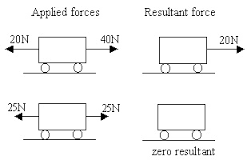
- A Resultant Force means that an object is accelerating,. This means that the forces acting on the object are unbalanced. If the forces of an object are balanced, then the resultant force is zero. The diagram shows resultant forces.
- When an object falls, it encounters air resistance while gravity is pulling it down. The velocity continues to increase until the force of gravity is balanced with the force of air resistance. This property is called Terminal velocity, the velocity at which an object stops accelerating.
- To calculate a force, you can use two equations depending on what values you are given in the exam question. Force is always measured in Newtons.
- Mass is not the weight of an object, but measures the inertia an object has, in Kg. Weight is the mass of an object multiplied by the gravitational field strength(N/Kg). Weight is measured in Newtons.
D-T and V-T Time Graphs
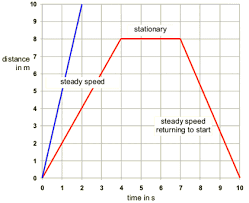
- D-T (Distance Time Graph
- A distance-time graph shows how far an object travels over a period of time.
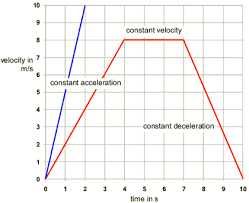
- V-T (Velocity Time Graph)
- A velocity time graph shows the change in velocity of an object over a period of time. A curved line shows acceleration, whereas a straight line shows a constant velocity. The area underneath the graph can be used to calculate the distance travelled by the object.
- D-T (Distance Time Graph
Speed, Velocity and Acceleration
- Speed is how fast an object is moving, measured in m/s.
- Speed is given by Speed= Distance divided by time taken to cover distance
- Acceleration is the rate of change of Velocity, measured in m/s^2
- Acceleration = v-u (change in velocity or final velocity - initial velocity) / time taken
- Change in velocity is measured in m/s and time is measured in seconds.
- Acceleration = v-u (change in velocity or final velocity - initial velocity) / time taken
- Speed is how fast an object is moving, measured in m/s.