Mapa mental
Design Rules
Contenido del mapa
Design Rules
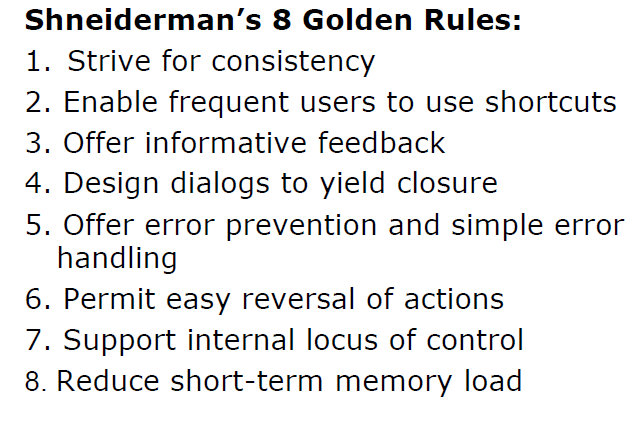
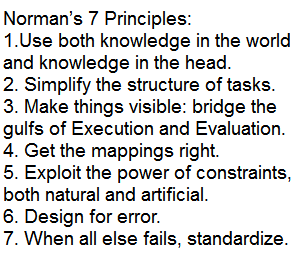
Golden rules and heuristics
(Principles of Usability)
- 1- Learnability: the ease with which new users can begin effective interaction and achieve maximum performance
- 1.1 Predictability : it is means that the user’s knowledge of the interaction history is sufficient to determine the result of future interaction.(can I ‘tell’ what will happen based on what I have gone through in past)
- 1.2 Familiarity : how prior knowledge from real world applies to new system , The appearance of the object stimulates a familiarity with its behavior (like a button on door & form) , Guessability
- 1.3 Generalizability : Applying specific interaction knowledge to new situations like MS word & excel etc , Can be seen as a form of consistency , applications should offer the Cut/Copy/Paste operations whenever possible
- 1.4 Consistency : Likeness in input - output behaviour arising from similar operation , The user relies on a consistent interface
- 2- Flexibility: the variety of ways the user and system exchange information
- 2.1 Dialogue initiative : Who controls dialouge. freedom from system imposed constraints on input dialogue , a system-driven interaction hinders flexibility whereas a user-driven interaction favours it , user should be able to Cancel, suspend or resume tasks at any point .
- 2.2 Multithreading : ability of system to support user interaction for more than one task at a time
- 2.4 Substitutivity : allowing equivalent values of input and output that be substituted for each other , Ex : Margin settings provide measurement in inches & centimetres
- 2.5 Customizability : Interface can be modified to different needs ex : Colours & layout change, provide choice of methods; allow short-cuts; permit users to change features: deferred design
- 2.3 Task migratability : Transfer responsibility for task execution between user and system like spell-checking.
- 3- Robustness: the level of support provided to the user in determining successful achievement and assessment of goal
- 3.1 Observability : ability of user to evaluate the internal state of the system from its apparent representation
- 3.2 Recoverability : Support for Undoing errors , ability of user to take corrective action once an error has been recognized , Error messages should be concise, informative, Specific & constructive
- 3.4 Task conformance/Completeness : degree to which system services support user's tasks , System should perform all the tasks that user needs or wants
- 3.3 Responsiveness : Measures the rate of communication between the system and user , Response time is generally defined as the duration of time needed by the system to express state changes to the user, short durations and immediate response times are desirable
- 1- Learnability: the ease with which new users can begin effective interaction and achieve maximum performance