
Mapa mental
Lecture 6 - Semantic Memory
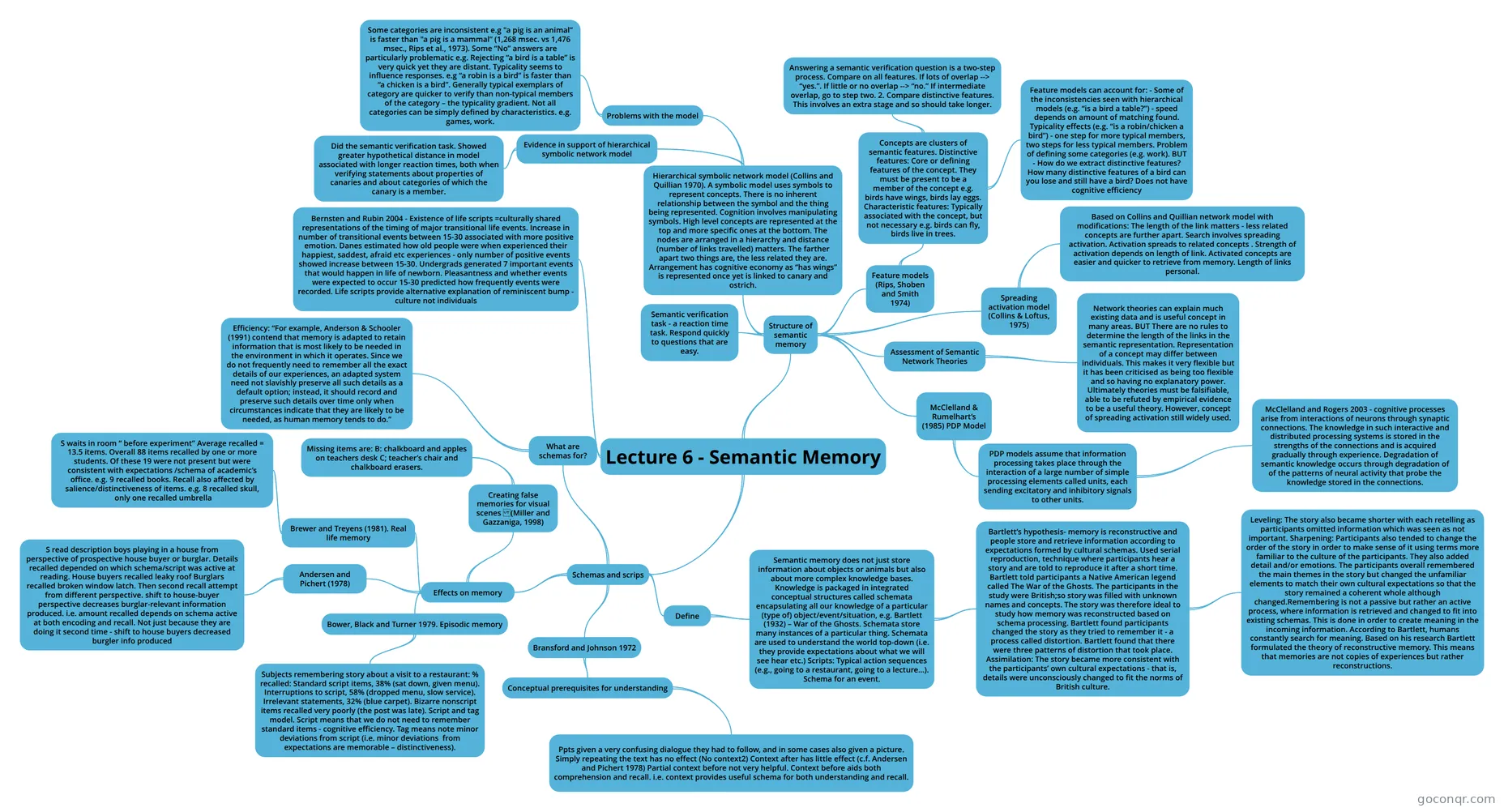
Mind map: Lecture 6: Semantic memory
Contenido del mapa
Lecture 6 - Semantic Memory
Structure of semantic memory
- Semantic verification task - a reaction time task. Respond quickly to questions that are easy.
- Hierarchical symbolic network model (Collins and Quillian 1970). A symbolic model uses symbols to represent concepts. There is no inherent relationship between the symbol and the thing being represented. Cognition involves manipulating symbols. High level concepts are represented at the top and more specific ones at the bottom. The nodes are arranged in a hierarchy and distance (number of links travelled) matters. The farther apart two things are, the less related they are. Arrangement has cognitive economy as “has wings” is represented once yet is linked to canary and ostrich.
- Evidence in support of hierarchical symbolic network model
- Did the semantic verification task. Showed greater hypothetical distance in model associated with longer reaction times, both when verifying statements about properties of canaries and about categories of which the canary is a member.
- Problems with the model
- Some categories are inconsistent e.g "a pig is an animal” is faster than "a pig is a mammal” (1,268 msec. vs 1,476 msec., Rips et al., 1973). Some “No” answers are particularly problematic e.g. Rejecting “a bird is a table” is very quick yet they are distant. Typicality seems to influence responses. e.g “a robin is a bird” is faster than “a chicken is a bird”. Generally typical exemplars of category are quicker to verify than non-typical members of the category – the typicality gradient. Not all categories can be simply defined by characteristics. e.g. games, work.
- Evidence in support of hierarchical symbolic network model
- Feature models (Rips, Shoben and Smith 1974)
- Concepts are clusters of semantic features. Distinctive features: Core or defining features of the concept. They must be present to be a member of the concept e.g. birds have wings, birds lay eggs. Characteristic features: Typically associated with the concept, but not necessary e.g. birds can fly, birds live in trees.
- Answering a semantic verification question is a two-step process. Compare on all features. If lots of overlap --> “yes.”. If little or no overlap --> “no.” If intermediate overlap, go to step two. 2. Compare distinctive features. This involves an extra stage and so should take longer.
- Feature models can account for: - Some of the inconsistencies seen with hierarchical models (e.g. “is a bird a table?”) - speed depends on amount of matching found. Typicality effects (e.g. “is a robin/chicken a bird”) - one step for more typical members, two steps for less typical members. Problem of defining some categories (e.g. work). BUT - How do we extract distinctive features? How many distinctive features of a bird can you lose and still have a bird? Does not have cognitive efficiency
- Concepts are clusters of semantic features. Distinctive features: Core or defining features of the concept. They must be present to be a member of the concept e.g. birds have wings, birds lay eggs. Characteristic features: Typically associated with the concept, but not necessary e.g. birds can fly, birds live in trees.
- Spreading activation model (Collins & Loftus, 1975)
- Based on Collins and Quillian network model with modifications: The length of the link matters - less related concepts are further apart. Search involves spreading activation. Activation spreads to related concepts . Strength of activation depends on length of link. Activated concepts are easier and quicker to retrieve from memory. Length of links personal.
- Assessment of Semantic Network Theories
- Network theories can explain much existing data and is useful concept in many areas. BUT There are no rules to determine the length of the links in the semantic representation. Representation of a concept may differ between individuals. This makes it very flexible but it has been criticised as being too flexible and so having no explanatory power. Ultimately theories must be falsifiable, able to be refuted by empirical evidence to be a useful theory. However, concept of spreading activation still widely used.
- McClelland & Rumelhart’s (1985) PDP Model
- PDP models assume that information processing takes place through the interaction of a large number of simple processing elements called units, each sending excitatory and inhibitory signals to other units.
- McClelland and Rogers 2003 - cognitive processes arise from interactions of neurons through synaptic connections. The knowledge in such interactive and distributed processing systems is stored in the strengths of the connections and is acquired gradually through experience. Degradation of semantic knowledge occurs through degradation of of the patterns of neural activity that probe the knowledge stored in the connections.
- PDP models assume that information processing takes place through the interaction of a large number of simple processing elements called units, each sending excitatory and inhibitory signals to other units.
Schemas and scrips
- Define
- Semantic memory does not just store information about objects or animals but also about more complex knowledge bases. Knowledge is packaged in integrated conceptual structures called schemata encapsulating all our knowledge of a particular (type of) object/event/situation, e.g. Bartlett (1932) – War of the Ghosts. Schemata store many instances of a particular thing. Schemata are used to understand the world top-down (i.e. they provide expectations about what we will see hear etc.) Scripts: Typical action sequences (e.g., going to a restaurant, going to a lecture…). Schema for an event.
- Bartlett’s hypothesis- memory is reconstructive and people store and retrieve information according to expectations formed by cultural schemas. Used serial reproduction, technique where participants hear a story and are told to reproduce it after a short time. Bartlett told participants a Native American legend called The War of the Ghosts. The participants in the study were British;so story was filled with unknown names and concepts. The story was therefore ideal to study how memory was reconstructed based on schema processing. Bartlett found participants changed the story as they tried to remember it - a process called distortion. Bartlett found that there were three patterns of distortion that took place. Assimilation: The story became more consistent with the participants’ own cultural expectations - that is, details were unconsciously changed to fit the norms of British culture.
- Leveling: The story also became shorter with each retelling as participants omitted information which was seen as not important. Sharpening: Participants also tended to change the order of the story in order to make sense of it using terms more familiar to the culture of the participants. They also added detail and/or emotions. The participants overall remembered the main themes in the story but changed the unfamiliar elements to match their own cultural expectations so that the story remained a coherent whole although changed.Remembering is not a passive but rather an active process, where information is retrieved and changed to fit into existing schemas. This is done in order to create meaning in the incoming information. According to Bartlett, humans constantly search for meaning. Based on his research Bartlett formulated the theory of reconstructive memory. This means that memories are not copies of experiences but rather reconstructions.
- Bartlett’s hypothesis- memory is reconstructive and people store and retrieve information according to expectations formed by cultural schemas. Used serial reproduction, technique where participants hear a story and are told to reproduce it after a short time. Bartlett told participants a Native American legend called The War of the Ghosts. The participants in the study were British;so story was filled with unknown names and concepts. The story was therefore ideal to study how memory was reconstructed based on schema processing. Bartlett found participants changed the story as they tried to remember it - a process called distortion. Bartlett found that there were three patterns of distortion that took place. Assimilation: The story became more consistent with the participants’ own cultural expectations - that is, details were unconsciously changed to fit the norms of British culture.
- Semantic memory does not just store information about objects or animals but also about more complex knowledge bases. Knowledge is packaged in integrated conceptual structures called schemata encapsulating all our knowledge of a particular (type of) object/event/situation, e.g. Bartlett (1932) – War of the Ghosts. Schemata store many instances of a particular thing. Schemata are used to understand the world top-down (i.e. they provide expectations about what we will see hear etc.) Scripts: Typical action sequences (e.g., going to a restaurant, going to a lecture…). Schema for an event.
- Bransford and Johnson 1972
- Conceptual prerequisites for understanding
- Ppts given a very confusing dialogue they had to follow, and in some cases also given a picture. Simply repeating the text has no effect (No context2) Context after has little effect (c.f. Andersen and Pichert 1978) Partial context before not very helpful. Context before aids both comprehension and recall. i.e. context provides useful schema for both understanding and recall.
- Conceptual prerequisites for understanding
- Effects on memory
- Bower, Black and Turner 1979. Episodic memory
- Subjects remembering story about a visit to a restaurant: % recalled: Standard script items, 38% (sat down, given menu). Interruptions to script, 58% (dropped menu, slow service). Irrelevant statements, 32% (blue carpet). Bizarre nonscript items recalled very poorly (the post was late). Script and tag model. Script means that we do not need to remember standard items - cognitive efficiency. Tag means note minor deviations from script (i.e. minor deviations from expectations are memorable – distinctiveness).
- Andersen and Pichert (1978)
- S read description boys playing in a house from perspective of prospective house buyer or burglar. Details recalled depended on which schema/script was active at reading. House buyers recalled leaky roof Burglars recalled broken window latch. Then second recall attempt from different perspective. shift to house-buyer perspective decreases burglar-relevant information produced. i.e. amount recalled depends on schema active at both encoding and recall. Not just because they are doing it second time - shift to house buyers decreased burgler info produced
- Brewer and Treyens (1981). Real life memory
- S waits in room “ before experiment” Average recalled = 13.5 items. Overall 88 items recalled by one or more students. Of these 19 were not present but were consistent with expectations /schema of academic’s office. e.g. 9 recalled books. Recall also affected by salience/distinctiveness of items. e.g. 8 recalled skull, only one recalled umbrella
- Creating false memories for visual scenes (Miller and Gazzaniga, 1998)
- Missing items are: B: chalkboard and apples on teachers desk C; teacher’s chair and chalkboard erasers.
- Bower, Black and Turner 1979. Episodic memory
- What are schemas for?
- Efficiency: “For example, Anderson & Schooler (1991) contend that memory is adapted to retain information that is most likely to be needed in the environment in which it operates. Since we do not frequently need to remember all the exact details of our experiences, an adapted system need not slavishly preserve all such details as a default option; instead, it should record and preserve such details over time only when circumstances indicate that they are likely to be needed, as human memory tends to do.”
- Define
Bernsten and Rubin 2004 - Existence of life scripts =culturally shared representations of the timing of major transitional life events. Increase in number of transitional events between 15-30 associated with more positive emotion. Danes estimated how old people were when experienced their happiest, saddest, afraid etc experiences - only number of positive events showed increase between 15-30. Undergrads generated 7 important events that would happen in life of newborn. Pleasantness and whether events were expected to occur 15-30 predicted how frequently events were recorded. Life scripts provide alternative explanation of reminiscent bump - culture not individuals
Información
- Descripción
- yr 2 Cognitive 1 Mapa Mental sobre Lecture 6 - Semantic Memory, creado por Issy de Silva el 05/05/2016.
- Creado por
- Issy de Silva
- Visitas
- 1
- Valoración