
Mapa mental
12.1 - The nature of EM waves
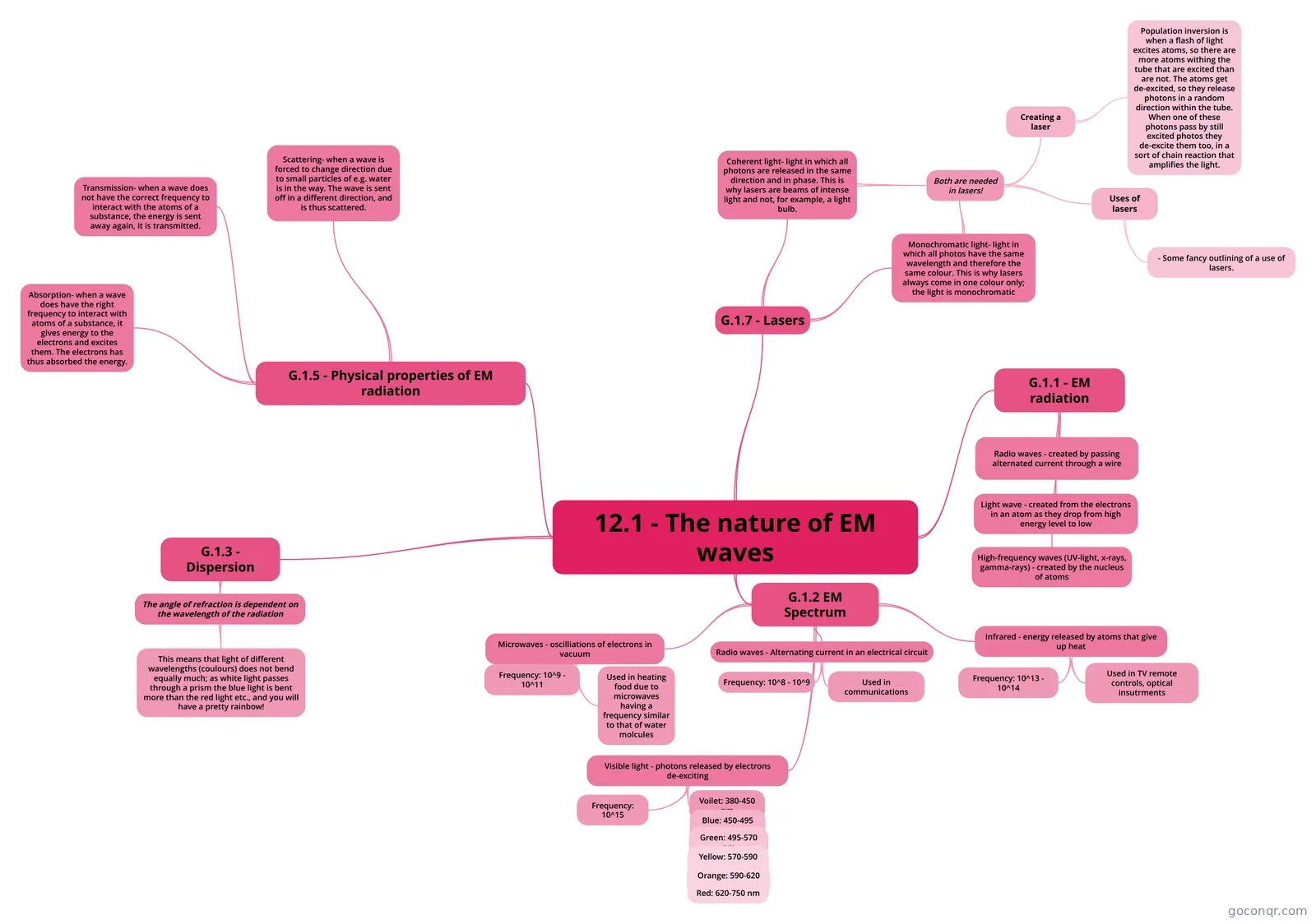
Mind map: The nature of EM waves
Contenido del mapa
12.1 - The nature of EM waves
G.1.1 - EM radiation
- Radio waves - created by passing alternated current through a wire
- Light wave - created from the electrons in an atom as they drop from high energy level to low
- High-frequency waves (UV-light, x-rays, gamma-rays) - created by the nucleus of atoms
G.1.2 EM Spectrum
- Radio waves - Alternating current in an electrical circuit
- Frequency: 10^8 - 10^9
- Used in communications
- Microwaves - oscilliations of electrons in vacuum
- Used in heating food due to microwaves having a frequency similar to that of water molcules
- Frequency: 10^9 - 10^11
- Infrared - energy released by atoms that give up heat
- Frequency: 10^13 - 10^14
- Used in TV remote controls, optical insutrments
- Visible light - photons released by electrons de-exciting
- Frequency: 10^15
- Voilet: 380-450 nm
- Blue: 450-495 nm
- Green: 495-570 nm
- Yellow: 570-590 nm
- Orange: 590-620 nm
- Red: 620-750 nm
- Orange: 590-620 nm
- Yellow: 570-590 nm
- Green: 495-570 nm
- Blue: 450-495 nm
- Radio waves - Alternating current in an electrical circuit
G.1.3 - Dispersion
- The angle of refraction is dependent on the wavelength of the radiation
- This means that light of different wavelengths (coulours) does not bend equally much; as white light passes through a prism the blue light is bent more than the red light etc., and you will have a pretty rainbow!
- The angle of refraction is dependent on the wavelength of the radiation
G.1.5 - Physical properties of EM radiation
- Transmission- when a wave does not have the correct frequency to interact with the atoms of a substance, the energy is sent away again, it is transmitted.
- Absorption- when a wave does have the right frequency to interact with atoms of a substance, it gives energy to the electrons and excites them. The electrons has thus absorbed the energy.
- Scattering- when a wave is forced to change direction due to small particles of e.g. water is in the way. The wave is sent off in a different direction, and is thus scattered.
G.1.7 - Lasers
- Monochromatic light- light in which all photos have the same wavelength and therefore the same colour. This is why lasers always come in one colour only; the light is monochromatic
- Coherent light- light in which all photons are released in the same direction and in phase. This is why lasers are beams of intense light and not, for example, a light bulb.
- Both are needed in lasers!
- Creating a laser
- Population inversion is when a flash of light excites atoms, so there are more atoms withing the tube that are excited than are not. The atoms get de-excited, so they release photons in a random direction within the tube. When one of these photons pass by still excited photos they de-excite them too, in a sort of chain reaction that amplifies the light.
- Uses of lasers
- - Some fancy outlining of a use of lasers.
- Creating a laser
- Both are needed in lasers!
- Monochromatic light- light in which all photos have the same wavelength and therefore the same colour. This is why lasers always come in one colour only; the light is monochromatic
Información
- Descripción
- (Option G - Electromagnetic Waves) Physics HL Mapa Mental sobre 12.1 - The nature of EM waves, creado por wondersnail el 07/03/2014.
- Creado por
- wondersnail
- Visitas
- 109
- Etiquetas
- Valoración