
Mapa mental
Computing Revision
Contenido del mapa
Computing Revision
Character set
- Its any one of the letters and symbols on a keyboard. You can also define a number as a character when you don't want to use it for a mathematical operation
Hexadecimal
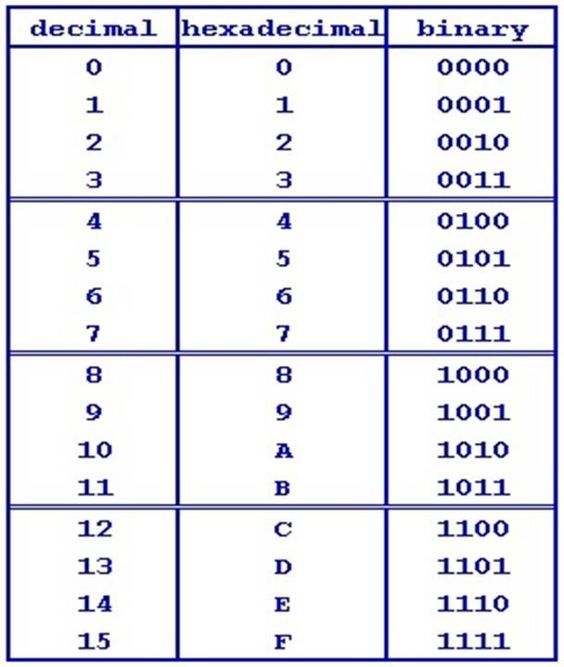
- hexadecimal is a digit that represents 4 bits (or a nibble), so its more human friendly.
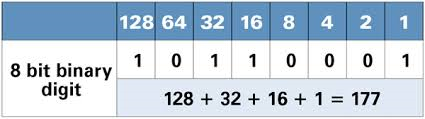
- Denary to Binary
Unicode and ASCII
- ASCII
- ASCII stands for American Standard Code for information interchange. The first 32 codes (0-31) are set aside for controlling devices like printers. 32 is a space, 33 is an exclamation mark, and the codes then follow the sequence along the top of a keyboard layout. There area a total of 128 characters represented by ASCII.
- Unicode
- Unicode is an industry standard for texts encountered in most of the worlds writing systems. Unicode uses the same codes as ASCII as far as it goes- and then extends to cover a wider range of alphabets and special symbols, using between 1 and 4 bytes per character.
- 1.ASCII uses an 8-bit encoding while Unicode uses a variable bit encoding. 2.Unicode is standardized while ASCII isn’t. 3.Unicode represents most written languages in the world while ASCII does not. 4.ASCII has its equivalent within Unicode.
- ASCII
Legal issuses
- Ethical Issuses
- Personal data or sensitive data may not be suitable for sharing with other researchers, depending on whether informed consent has been obtained from participants. You may wish to consider anonymisation techniques or data aggregation for numeric data, editing of video or sound recordings, use of pseudonyms in qualitative data etc. The UK Data Archive has a comprehensive guide on consent, confidentiality and ethics.
- The 1998 Data Protection Act affects the processing of personal or sensitive data and the circumstances under which you can share it with others.
- Ethical Issuses
Databases
- Primary Key
- A filed with contents unique to each record, enabling otherwise identical data records to still be separated and processed accurately, such as an account number
- DBMS
- Database Management System
- It is used by applications to access that data
- Database Management System
- Records
- this is one complete set of fields, for example one pupil's school record
- Querys
- Databases allow us to store and filter data to find specific information. A database can be queried using a variety of methods, although this depends on the software you are using.
- Primary Key
Selection
- In algorithms, selections are decisions or questions. They can be used to make algorithms more realistic. At certain steps there may be more than one way to proceed – so a decision needs to be made. In algorithms, selection is usually represented by the instructions IF, THEN and ELSE. The ‘IF-THEN’ part of the statement causes one path to be followed if the condition it relates to is true. The ‘ELSE’ part causes another path to be followed, if the condition is false.
Sequence
- a set of step-by-step instructions that a computer follows to solve a problem.To solve the problem, the instructions have to be followed in the right order.
iteration
- Iteration is the process of looping or repeating sections of a program. There are two types of iteration: count-controlled and condition-controlled. Count-controlled loops repeat the same steps a specific number of times, regardless of the outcome. But a condition-controlled loop will keep repeating the steps over and over…and over…and over…and over, until it gets a specific result.
Datatypes
- Data types allow us to categorise the range of data that is used in programs. Computer programs treat different types of data in different ways
IDE'S
- An integrated development environment (IDE) is an application used to create software. An IDE can often support different languages. IDEs have a number of different tools and functions that assist a developer in the creation of software.
Compilers and interpreters
- interpreters
- An interpreter translates code into machine code, instruction by instruction - the CPU executes each instruction before the interpreter moves on to translate the next instruction.
- Compilers
- A compiler translates the whole program into machine code before the program is run.
- interpreters
Bitmap images stored
- Bitmap images are widely used on digital cameras, smartphones and online. Common bitmap image file types include JPEG, GIF and PNG. Bitmaps are also known as pixelmaps or raster graphics.
- Bitmap images are organised as a grid of coloured squares called pixels (short for 'picture elements'). When zooming in or enlarging a bitmap image, the pixels are stretched and made into larger blocks. This is why bitmap images appear as poor quality when enlarged too much.
Compression
- Data compression is the art of reducing the number of bits needed to store or transmit data. Compression can be either lossless or lossy. Losslessly compressed data can be decompressed to exactly its original value.
Meta Data
- a set of data that describes and gives information about other data.
CPU's
- dual core processor is a CPU with two separate cores on the same die, each with its own cache. It’s the equivalent of getting two microprocessors in one. In a SINGLE CORE or traditional processor the CPU is fed strings of instructions it must order, execute, then selectively store in its cache for quick retrieval.
RAM and ROM
- ROM is memory that cannot be changed by a program or user. ROM retains its memory even after the computer is turned off. For example, ROM stores the instructions for the computer to start up when it is turned on again.
- RAM is a fast temporary type of memory in which programs, applications and data are stored.
The sample rate is how many samples, or measurements, of the sound are taken each second. The more samples that are taken, the more detail about where the waves rise and fall is recorded and the higher the quality of the audio.
- A common audio sample rate for music is 44,100 samples per second. The unit for the sample rate is hertz (Hz). 44,100 samples per second is 44,100 hertz or 44.1 kilohertz (kHz).
Lan and Wan
- The Internet is a WAN. A network of bank cash dispensers is a WAN. A school network is usually a LAN. LANs are often connected to WANs, for example a school network could be connected to the Internet. WANs can be connected together using the Internet, leased lines or satellite links.
The internet is a huge network of computers all connected together. The world wide web (‘www’ or ‘web’ for short) is a collection of webpages found on this network of computers. Your web browser uses the internet to access the web.
Imágenes y archivos del mapa
Información
- Descripción
- Mapa Mental sobre Computing Revision, creado por Chloe Hambly el 04/11/2016.
- Creado por
- Chloe Hambly
- Visitas
- 1
- Valoración