
Mapa mental
Soils: Module 3
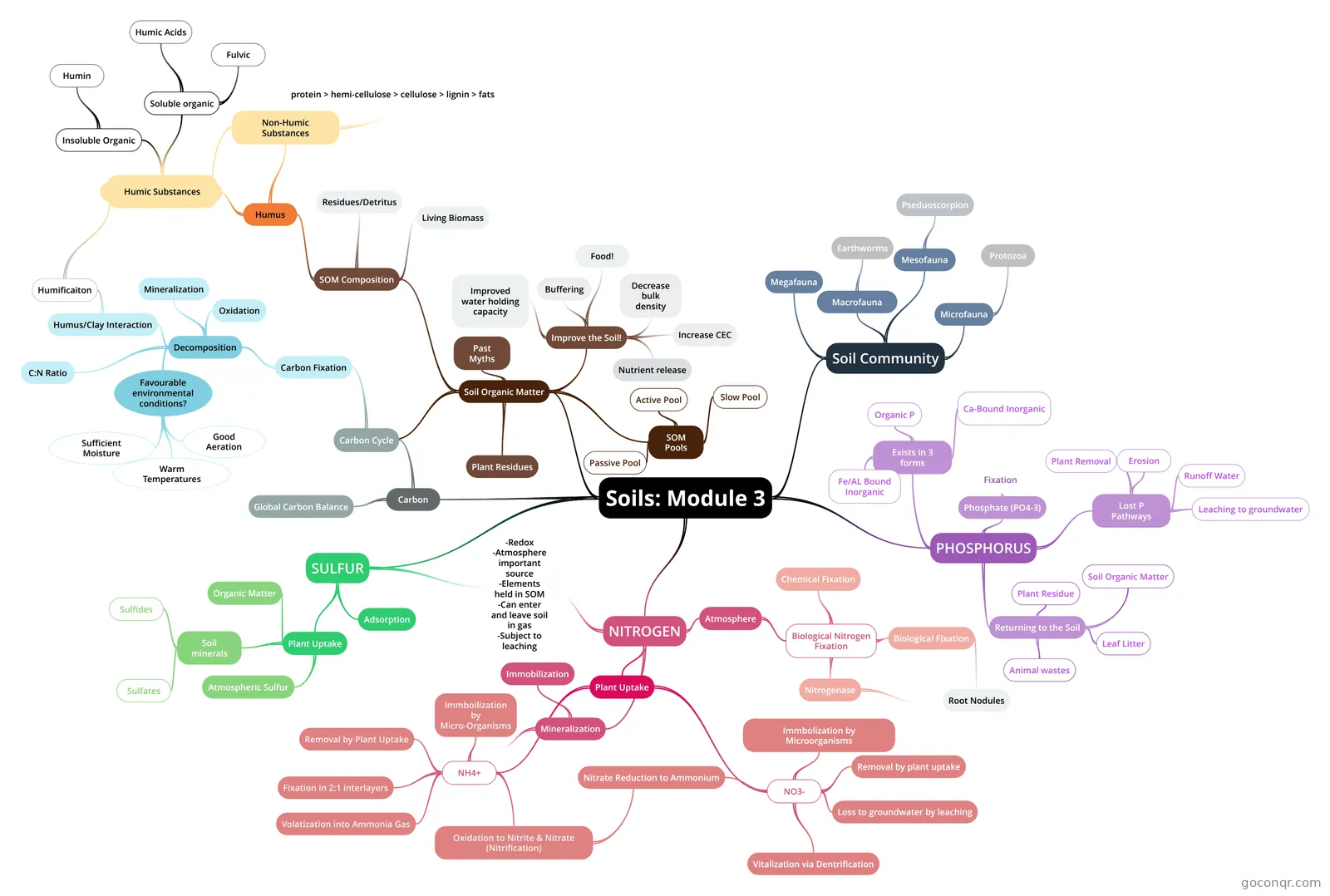
Mind map: Soils: Module 3
Contenido del mapa
Soils: Module 3
Soil Organic Matter
- The percentage of organic matter found in the soil is small, but the effects upon the soil are dramatic. On average, carbon comprises about half of soil organic matter. Therefore, SOM has a role in the global carbon balance that is part of the greenhouse effect and global warming.
- Improve the Soil!
- Decrease bulk density
- By the same token, porosity is INCREASED. Granulation and aggregate stability are encouraged. Humic fractions reduce the plasticity, cohesion, and stickiness of clay-ey soils, making them easier to manipulate.
- Increase CEC
- Humus colloids can act like clay colloids. Humus generally accounts for 50-90% of cation-adsorbing power of mineral surface soils. Humus colloids hold nutrient cations in easily exchangeable forms, wherin they can be used by plants but are not too readily leached out of the profile by water.
- Buffering
- Improved water holding capacity
- Infiltration rate is also improved.
- Nutrient release
- N, P, S and micronutrients are stored as constituents of SOM, from which they are slowly released via mineralization. Humic acids also attack soil minerals and accelerate their decomposition, thereby releasing essential nutrients as exchangeable cations.
- Food!
- SOM provides most of the food for the community of heterotrophic soil organisms.
- Decrease bulk density
- Plant Residues
- Principle material undergoing decomposition in soils, and therefore are the primary source of SOM.
- SOM Composition
- Living Biomass
- Roots, microbes, animals, etc. About 5-30% of SOM
- Residues/Detritus
- Dead roots, feces, litter. DEAD but RECOGNIZEABLE stuff. About 5-40% total SOM.
- Humus
- Humus is highly resistant to attack and may be further strengthened by binding to clay particles. In this way, a small percentage of carbon residue is retained in the soil, increasing slightly the pool of stable organic matter in the soil.
- Non-Humic Substances
- Biopolymers and other known substances, generally with LOW molecular weights. 5-10% Total SOM.
- Identifiable biomolecules that are mainly produced by microbial action and are generally less resistant to breakdown. Unlike humic substances, they are comprised of specific biomolecules with definite physical and chemical properties.
- Includes: Lignin Cellulose Hemi-Cellulose Lipids Proteins
- protein > hemi-cellulose > cellulose > lignin > fats
- Humic Substances
- Biopolymers with HIGH molecular weights that cannot be identified chemically. 40-90% SOM.
- As decomposition of plant residues proceeds, microbes will link the new materials together to form long, complex chains that are high MW compounds that interact with amino acids. These ill-defined, complex, resistant, polymeric compounds are called humic substances.
- Note that these result from MICROBIAL CONVERSION of non-humic substances.
- CEC is possible on the charged colloid surfaces.
- Insoluble Organic
- Humin
- Highly condensed, complexed with clays. Difficult to decompose.
- Humin
- Soluble organic
- Humic Acids
- PRECIPITATE IN ACID. Dark brown substances of a high molecular weight. (300 000d/mol)
- Fulvic
- SOLUBLE IN ACID. Yellow-red material, lighter molecular weight. (2000-50000d/mol). More fulvic acid is a more fertile soil.
- Humic Acids
- Living Biomass
- Past Myths
- People used to think that plants derived most of their nutrition from absorbing humus in the soil. We now know that higher plants derive their carbon from carbon dioxide and most of their nutrients from inorganic sources in the soil. The benefits that plants accrue from organic matter in the soil are largely indirect.
- SOM Pools
- Soil management practices that cause only very small changes in the total soil organic matter can cause rather dramatic changes in aggregate stability, nitrogen mineralization rate, or other soil properties associated with SOM, because the small pool of active SOM is what undergoes the change without changing the larger, underlying passive pool.
- Active Pool
- Easily decomposable material with relatively short half lives. This pool provides most of the readily accessible food for soil organisms and most of the readily mineralizable nitrogen. This can be readily increased by the addition of fresh plant and animal residues, but also can be readily lost.
- Slow Pool
- Includes materials with chemical resistance to breakdown, like cellulose. CN ratio is generally around 20-25. Most material found here is lignin or lignin derivatives. This pool is an important source of mineralizable nitrogen and other plant nutrients, and it provides much of the food for underlying k-strategy organisms.
- Passive Pool
- Consists of very stable materials that remain in the soil for hundreds, or thousands, of years. Includes most of the material protected in clay/humus complexes. This property is responsible for most of the CEC and water holding capacity of the soil.
Carbon
- Carbon Cycle
- During the carbon cycle, carbon begins in the atmosphere, where it is used by plants for photosynthesis. If carbon is put into the soil, microbial metabolism and interaction with clay in the soil may produce organic materials of such stability that many, many years may pass before the carbon is returned to the atmosphere. This resistance is what allows carbon to build up in the soil organic matter.
- Carbon Fixation
- Also known as photosynthesis. Is called FIXATION because inorganic carbon is converted into long, complicated organic carbon strings, which are unusable to organisms unless they are broken down. Some substances, such as lignin, are notoriously resistant to decomposition. RUBISCO is the enzyme that fixes carbon within the photosynthetic organs of a plant.
- Decomposition
- The breakdown of large organic molecules in smaller, simpler components. When organic tissue is added to aerobic soils, three microbiological reactions take place. A CHEMICAL REACTION during the decay of organic materials that changes the chemical composition of the material and releases energy.
- Oxidation
- Enzymatic oxidation of organic material produces CO2, water, and energy.
- Mineralization
- Release of the essential nutrient elements though a series of reactions unique to each element. When plant tissues decay, they yield amino acids in addition to CO2 and water. These amino acids can be broken down into simply inorganic molecules such as NH4, NO3, and SO4. MINERALIZATION: release of soluble inorganic constituents during decomposition. Organic materials become inorganic.
- Humus/Clay Interaction
- Compounds that are very resistant to microbial action are formed.
- Humificaiton
- Process of humus formation - CONDENSATION reaction where low molecular weight polymers become high molecular weight polymers. Labile carbon becomes recalcitrant carbon.
- Favourable environmental conditions?
- Sufficient Moisture
- Good Aeration
- Warm Temperatures
- C:N Ratio
- If the CN ration of the soil exceeds 25:1, the microbes will struggle to get enough nitrogen and won't be able to turn over OM quickly.
- The rate of decay of organic matter is highly dependent on the C:N ratio in the soil.
- Global Carbon Balance
- Annually, the release of carbon as CO2 from oxidation of soils is balanced by the input of carbon by plant residues. About 2pg/year of carbon are added as a net gain to the atmosphere every year.
- Carbon Cycle
NITROGEN
- Scarcity of nitrogen is the most widely-occuring nutritional limit on productivity of terrestrial ecosystems. It is also the most widely over-applied element to agro-ecosystems and most widely responsible for the deterioration of water quality.
- Nitrogen is a major part of all proteins, including enzymes, which control almost all biological processes.
- Plant Uptake
- A relatively equal mixture of the ions below tends to give plants the best results.
- NH4+
- Since ammonium is a cation, in young soils with low CEC it is very prone to leaching and is not well maintained.
- Immboilization by Micro-Organisms
- Removal by Plant Uptake
- Fixation in 2:1 interlayers
- Like other positively charged ions, ammonium isons are attracted to the negatively charged surfaces of clay and humus, where they are held in an exchangeable form available for plant uptake. They are protected from leaching here, but because of their size, they are prone to becoming stuck between the layers of the 2:1 sheets.
- This is much more likely to happen in soils without a lot of weathering (recall lightly weathered soils have a higher presence of 2:1 clays)
- Volatization into Ammonia Gas
- Ammonia gas, NH3, can be produced from the breakdown of organic materials or fertilizers. It is more pronounced at high PH's or in soils with low amounts of colloids.
- Oxidation to Nitrite & Nitrate (Nitrification)
- Ammonium ions in the soil may be enzymeatically oxidized by certain bacteria. The autotrophic bacteria that do this will have the second reaction occur quickly after the first, so there is no buildup of nitrite in the soil.
- Nitrification can be reversed in anaerobic conditions. The nitrifying bacteria are quite sensitive to the environment, so they won't do this unless the conditions are right.
- NO3-
- Immbolization by Microorganisms
- Removal by plant uptake
- Loss to groundwater by leaching
- In contrast to ammonium, nitrite anions are not adsorbed by negatively charged colloids that dominate most soils. Therefore, nitrate ions move downward freely with the drainage water and are readily leached form the soil. Water quality problems caused by nitrogen are mainly associated with the movement of nitrate in drainage waters into groundwater sotres.
- Vitalization via Dentrification
- Can be released into the atmosphere as several N-containing gases by dentrification. The organisms that carry out these processes are heterotrophs, which obtain their energy from the oxidation of organic compounds.
- For these reactions to take place, sources of organic residues or sulfides should be available to provide the energy the dentrifiers need.
- Nitrate Reduction to Ammonium
- Atmosphere
- The atmosphere is the best supplier of N, for it is comprised of almost 80% nitrogen gas. However, the triple bond between the molecules in N2 is very hard to break, and requires very specific reactions to get it into a useable form.
- Biological Nitrogen Fixation
- Nitrogen fixation is the process by which high-energy, unusable N2 is converted into something usable for organisms.
- Chemical Fixation
- Includes people, lightning.
- Biological Fixation
- Majority of fixation is biological. Usually occurs in symbiotic root nodules (99%), though some free living bacteria are able to fix nitrogen.
- Root Nodules
- When fixation takes place in root nodules, one means of protecting the nitrogenase enzyme is leghemoglobin, which binds to the oxygen molecules to protect the plant. The symbiosis of plants in the legume family and bacteria of the genera Rhizobium provide the major source of biologically fixed nitrogen in agricultural soils.
- Nitrogenase
- Mineralization
- Nitrogen in organic compounds is protected from loss but unavailable to higher plants. The decomposition process involves the breakdown of large, insoluble N-containing compounds into smaller and smaller unites, with the eventual release of nitrogen as NH4+
- Immobilization
- The opposite of mineralization, conversion of inorganic nitrogen into organic forms. Biological immobilization occurs when micro-organisms decomposing organic residues need more N than they can obtain from the residues they are decomposing.
- -Redox -Atmosphere important source -Elements held in SOM -Can enter and leave soil in gas -Subject to leaching
SULFUR
- Sulfur is a constituent of amino acids, vitamins, enzymes, and aromatic oils. The sulfur cycle is remarkably like the nitrogen cycle - sulfur undergoes redox reactions and has lots of redox potential.
- Plant Uptake
- Plants can obtain sulfur from: adsorbed S in subsoil (mineral dissolution), soil turnover & SOM mineralization, dust and rain or atmospheric deposition.
- Organic Matter
- Over time, soil microorganisms break down organic sulfur into soluble forms, analogus to the release of nitrate and ammonium from organic nitrogen.
- Called "ORGANIC BOUND" sulfur. Can be Carbon bonded, or ester bonded.
- Soil minerals
- The inorganic forms of sulfur include the soluble compounds which plants and microbes depend on. The two most common inorganic sulfur compounds are sulfides and sulfates.
- The organic forms of sulfur must be mineralized by soil organisms to be used by plants.
- Sulfides
- Sulfates
- Sulfate ions react directly with hydroxyl groups exposed on the surfaces of 1:1 type silicate clays.
- Atmospheric Sulfur
- The atmosphere contains varying quantities of gaseous sulfur compounds.
- Adsorption
- Sulfate would be readily leached from soils in humid regions, were it not for its adsorption to soil colloids. Sulfate ions react directly with hydroxyl groups exposed on the surfaces of 1:1 type silicate clays.
PHOSPHORUS
- Essential component of ATP, DNA, and RNA. This phosphorus compounds in soils are mostly unavailable for plant uptake, because they are insoluble, and when there are soluble sources of phosphorus around, they are fixed and changed to unavailable, highly insoluble compounds.
- NO REDOX
- Phosphate (PO4-3)
- Plant roots absorb phosphorus dissolved in the soil solution, mainly as phosphate ions. Some soluble organic P compounds may also be taken up.
- Dissolved phosphate ions are subject to many types of reactions that rent ro remove ions from the soil solution and produce p-containing compounds of low solubility. These reactions may be termed P-fixation.
- P concentration is highest in soils of PH 6-7.
- Fixation
- Returning to the Soil
- Plant Residue
- Leaf Litter
- Animal wastes
- Soil Organic Matter
- Some of the phosphorus may become associated with the active and passive fractions of the soil organic mater, where it is subject to storage and further release.
- Exists in 3 forms
- All three groups slowly contribute P to the soil solution, but each group is of low solubility and not readily available for plant uptake.
- Organic P
- Ca-Bound Inorganic
- Fe/AL Bound Inorganic
- Lost P Pathways
- Plant Removal
- Erosion
- Runoff Water
- Leaching to groundwater
Soil Community
- Megafauna
- Gophers, squirrels, etc. Contribute bioturbation and soil mixing - a kind of "natural disturbance"
- Macrofauna
- Ants, Milipedes, Termites, Earthworms, Beetle, Centipede
- Earthworms
- Non-native invasive species! They were wiped out by the last glaciation event in Canada and are very bad for the natural ecosystem as they consume the sensitive LFH soil layer.
- Mesofauna
- Mites, invertebrates, shredders of OM, both consumers and predators. 1-2mm in diameter.
- Pseduoscorpion
- Mites are a group with very high diversity that is quite understudied. Mites may be an indicator of ecosystem health.
- Microfauna
- >0.05mm. Nematodes, protozoa.
- Protozoa
- Very small, seen under light microscop. Ciliates ,amoebae, flagellates. Can be predatory, feel on bacteria/archaea, fungi.
- Megafauna
Información
- Descripción
- RR210 Mapa Mental sobre Soils: Module 3, creado por Maya Frederickson el 11/12/2016.
- Creado por
- Maya Frederickson
- Visitas
- 1
- Valoración