
Mapa mental
Aphasia 1
Contenido del mapa
Aphasia 1
- See word doc causes of aphasia....
BRAIN
- Cerebrum = big outer bits, L & R Hemispheres
- Corpus Callosum (hard body) joins the two halves
- Outer surface is cortex, made of grey matter
- Sulci = groves
- gyri = folds
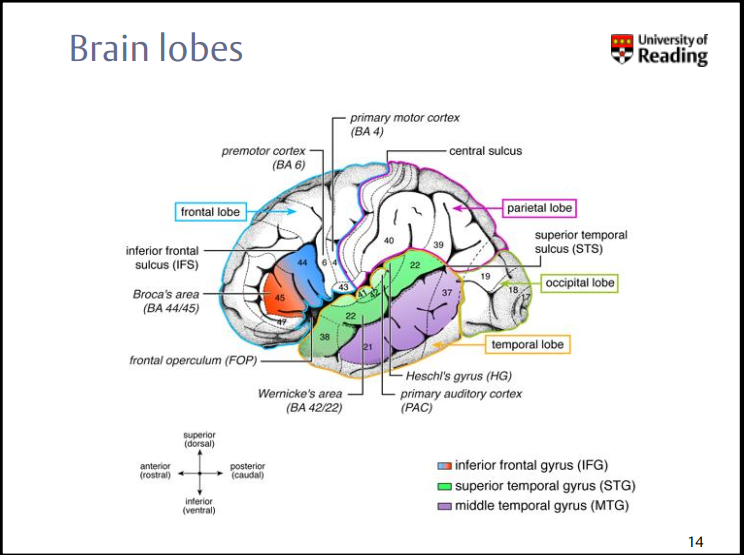
- FRONTAL: Voluntary movement, planning S&L production & understanding
- Contains BROCA's A (44/45): Sentence production & understanding
- Located in 3rd frontal convolution anterior to the pre-central gyrus - proximal to the pre-motor strip
- "There is still some controversy about anotomical underpinnings of Broca's area" (Damasio, 2001, p.25)
- Contains MOTOR CORTEX (4): Sends motor commands to body, including lips and tongue
- Contains BROCA's A (44/45): Sentence production & understanding
- TEMPROAL LOBE: Auditory perception & processing
- Contains WERNIKE's AREA (42/22): Analysis auditory stimuli, plus comprehension of words and sentences
- PARIETAL: Body awareness, touch, space perception
- OCCIPITAL: Visual perception & processing
- IMAGING
- Computerised Tomography (CT) - path. indicated by by alterations in expected denisty. Infarct = decreased, haemorrhage = increased dens.
- Cerebral angiography - X-ray with iodine fluid
- Magnetic Resonance Imaging (MRI) Magnet manipulates spin of hydrogen mollecule. Superior to CT
- Diffusion weighted imaging
- Perfusion weighted imaging
- fMRI (Functional MRI) diff oxygen levels in brain - regions activated whislt performing an activity.
- Diffusion weighted imaging
- Cerebrum = big outer bits, L & R Hemispheres
Language Localisation
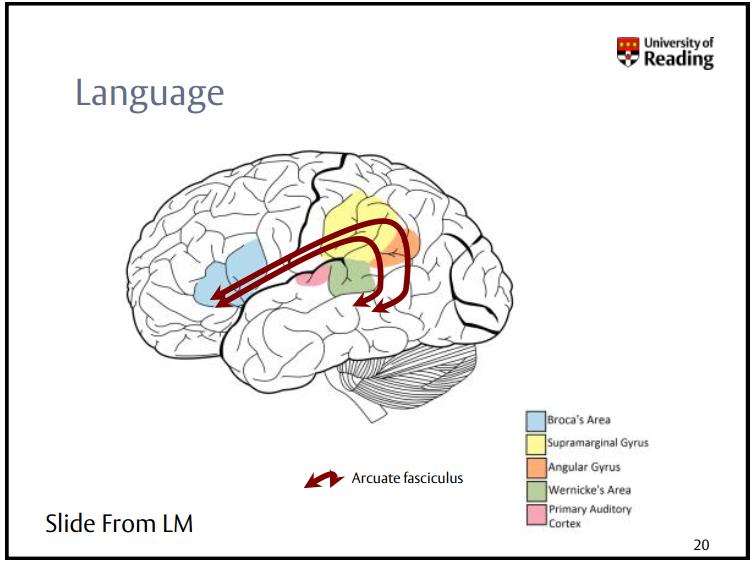
- Anteriorly = Broca's
- Posteriorly = Wernike's
- Between the two = Arcuate Fasciculus (Curved bundle)
- Connects posterior receptive areas with pre-motor / motor areas
- Localisation hypothesis is disputed
- DOUBLE DISSOCATION = Where one group produces a deficit in a task, but no deficit in another task, whilst another group produces the opposite pattern
- Aphasic patients have diff dissociations e.g anomia vs agrammatism
- Patterns between type of deficit and lesion sites
APHASIA
- Manefestations will alter depending on aetiology
- TBI
- STROKE
- PPA
- Dementia
- Parkinson's / Huntington's
- MS
- Tumour
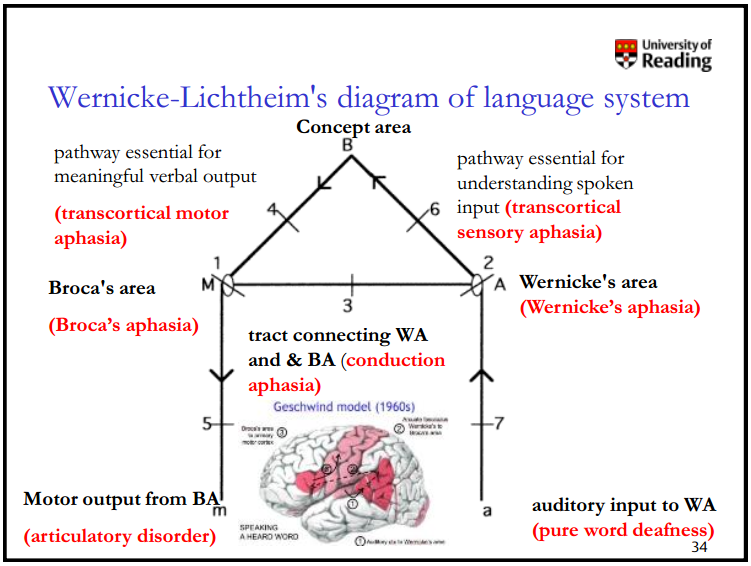
- Gershwind Model
- TYPES
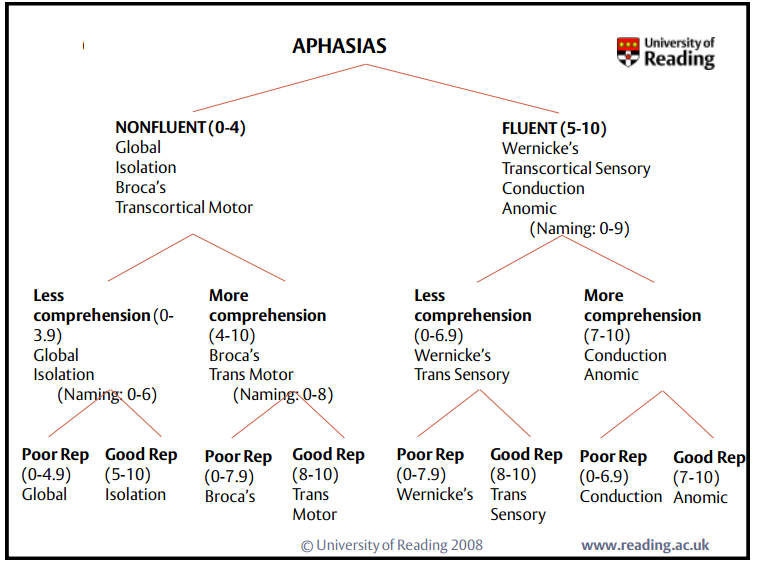
- NON-FLUENT: Damage to frontal lobe / Broca's areas
- Shorter sentences
- May include Agrammatism of Broca's - Loss of grammatical markers / inflections
- "Boy um... ladders um ladders... boy tooking um jar"
- 4-5 words max
- Prosody comprimised
- Slow, effortful speech
- More major lexical items
- Verbs more affected than nouns
- FLUENT: Temporal lobe damage / Wernike's areas
- Longer sentences - WNL
- Lacking in meaning
- Fewer content words
- Jargon Aphasia of Wernike's - Neologisms
- "And looks like the lugyburgers..."
- Can also pertain to conduction aph.
- Good prosody
- Often poor awareness
- NON-FLUENT: Damage to frontal lobe / Broca's areas
- CLASSIFICATION process
- 'BOSTON classification system' (Gershwind, Benson, Goodglass & Kaplan)
- ASSESSMENTS such as:
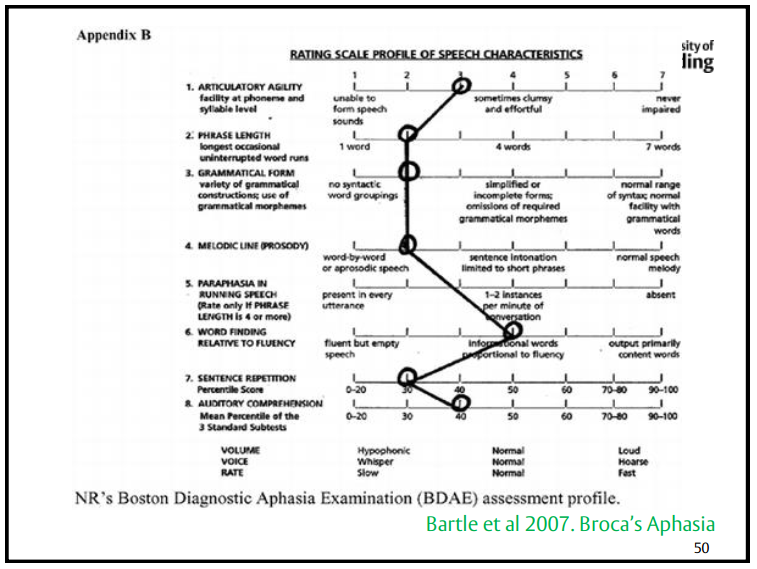
- BDAE (Boston Diagnostic Aphasia Examination
- WAB (Western Aphasia Battery)
- AQ < 93.8 = aphasic
- MMSE (Mini - mental state examination) by Folstein, Folstein & McHugh 75)
- ASSESSMENTS such as:
- 1. Determine phrase length
- 2. Determine auditory comprehension skills
- 3. Determining level of repetition skills
- 2. Determine auditory comprehension skills
- 'BOSTON classification system' (Gershwind, Benson, Goodglass & Kaplan)
- May be accompanied by hemiplegia / hemianesthesia
- homonomous hemianopia
- Manefestations will alter depending on aetiology
150,000 people in the UK have a stroke every year.
- 1/3 of people will have COMMUNICATION DIFFS post stroke ((Department of Health 2007) )
- Half of recovery occurs within the first monht, but can continue up 6 months after and beyond (Greener 08)
- 1/3 of people will have COMMUNICATION DIFFS post stroke ((Department of Health 2007) )
Imágenes y archivos del mapa
Información
- Descripción
- Aphasia Mapa Mental sobre Aphasia 1, creado por Heather Snaith el 20/12/2016.
- Creado por
- Heather Snaith
- Visitas
- 15
- Valoración