
Mapa mental
World Cities
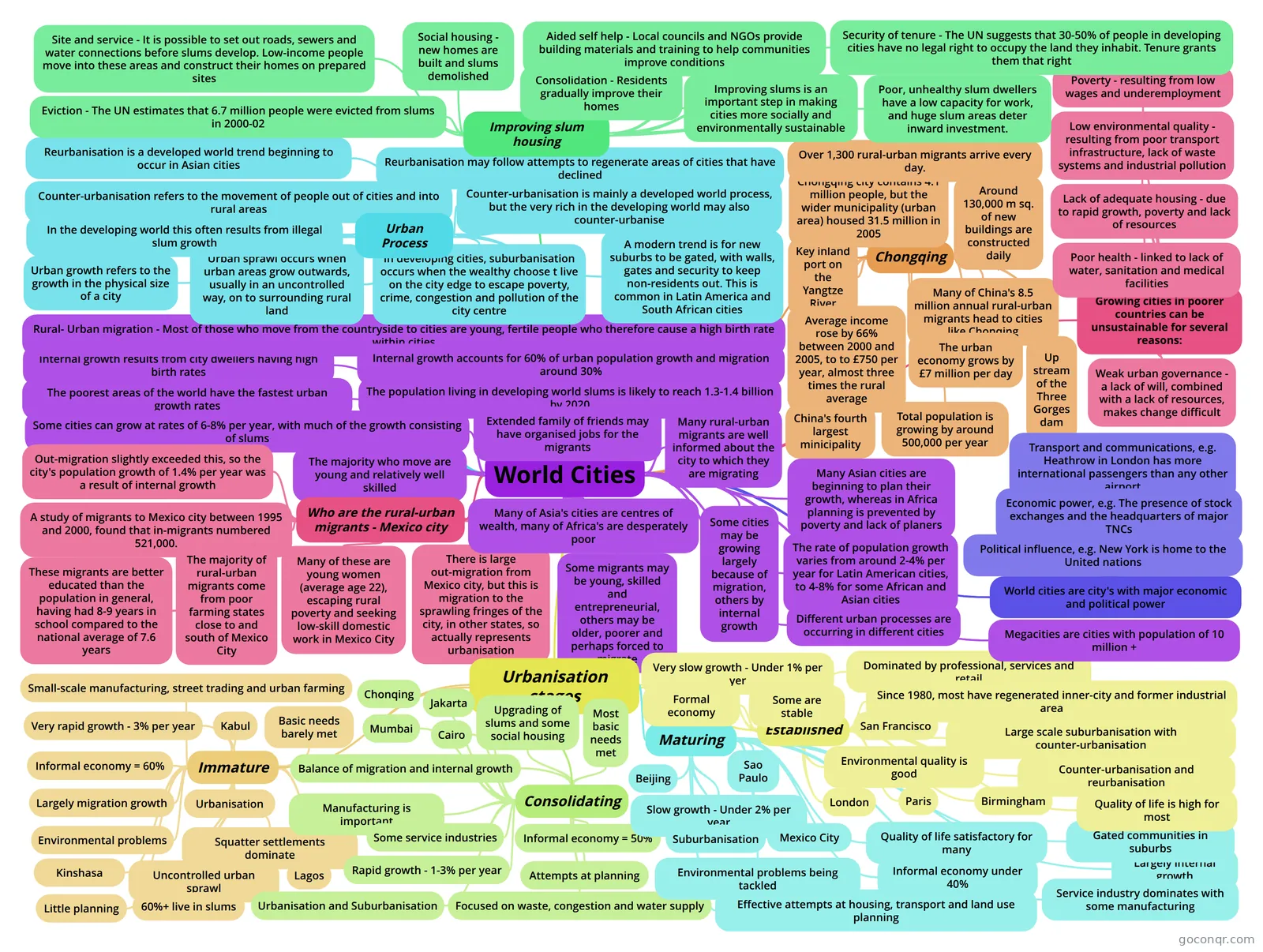
Mind map: World cities urban growth
Contenido del mapa
World Cities
Internal growth results from city dwellers having high birth rates
Rural- Urban migration - Most of those who move from the countryside to cities are young, fertile people who therefore cause a high birth rate within cities
Internal growth accounts for 60% of urban population growth and migration around 30%
The poorest areas of the world have the fastest urban growth rates
Some cities can grow at rates of 6-8% per year, with much of the growth consisting of slums
The population living in developing world slums is likely to reach 1.3-1.4 billion by 2020
Many rural-urban migrants are well informed about the city to which they are migrating
Extended family of friends may have organised jobs for the migrants
The majority who move are young and relatively well skilled
Who are the rural-urban migrants - Mexico city
- A study of migrants to Mexico city between 1995 and 2000, found that in-migrants numbered 521,000.
- Out-migration slightly exceeded this, so the city's population growth of 1.4% per year was a result of internal growth
- The majority of rural-urban migrants come from poor farming states close to and south of Mexico City
- Many of these are young women (average age 22), escaping rural poverty and seeking low-skill domestic work in Mexico City
- These migrants are better educated than the population in general, having had 8-9 years in school compared to the national average of 7.6 years
- There is large out-migration from Mexico city, but this is migration to the sprawling fringes of the city, in other states, so actually represents urbanisation
Many of Asia's cities are centres of wealth, many of Africa's are desperately poor
Some migrants may be young, skilled and entrepreneurial, others may be older, poorer and perhaps forced to migrate
Urban Process
- Urban growth refers to the growth in the physical size of a city
- Urban sprawl occurs when urban areas grow outwards, usually in an uncontrolled way, on to surrounding rural land
- In the developing world this often results from illegal slum growth
- In developing cities, suburbanisation occurs when the wealthy choose t live on the city edge to escape poverty, crime, congestion and pollution of the city centre
- A modern trend is for new suburbs to be gated, with walls, gates and security to keep non-residents out. This is common in Latin America and South African cities
- Counter-urbanisation refers to the movement of people out of cities and into rural areas
- Counter-urbanisation is mainly a developed world process, but the very rich in the developing world may also counter-urbanise
- Reurbanisation may follow attempts to regenerate areas of cities that have declined
- Reurbanisation is a developed world trend beginning to occur in Asian cities
Some cities may be growing largely because of migration, others by internal growth
Many Asian cities are beginning to plan their growth, whereas in Africa planning is prevented by poverty and lack of planers
The rate of population growth varies from around 2-4% per year for Latin American cities, to 4-8% for some African and Asian cities
Different urban processes are occurring in different cities
Chongqing
- China's fourth largest minicipality
- Up stream of the Three Gorges dam
- Key inland port on the Yangtze River
- Many of China's 8.5 million annual rural-urban migrants head to cities like Chonqing
- Chongqing city contains 4.1 million people, but the wider municipality (urban area) housed 31.5 million in 2005
- Over 1,300 rural-urban migrants arrive every day.
- The urban economy grows by £7 million per day
- Total population is growing by around 500,000 per year
- Around 130,000 m sq. of new buildings are constructed daily
- Average income rose by 66% between 2000 and 2005, to to £750 per year, almost three times the rural average
Urbanisation stages
- Immature
- Very rapid growth - 3% per year
- Largely migration growth
- Informal economy = 60%
- Small-scale manufacturing, street trading and urban farming
- Urbanisation
- Little planning
- Uncontrolled urban sprawl
- Squatter settlements dominate
- Basic needs barely met
- 60%+ live in slums
- Environmental problems
- Kabul
- Lagos
- Kinshasa
- Consolidating
- Rapid growth - 1-3% per year
- Balance of migration and internal growth
- Manufacturing is important
- Some service industries
- Informal economy = 50%
- Urbanisation and Suburbanisation
- Attempts at planning
- Focused on waste, congestion and water supply
- Upgrading of slums and some social housing
- Most basic needs met
- Cairo
- Mumbai
- Jakarta
- Chonqing
- Maturing
- Slow growth - Under 2% per year
- Largely internal growth
- Service industry dominates with some manufacturing
- Informal economy under 40%
- Suburbanisation
- Effective attempts at housing, transport and land use planning
- Environmental problems being tackled
- Quality of life satisfactory for many
- Gated communities in suburbs
- Mexico City
- Sao Paulo
- Beijing
- Established
- Very slow growth - Under 1% per yer
- Some are stable
- Dominated by professional, services and retail
- Formal economy
- Counter-urbanisation and reurbanisation
- Large scale suburbanisation with counter-urbanisation
- Since 1980, most have regenerated inner-city and former industrial area
- Quality of life is high for most
- Environmental quality is good
- London
- San Francisco
- Paris
- Birmingham
- Immature
Megacities are cities with population of 10 million +
World cities are city's with major economic and political power
- Political influence, e.g. New York is home to the United nations
- Transport and communications, e.g. Heathrow in London has more international passengers than any other airport
- Economic power, e.g. The presence of stock exchanges and the headquarters of major TNCs
Growing cities in poorer countries can be unsustainable for several reasons:
- Lack of adequate housing - due to rapid growth, poverty and lack of resources
- Poor health - linked to lack of water, sanitation and medical facilities
- Weak urban governance - a lack of will, combined with a lack of resources, makes change difficult
- Low environmental quality - resulting from poor transport infrastructure, lack of waste systems and industrial pollution
- Poverty - resulting from low wages and underemployment
Improving slum housing
- Poor, unhealthy slum dwellers have a low capacity for work, and huge slum areas deter inward investment.
- Improving slums is an important step in making cities more socially and environmentally sustainable
- Eviction - The UN estimates that 6.7 million people were evicted from slums in 2000-02
- Security of tenure - The UN suggests that 30-50% of people in developing cities have no legal right to occupy the land they inhabit. Tenure grants them that right
- Site and service - It is possible to set out roads, sewers and water connections before slums develop. Low-income people move into these areas and construct their homes on prepared sites
- Consolidation - Residents gradually improve their homes
- Aided self help - Local councils and NGOs provide building materials and training to help communities improve conditions
- Social housing - new homes are built and slums demolished
Información
- Descripción
- A-Levels (Going Global) Geography Mapa Mental sobre World Cities, creado por Jodie Goodacre el 06/05/2013.
- Creado por
- Jodie Goodacre
- Visitas
- 239
- Etiquetas
- Valoración