
Mapa mental
Retake overview
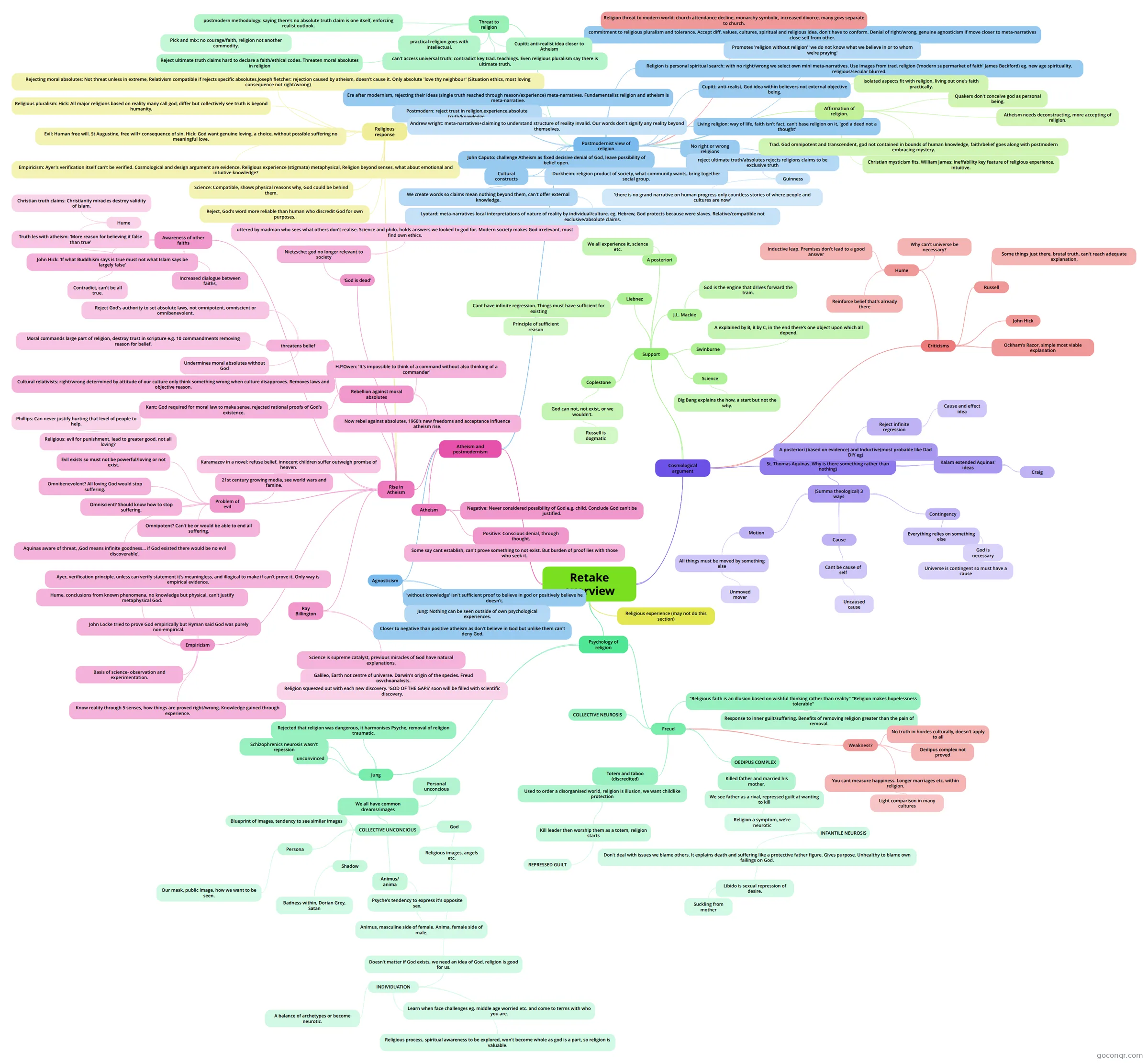
Mind map: Retake overview
Contenido del mapa
Retake overview
Cosmological argument
- St. Thomas Aquinas. Why is there something rather than nothing)
- A posteriori (based on evidence) and Inductive(most probable like Dad DIY eg)
- Reject infinite regression
- Cause and effect idea
- Reject infinite regression
- (Summa theological) 3 ways
- Motion
- All things must be moved by something else
- Unmoved mover
- All things must be moved by something else
- Cause
- Cant be cause of self
- Uncaused cause
- Cant be cause of self
- Contingency
- Everything relies on something else
- God is necessary
- Universe is contingent so must have a cause
- God is necessary
- Everything relies on something else
- Motion
- Kalam extended Aquinas' ideas
- Craig
- A posteriori (based on evidence) and Inductive(most probable like Dad DIY eg)
- Support
- Liebnez
- Cant have infinite regression. Things must have sufficient for existing
- Principle of sufficient reason
- Cant have infinite regression. Things must have sufficient for existing
- J.L. Mackie
- God is the engine that drives forward the train.
- Coplestone
- God can not, not exist, or we wouldn't.
- Russell is dogmatic
- God can not, not exist, or we wouldn't.
- Swinburne
- A explained by B, B by C, in the end there's one object upon which all depend.
- Science
- Big Bang explains the how, a start but not the why.
- A posteriori
- We all experience it, science etc.
- Liebnez
- Criticisms
- Hume
- Inductive leap. Premises don't lead to a good answer
- Why can't universe be necessary?
- Reinforce belief that's already there
- Russell
- Some things just there, brutal truth, can't reach adequate explanation.
- John Hick
- Ockham's Razor, simple most viable explanation
- Hume
- St. Thomas Aquinas. Why is there something rather than nothing)
Psychology of religion
- Freud
- Totem and taboo (discredited)
- Used to order a disorganised world, religion is illusion, we want childlike protection
- Kill leader then worship them as a totem, religion starts
- REPRESSED GUILT
- Kill leader then worship them as a totem, religion starts
- Used to order a disorganised world, religion is illusion, we want childlike protection
- OEDIPUS COMPLEX
- Killed father and married his mother.
- We see father as a rival, repressed guilt at wanting to kill
- Religion a symptom, we're neurotic
- INFANTILE NEUROSIS
- Don't deal with issues we blame others. It explains death and suffering like a protective father figure. Gives purpose. Unhealthy to blame own failings on God.
- Libido is sexual repression of desire.
- Suckling from mother
- Libido is sexual repression of desire.
- Don't deal with issues we blame others. It explains death and suffering like a protective father figure. Gives purpose. Unhealthy to blame own failings on God.
- INFANTILE NEUROSIS
- Religion a symptom, we're neurotic
- We see father as a rival, repressed guilt at wanting to kill
- Killed father and married his mother.
- "Religious faith is an illusion based on wishful thinking rather than reality" "Religion makes hopelessness tolerable"
- Response to inner guilt/suffering. Benefits of removing religion greater than the pain of removal.
- Weakness?
- No truth in hordes culturally, doesn't apply to all
- Oedipus complex not proved
- You cant measure happiness. Longer marriages etc. within religion.
- Light comparison in many cultures
- COLLECTIVE NEUROSIS
- Totem and taboo (discredited)
- Jung
- Rejected that religion was dangerous, it harmonises Psyche, removal of religion traumatic.
- Schizophrenics neurosis wasn't repession
- unconvinced
- We all have common dreams/images
- COLLECTIVE UNCONCIOUS
- Blueprint of images, tendency to see similar images
- Persona
- Our mask, public image, how we want to be seen.
- Shadow
- Badness within, Dorian Grey, Satan
- Animus/ anima
- Psyche's tendency to express it's opposite sex.
- Animus, masculine side of female. Anima, female side of male.
- Psyche's tendency to express it's opposite sex.
- God
- Religious images, angels etc.
- Doesn't matter if God exists, we need an idea of God, religion is good for us.
- INDIVIDUATION
- A balance of archetypes or become neurotic.
- Religious process, spiritual awareness to be explored, won't become whole as god is a part, so religion is valuable.
- Learn when face challenges eg. middle age worried etc. and come to terms with who you are.
- INDIVIDUATION
- Doesn't matter if God exists, we need an idea of God, religion is good for us.
- Religious images, angels etc.
- Personal unconcious
- COLLECTIVE UNCONCIOUS
- Freud
Atheism and postmodernism
- Atheism
- Negative: Never considered possibility of God e.g. child. Conclude God can't be justified.
- Positive: Conscious denial, through thought.
- Some say cant establish, can't prove something to not exist. But burden of proof lies with those who seek it.
- Agnosticism
- 'without knowledge' isn't sufficient proof to believe in god or positively believe he doesn't.
- Jung: Nothing can be seen outside of own psychological experiences.
- Closer to negative than positive atheism as don't believe in God but unlike them can't deny God.
- 'without knowledge' isn't sufficient proof to believe in god or positively believe he doesn't.
- Rise in Atheism
- Ray Billington
- Science is supreme catalyst, previous miracles of God have natural explanations.
- Galileo, Earth not centre of universe. Darwin's origin of the species. Freud psychoanalysts.
- Religion squeezed out with each new discovery. 'GOD OF THE GAPS' soon will be filled with scientific discovery.
- Galileo, Earth not centre of universe. Darwin's origin of the species. Freud psychoanalysts.
- Science is supreme catalyst, previous miracles of God have natural explanations.
- Empiricism
- Know reality through 5 senses, how things are proved right/wrong. Knowledge gained through experience.
- Basis of science- observation and experimentation.
- John Locke tried to prove God empirically but Hyman said God was purely non-empirical.
- Hume, conclusions from known phenomena, no knowledge but physical, can't justify metaphysical God.
- Ayer, verification principle, unless can verify statement it's meaningless, and illogical to make if can't prove it. Only way is empirical evidence.
- Problem of evil
- Aquinas aware of threat, ,God means infinite goodness... if God existed there would be no evil discoverable'.
- Omnipotent? Can't be or would be able to end all suffering.
- Omniscient? Should know how to stop suffering.
- Omnibenevolent? All loving God would stop suffering.
- Evil exists so must not be powerful/loving or not exist.
- Religious: evil for punishment, lead to greater good, not all loving?
- Phillips: Can never justify hurting that level of people to help.
- Religious: evil for punishment, lead to greater good, not all loving?
- 21st century growing media, see world wars and famine.
- Karamazov in a novel: refuse belief, innocent children suffer outweigh promise of heaven.
- Rebellion against moral absolutes
- Now rebel against absolutes, 1960's new freedoms and acceptance influence atheism rise.
- H.P.Owen: 'It's impossible to think of a command without also thinking of a commander'
- Kant: God required for moral law to make sense, rejected rational proofs of God's existence.
- Cultural relativists: right/wrong determined by attitude of our culture only think something wrong when culture disapproves. Removes laws and objective reason.
- threatens belief
- Undermines moral absolutes without God
- Moral commands large part of religion, destroy trust in scripture e.g. 10 commandments removing reason for belief.
- Reject God's authority to set absolute laws, not omnipotent, omniscient or omnibenevolent.
- Awareness of other faiths
- Increased dialogue between faiths,
- John Hick: 'If what Buddhism says is true must not what Islam says be largely false'
- Truth les with atheism: 'More reason for believing it false than true'
- Hume
- Christian truth claims: Christianity miracles destroy validity of Islam.
- Hume
- Contradict, can't be all true.
- Truth les with atheism: 'More reason for believing it false than true'
- 'God is dead'
- Nietzsche: god no longer relevant to society
- uttered by madman who sees what others don't realise. Science and philo. holds answers we looked to god for. Modern society makes God irrelevant, must find own ethics.
- Nietzsche: god no longer relevant to society
- Religious response
- Reject, God's word more reliable than human who discredit God for own purposes.
- Science: Compatible, shows physical reasons why, God could be behind them.
- Empiricism: Ayer's verification itself can't be verified. Cosmological and design argument are evidence. Religious experience (stigmata) metaphysical, Religion beyond senses, what about emotional and intuitive knowledge?
- Evil: Human free will. St Augustine, free will+ consequence of sin. Hick: God want genuine loving, a choice, without possible suffering no meaningful love.
- Rejecting moral absolutes: Not threat unless in extreme, Relativism compatible if rejects specific absolutes.Joseph fletcher: rejection caused by atheism, doesn't cause it. Only absolute 'love thy neighbour' (Situation ethics, most loving consequence not right/wrong)
- Religious pluralism: Hick: All major religions based on reality many call god, differ but collectively see truth is beyond humanity.
- Ray Billington
- Postmodernist view of religion
- Era after modernism, rejecting their ideas (single truth reached through reason/experience) meta-narratives. Fundamentalist religion and atheism is meta-narrative.
- Postmodern: reject trust in religion,experience,absolute truth/knowledge.
- Andrew wright: meta-narratives+claiming to understand structure of reality invalid. Our words don't signify any reality beyond themselves.
- Postmodern: reject trust in religion,experience,absolute truth/knowledge.
- John Caputo: challenge Atheism as fixed decisive denial of God, leave possibility of belief open.
- Cultural constructs
- We create words so claims mean nothing beyond them, can't offer external knowledge.
- Lyotard: meta-narratives local interpretations of nature of reality by individual/culture. eg. Hebrew, God protects because were slaves. Relative/compatible not exclusive/absolute claims.
- Durkheim: religion product of society, what community wants, bring together social group.
- We create words so claims mean nothing beyond them, can't offer external knowledge.
- No right or wrong religions
- reject ultimate truth/absolutes rejects religions claims to be exclusive truth
- Guinness
- 'there is no grand narrative on human progress only countless stories of where people and cultures are now'
- Guinness
- reject ultimate truth/absolutes rejects religions claims to be exclusive truth
- commitment to religious pluralism and tolerance. Accept diff. values, cultures, spiritual and religious idea, don't have to conform. Denial of right/wrong, genuine agnosticism if move closer to meta-narratives close self from other.
- Promotes 'religion without religion' 'we do not know what we believe in or to whom we're praying'
- Religion is personal spiritual search: with no right/wrong we select own mini meta-narratives. Use images from trad. religion ('modern supermarket of faith' James Beckford) eg. new age spirituality. religious/secular blurred.
- Cupitt: anti-realist, God idea within believers not external objective being.
- Living religion: way of life, faith isn't fact, can't base religion on it, 'god a deed not a thought'
- Affirmation of religion.
- isolated aspects fit with religion, living out one's faith practically.
- Quakers don't conceive god as personal being.
- Trad. God omnipotent and transcendent, god not contained in bounds of human knowledge, faith/belief goes along with postmodern embracing mystery.
- Atheism needs deconstructing, more accepting of religion.
- Christian mysticism fits. William James: ineffability key feature of religious experience, intuitive.
- Threat to religion
- can't access universal truth: contradict key trad. teachings. Even religious pluralism say there is ultimate truth.
- Cupitt: anti-realist idea closer to Atheism
- practical religion goes with intellectual.
- Reject ultimate truth claims hard to declare a faith/ethical codes. Threaten moral absolutes in religion
- Pick and mix: no courage/faith, religion not another commodity.
- postmodern methodology: saying there's no absolute truth claim is one itself, enforcing realist outlook.
- Religion threat to modern world: church attendance decline, monarchy symbolic, increased divorce, many govs separate to church.
- Era after modernism, rejecting their ideas (single truth reached through reason/experience) meta-narratives. Fundamentalist religion and atheism is meta-narrative.
- Atheism
Religious experience (may not do this section)
Información
- Descripción
- A Levels Philosophy of Religion and Ethics Mapa Mental sobre Retake overview, creado por laurahartfield el 08/04/2014.
- Creado por
- laurahartfield
- Visitas
- 83
- Etiquetas
- Valoración