
Mapa mental
C3a - Rate of reaction (1)
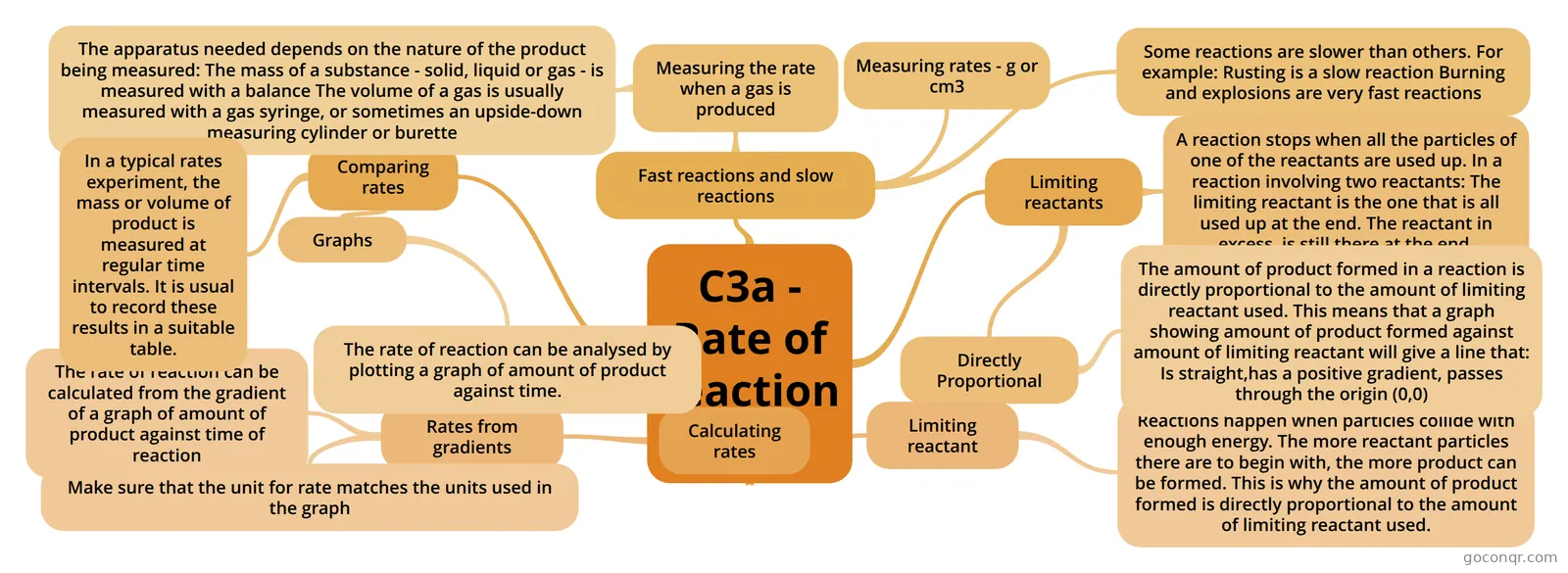
Mind map: Rate of reaction
Contenido del mapa
C3a - Rate of reaction (1)
Fast reactions and slow reactions
- Measuring rates - g or cm3
- Measuring the rate when a gas is produced
- The apparatus needed depends on the nature of the product being measured: The mass of a substance - solid, liquid or gas - is measured with a balance The volume of a gas is usually measured with a gas syringe, or sometimes an upside-down measuring cylinder or burette
- Some reactions are slower than others. For example: Rusting is a slow reaction Burning and explosions are very fast reactions
Comparing rates
- Graphs
- The rate of reaction can be analysed by plotting a graph of amount of product against time.
- In a typical rates experiment, the mass or volume of product is measured at regular time intervals. It is usual to record these results in a suitable table.
- Graphs
Limiting reactants
- Directly Proportional
- The amount of product formed in a reaction is directly proportional to the amount of limiting reactant used. This means that a graph showing amount of product formed against amount of limiting reactant will give a line that: Is straight,has a positive gradient, passes through the origin (0,0)
- A reaction stops when all the particles of one of the reactants are used up. In a reaction involving two reactants: The limiting reactant is the one that is all used up at the end. The reactant in excess, is still there at the end.
- Directly Proportional
Calculating rates
- Limiting reactant
- Reactions happen when particles collide with enough energy. The more reactant particles there are to begin with, the more product can be formed. This is why the amount of product formed is directly proportional to the amount of limiting reactant used.
- Rates from gradients
- The rate of reaction can be calculated from the gradient of a graph of amount of product against time of reaction
- Make sure that the unit for rate matches the units used in the graph
- Limiting reactant
Información
- Descripción
- GCSE (C3) CHEMISTRY Mapa Mental sobre C3a - Rate of reaction (1), creado por Chloe.Sharland el 09/04/2014.
- Creado por
- Chloe.Sharland
- Visitas
- 72
- Etiquetas
- Valoración