
Mapa mental
Using EU Law before National Courts
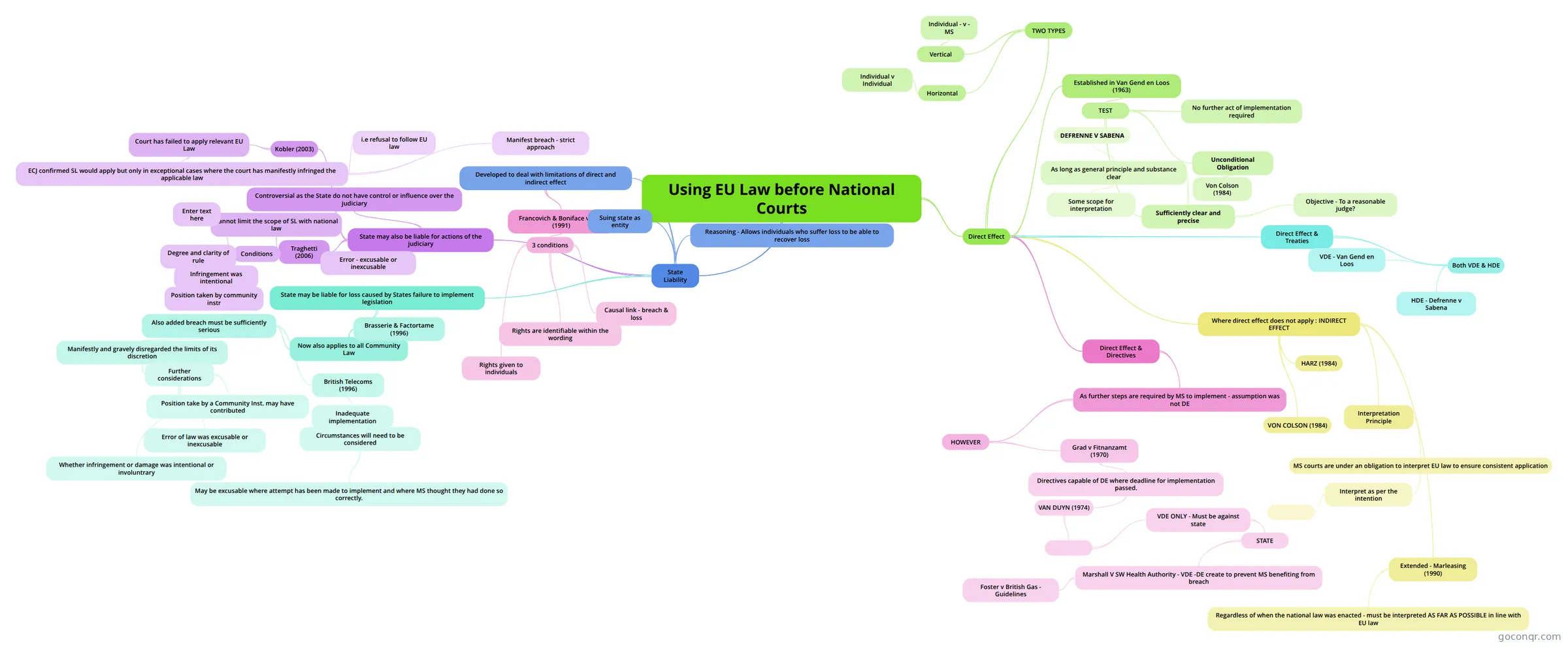
Mind map: Using EU law before national courts
Contenido del mapa
Using EU Law before National Courts
Direct Effect
- Established in Van Gend en Loos (1963)
- TEST
- Sufficiently clear and precise
- Objective - To a reasonable judge?
- As long as general principle and substance clear
- Some scope for interpretation
- DEFRENNE V SABENA
- Unconditional Obligation
- Von Colson (1984)
- No further act of implementation required
- Sufficiently clear and precise
- TEST
- TWO TYPES
- Vertical
- Individual - v - MS
- Horizontal
- Individual v Individual
- Vertical
- Direct Effect & Directives
- As further steps are required by MS to implement - assumption was not DE
- HOWEVER
- Grad v Fitnanzamt (1970)
- Directives capable of DE where deadline for implementation passed.
- VAN DUYN (1974)
- VDE ONLY - Must be against state
- STATE
- Marshall V SW Health Authority - VDE -DE create to prevent MS benefiting from breach
- Foster v British Gas - Guidelines
- Marshall V SW Health Authority - VDE -DE create to prevent MS benefiting from breach
- STATE
- VDE ONLY - Must be against state
- VAN DUYN (1974)
- Directives capable of DE where deadline for implementation passed.
- Grad v Fitnanzamt (1970)
- HOWEVER
- As further steps are required by MS to implement - assumption was not DE
- Direct Effect & Treaties
- Both VDE & HDE
- HDE - Defrenne v Sabena
- VDE - Van Gend en Loos
- Both VDE & HDE
- Where direct effect does not apply : INDIRECT EFFECT
- Interpretation Principle
- MS courts are under an obligation to interpret EU law to ensure consistent application
- Interpret as per the intention
- Interpret as per the intention
- MS courts are under an obligation to interpret EU law to ensure consistent application
- VON COLSON (1984)
- HARZ (1984)
- Extended - Marleasing (1990)
- Regardless of when the national law was enacted - must be interpreted AS FAR AS POSSIBLE in line with EU law
- Interpretation Principle
- Established in Van Gend en Loos (1963)
State Liability
- Developed to deal with limitations of direct and indirect effect
- Francovich & Boniface v Italy (1991)
- 3 conditions
- Rights given to individuals
- Rights are identifiable within the wording
- Causal link - breach & loss
- 3 conditions
- Francovich & Boniface v Italy (1991)
- State may be liable for loss caused by States failure to implement legislation
- Now also applies to all Community Law
- Also added breach must be sufficiently serious
- Manifestly and gravely disregarded the limits of its discretion
- Further considerations
- Whether infringement or damage was intentional or involuntrary
- Error of law was excusable or inexcusable
- Position take by a Community Inst. may have contributed
- Further considerations
- British Telecoms (1996)
- Inadequate implementation
- Circumstances will need to be considered
- May be excusable where attempt has been made to implement and where MS thought they had done so correctly.
- Circumstances will need to be considered
- Inadequate implementation
- Manifestly and gravely disregarded the limits of its discretion
- Brasserie & Factortame (1996)
- Also added breach must be sufficiently serious
- Now also applies to all Community Law
- Suing state as entity
- State may also be liable for actions of the judiciary
- Controversial as the State do not have control or influence over the judiciary
- Kobler (2003)
- Court has failed to apply relevant EU Law
- ECJ confirmed SL would apply but only in exceptional cases where the court has manifestly infringed the applicable law
- i.e refusal to follow EU law
- Manifest breach - strict approach
- ECJ confirmed SL would apply but only in exceptional cases where the court has manifestly infringed the applicable law
- Court has failed to apply relevant EU Law
- Traghetti (2006)
- Cannot limit the scope of SL with national law
- Conditions
- Degree and clarity of rule
- Infringement was intentional
- Error - excusable or inexcusable
- Position taken by community instr
- Enter text here
- Reasoning - Allows individuals who suffer loss to be able to recover loss
- Developed to deal with limitations of direct and indirect effect
Información
- Descripción
- EU Law Mapa Mental sobre Using EU Law before National Courts, creado por axw el 22/04/2014.
- Creado por
- axw
- Visitas
- 38
- Valoración