
Mapa mental
ELECTRICITY(circuits)
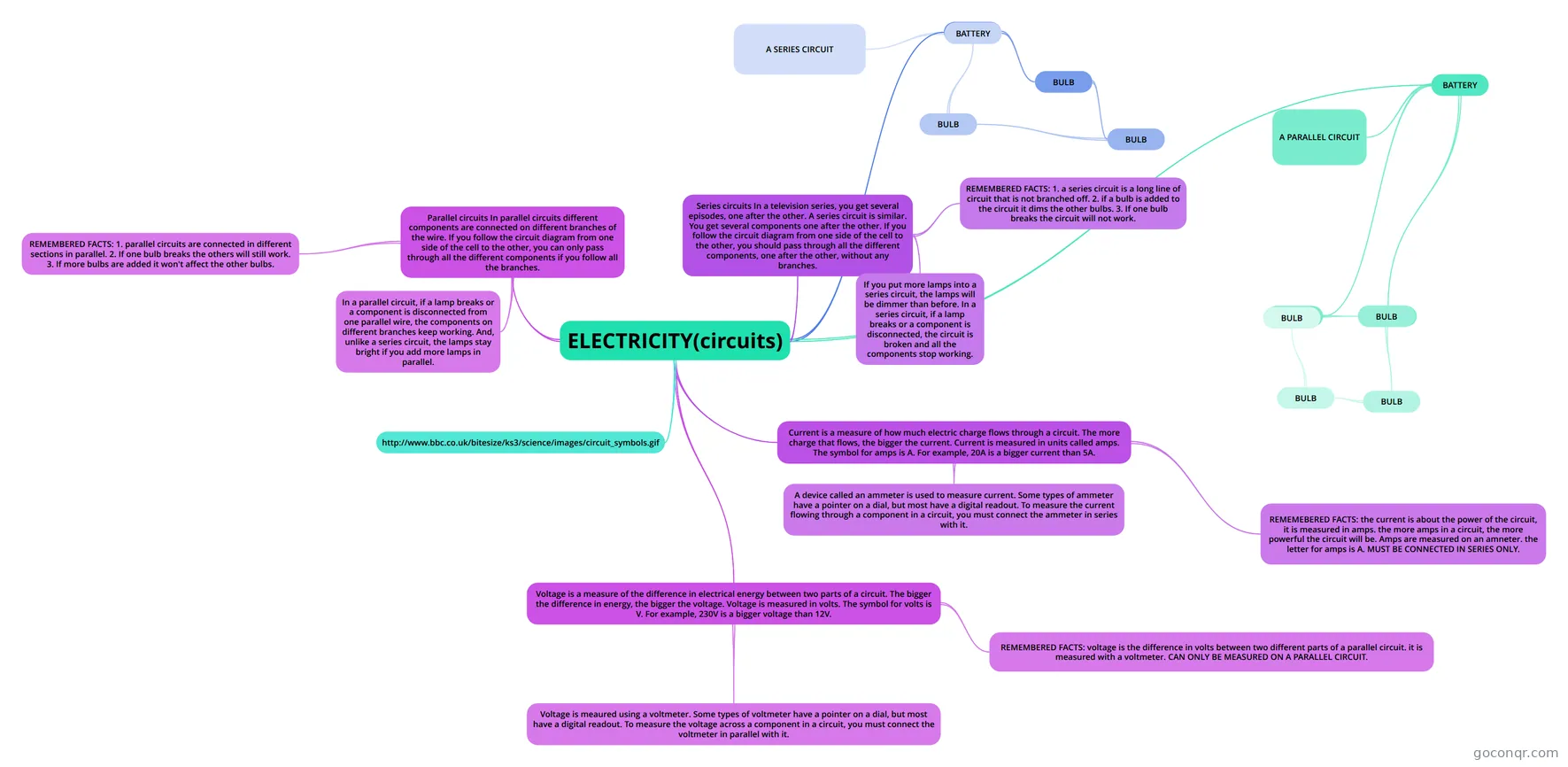
Mind map: electricity circuits
Contenido del mapa
ELECTRICITY(circuits)
http://www.bbc.co.uk/bitesize/ks3/science/images/circuit_symbols.gif
Series circuits In a television series, you get several episodes, one after the other. A series circuit is similar. You get several components one after the other. If you follow the circuit diagram from one side of the cell to the other, you should pass through all the different components, one after the other, without any branches.
- If you put more lamps into a series circuit, the lamps will be dimmer than before. In a series circuit, if a lamp breaks or a component is disconnected, the circuit is broken and all the components stop working.
- REMEMBERED FACTS: 1. a series circuit is a long line of circuit that is not branched off. 2. if a bulb is added to the circuit it dims the other bulbs. 3. If one bulb breaks the circuit will not work.
Parallel circuits In parallel circuits different components are connected on different branches of the wire. If you follow the circuit diagram from one side of the cell to the other, you can only pass through all the different components if you follow all the branches.
- In a parallel circuit, if a lamp breaks or a component is disconnected from one parallel wire, the components on different branches keep working. And, unlike a series circuit, the lamps stay bright if you add more lamps in parallel.
- REMEMBERED FACTS: 1. parallel circuits are connected in different sections in parallel. 2. If one bulb breaks the others will still work. 3. If more bulbs are added it won't affect the other bulbs.
Current is a measure of how much electric charge flows through a circuit. The more charge that flows, the bigger the current. Current is measured in units called amps. The symbol for amps is A. For example, 20A is a bigger current than 5A.
- A device called an ammeter is used to measure current. Some types of ammeter have a pointer on a dial, but most have a digital readout. To measure the current flowing through a component in a circuit, you must connect the ammeter in series with it.
- REMEMEBERED FACTS: the current is about the power of the circuit, it is measured in amps. the more amps in a circuit, the more powerful the circuit will be. Amps are measured on an amneter. the letter for amps is A. MUST BE CONNECTED IN SERIES ONLY.
BATTERY
- BULB
- BULB
- BULB
- BULB
- BULB
- BULB
- BULB
- A PARALLEL CIRCUIT
·
- BULB
- BULB
- BULB
- BATTERY
- A SERIES CIRCUIT
- BATTERY
- BULB
- BULB
- BULB
Voltage is a measure of the difference in electrical energy between two parts of a circuit. The bigger the difference in energy, the bigger the voltage. Voltage is measured in volts. The symbol for volts is V. For example, 230V is a bigger voltage than 12V.
- Voltage is meaured using a voltmeter. Some types of voltmeter have a pointer on a dial, but most have a digital readout. To measure the voltage across a component in a circuit, you must connect the voltmeter in parallel with it.
- REMEMBERED FACTS: voltage is the difference in volts between two different parts of a parallel circuit. it is measured with a voltmeter. CAN ONLY BE MEASURED ON A PARALLEL CIRCUIT.
Información
- Descripción
- GCSE (End of KS3 revision) science Mapa Mental sobre ELECTRICITY(circuits), creado por jesswarner27 el 09/05/2013.
- Creado por
- jesswarner27
- Visitas
- 196
- Etiquetas
- Valoración