
Mapa mental
Distribution
Contenido del mapa
Distribution
Volume of Distribution (Vd)
- Drugs that are very polar, or, have a high affinity for plasma proteins tend to remain in the blood: •Restricted to blood = SMALL Vd
- Drugs that are very lipophillic, or, that extensively bind to tissue “structures” (proteins/membranes/fat) •Tend to have a greater affinity for the tissues •Tend to be able to cross membrane barriers to enter tissues = LARGE Vd
- It is NOT a “real” volume at all •It simply relates the concentration in the fluid (plasma/ blood) to the amount we know is in the body
- In general one might expect a drug with a high fu to have a large Vd. In general one might expect a highly lipophilic drug to have a large Vd. However, Vd is DETERMINED BY IT'S PERMEABILITY ACROSS MEMBRANES and both tissue binding and plasma protein binding. One must consider both aspects.
- a poorly lipophilic compound with a high fu might have a small Vd (eg lithium) because it cannot accumulate within tissue cells significantly.
- a highly lipophilic compound with a low fu might have a large Vd (eg amiodarone). This is because the drug accumulates within tissues to a large extent, and it is also quite lipophillic.
- a large molecule (eg a protein-based drug) might have a small Vd as it cannot diffuse out of the blood due to it's high molecular weight, irrespective of it's lipophilicity
- double Vd, double t1/2
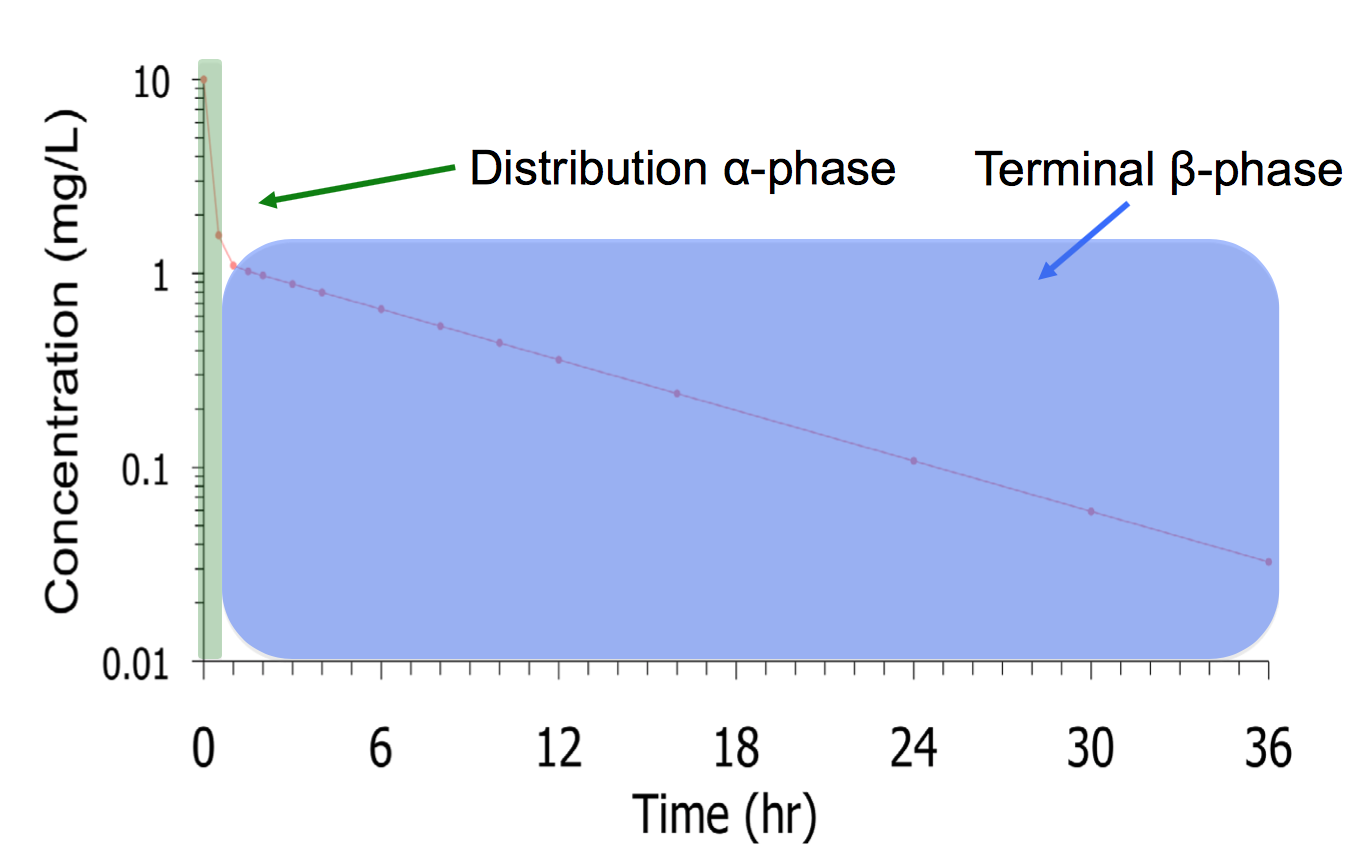
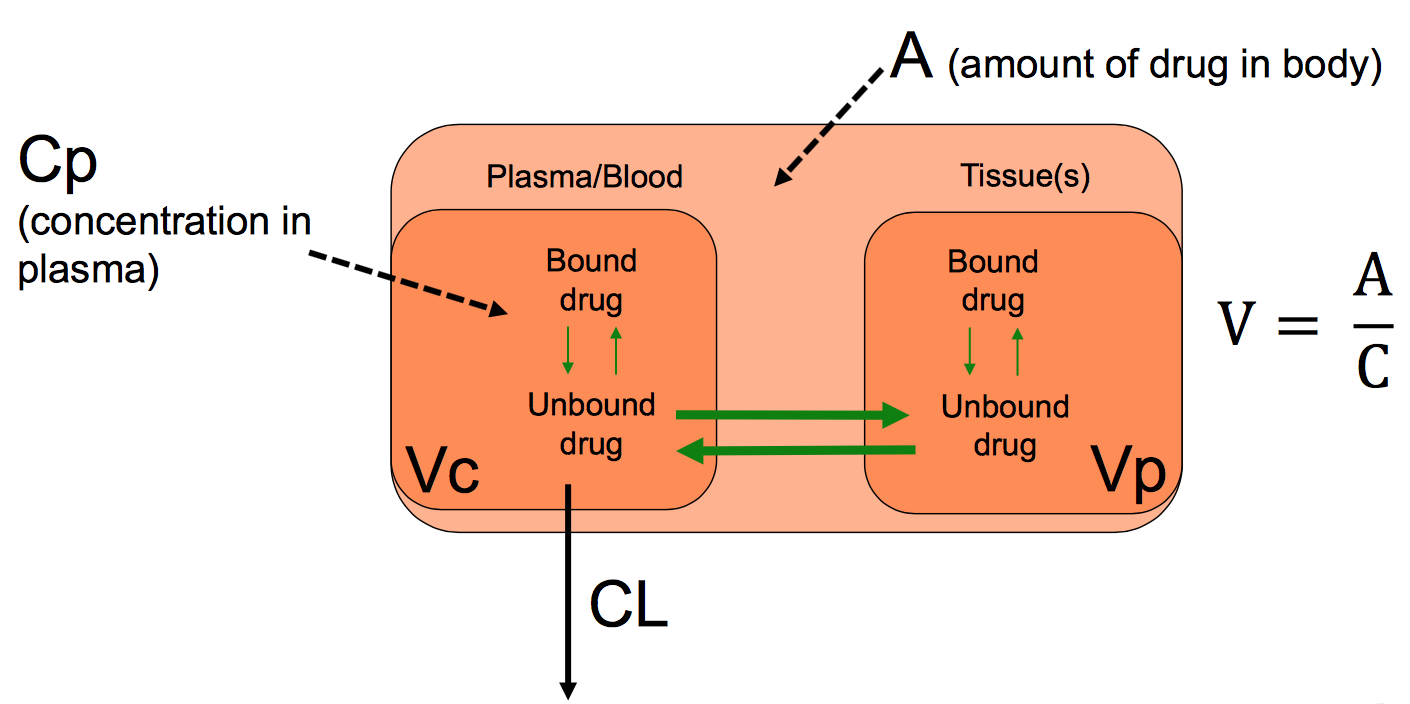
two compartment distribution
- Central compartment Vc - fast equilibrating. highly perfused
- Peripheral compartment Vp = slow equilibrating. less perfused.
- graphing
- distribution phase = α phase. rate constant = α intercept = A
- terminal (elimination phase) = ß phase. Rate constant = ß intercept = B
- 2 compartment:
- initial period Vc - highly perfuesed tissues
- when it curves - Vp -less perfused tissues
reversible movement of drug between the systemic circulation and other organs and tissues of the body
Drug distribution is a passive process generally and so tissues and blood are in free equilibrium. Distribution out of the blood into tissues must first involve the drug crossing the blood vessel wall. This is typically via a combination of passive diffusion processes. This is typically very easy for most drugs that are <5000 Da molecular weight, and is independent of change, molecular weight or ionisation. a. between junctions in the cells forming the wall (paracellular movement). b. across the cell membranes (transcellular movement). Once this has occurred, then the drug is in the extracellular water (interstitial fluid ~ 12-15L).
permeability limitations: Applies to drugs that do not readily cross membranes • largeand/or • polarand/or • ionized at pH 7.4
Vd = CL/K
- Vd=At/Cpt
2 compartment
Imágenes y archivos del mapa
Información
- Descripción
- pharmacokinetics Mapa Mental sobre Distribution, creado por Amelia Claire el 28/04/2017.
- Creado por
- Amelia Claire
- Visitas
- 2
- Valoración