
Mapa mental
Project Phases
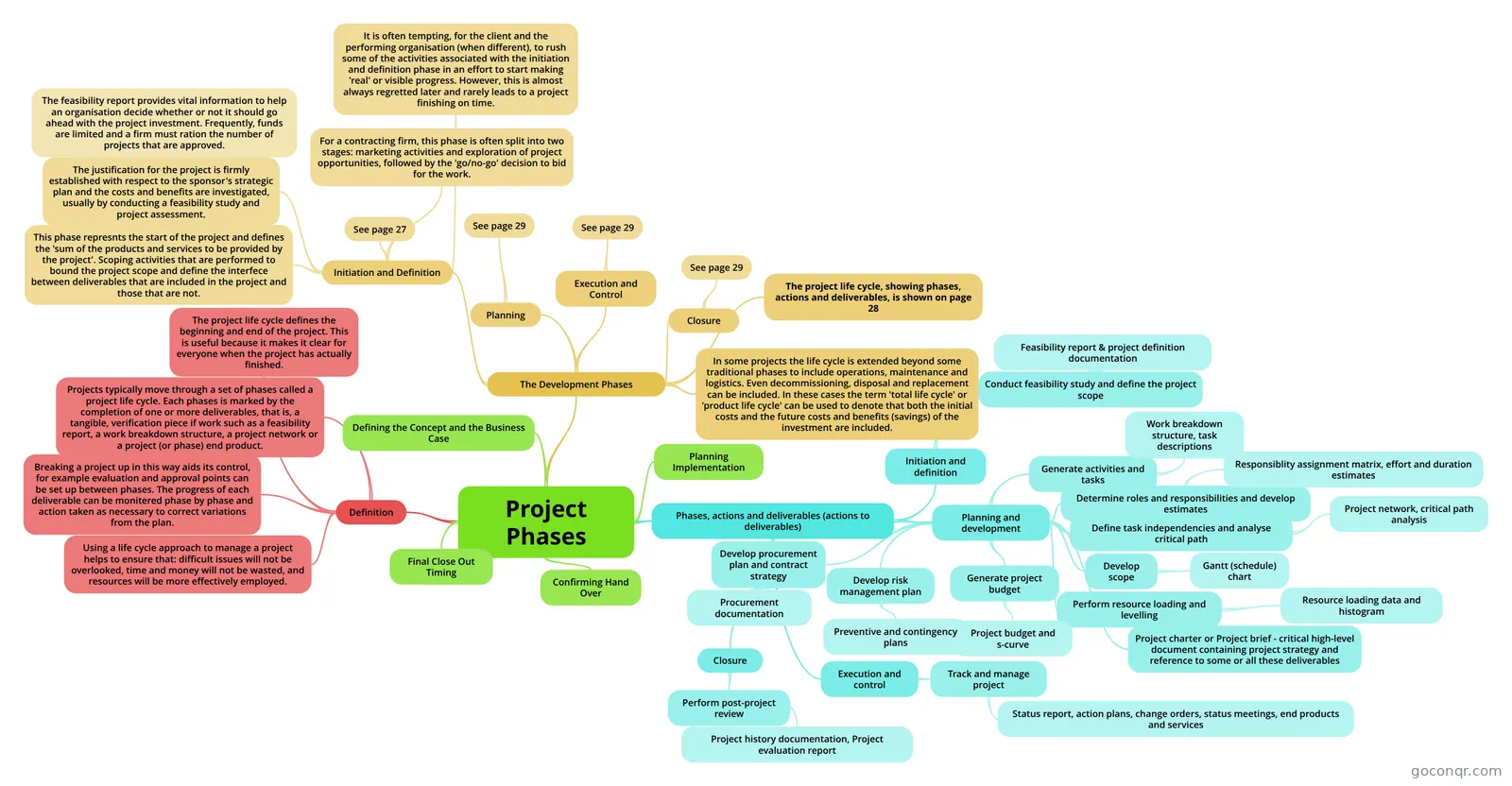
Mind map: Project phases
Contenido del mapa
Project Phases
Defining the Concept and the Business Case
The Development Phases
- Initiation and Definition
- See page 27
- This phase represnts the start of the project and defines the 'sum of the products and services to be provided by the project'. Scoping activities that are performed to bound the project scope and define the interfece between deliverables that are included in the project and those that are not.
- The justification for the project is firmly established with respect to the sponsor's strategic plan and the costs and benefits are investigated, usually by conducting a feasibility study and project assessment.
- The feasibility report provides vital information to help an organisation decide whether or not it should go ahead with the project investment. Frequently, funds are limited and a firm must ration the number of projects that are approved.
- For a contracting firm, this phase is often split into two stages: marketing activities and exploration of project opportunities, followed by the 'go/no-go' decision to bid for the work.
- It is often tempting, for the client and the performing organisation (when different), to rush some of the activities associated with the initiation and definition phase in an effort to start making 'real' or visible progress. However, this is almost always regretted later and rarely leads to a project finishing on time.
- In some projects the life cycle is extended beyond some traditional phases to include operations, maintenance and logistics. Even decommissioning, disposal and replacement can be included. In these cases the term 'total life cycle' or 'product life cycle' can be used to denote that both the initial costs and the future costs and benefits (savings) of the investment are included.
- Planning
- See page 29
- Execution and Control
- See page 29
- Closure
- See page 29
- The project life cycle, showing phases, actions and deliverables, is shown on page 28
- Initiation and Definition
Planning Implementation
Confirming Hand Over
Final Close Out Timing
Definition
- Projects typically move through a set of phases called a project life cycle. Each phases is marked by the completion of one or more deliverables, that is, a tangible, verification piece if work such as a feasibility report, a work breakdown structure, a project network or a project (or phase) end product.
- Breaking a project up in this way aids its control, for example evaluation and approval points can be set up between phases. The progress of each deliverable can be monitered phase by phase and action taken as necessary to correct variations from the plan.
- Using a life cycle approach to manage a project helps to ensure that: difficult issues will not be overlooked, time and money will not be wasted, and resources will be more effectively employed.
- The project life cycle defines the beginning and end of the project. This is useful because it makes it clear for everyone when the project has actually finished.
Phases, actions and deliverables (actions to deliverables)
- Initiation and definition
- Conduct feasibility study and define the project scope
- Feasibility report & project definition documentation
- Conduct feasibility study and define the project scope
- Planning and development
- Generate activities and tasks
- Work breakdown structure, task descriptions
- Determine roles and responsibilities and develop estimates
- Responsiblity assignment matrix, effort and duration estimates
- Define task independencies and analyse critical path
- Project network, critical path analysis
- Develop scope
- Gantt (schedule) chart
- Perform resource loading and levelling
- Resource loading data and histogram
- Generate project budget
- Project budget and s-curve
- Develop risk management plan
- Preventive and contingency plans
- Develop procurement plan and contract strategy
- Procurement documentation
- Project charter or Project brief - critical high-level document containing project strategy and reference to some or all these deliverables
- Generate activities and tasks
- Execution and control
- Track and manage project
- Status report, action plans, change orders, status meetings, end products and services
- Track and manage project
- Closure
- Perform post-project review
- Project history documentation, Project evaluation report
- Perform post-project review
- Initiation and definition
Información
- Descripción
- Mapa Mental sobre Project Phases, creado por juliajchesher el 13/05/2014.
- Creado por
- juliajchesher
- Visitas
- 25
- Valoración
Más sobre Project Life Cycle and Process Groups