
Mapa mental
Chem Unit 1
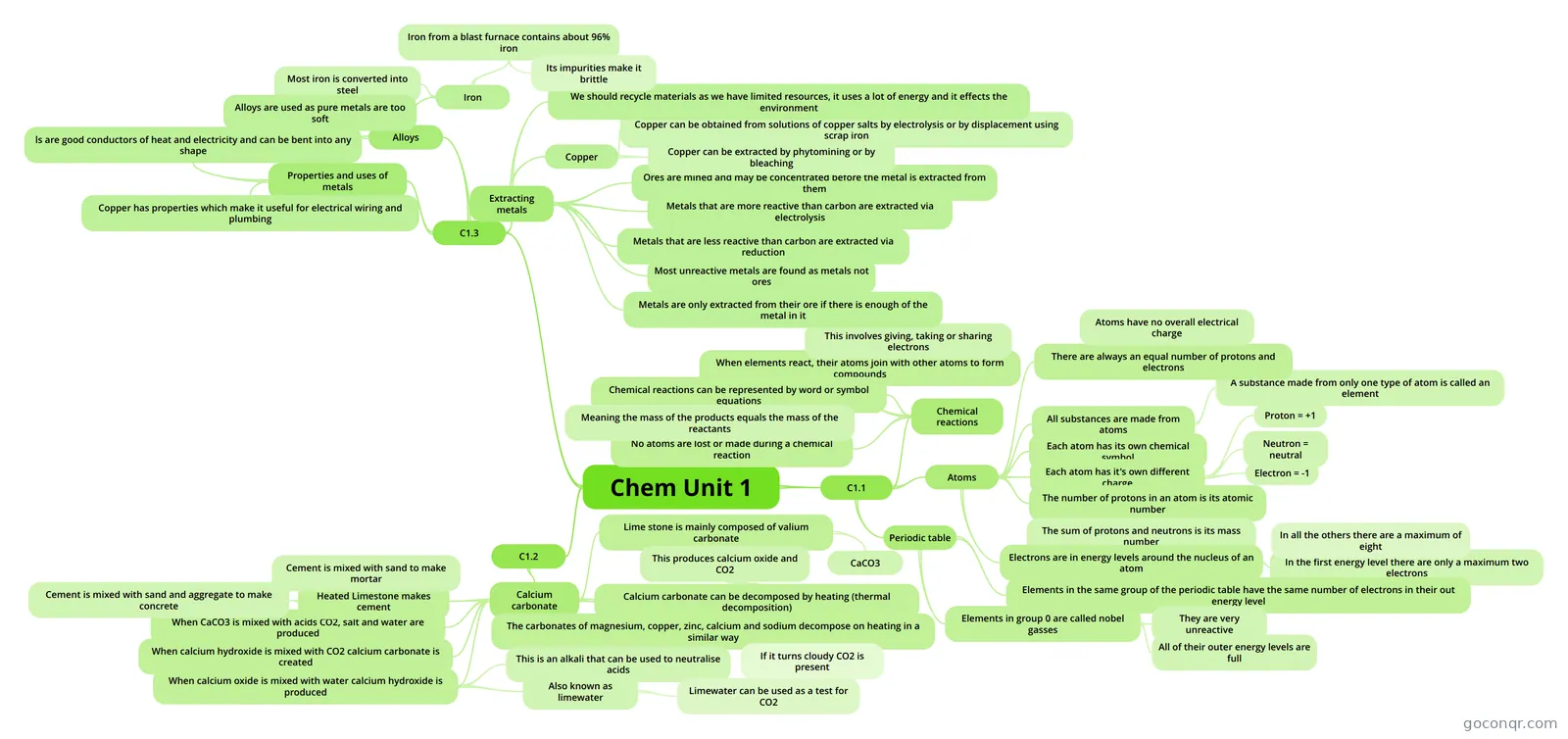
Mind map: Chem Unit 1
Contenido del mapa
Chem Unit 1
C1.1
- Atoms
- All substances are made from atoms
- A substance made from only one type of atom is called an element
- Each atom has its own chemical symbol
- Each atom has it's own different charge
- Proton = +1
- Neutron = neutral
- Electron = -1
- There are always an equal number of protons and electrons
- Atoms have no overall electrical charge
- The number of protons in an atom is its atomic number
- The sum of protons and neutrons is its mass number
- Electrons are in energy levels around the nucleus of an atom
- In the first energy level there are only a maximum two electrons
- In all the others there are a maximum of eight
- In the first energy level there are only a maximum two electrons
- All substances are made from atoms
- Periodic table
- Elements in the same group of the periodic table have the same number of electrons in their out energy level
- Elements in group 0 are called nobel gasses
- They are very unreactive
- All of their outer energy levels are full
- Chemical reactions
- When elements react, their atoms join with other atoms to form compounds
- This involves giving, taking or sharing electrons
- Chemical reactions can be represented by word or symbol equations
- No atoms are lost or made during a chemical reaction
- Meaning the mass of the products equals the mass of the reactants
- When elements react, their atoms join with other atoms to form compounds
- Atoms
C1.2
- Calcium carbonate
- Lime stone is mainly composed of valium carbonate
- CaCO3
- Calcium carbonate can be decomposed by heating (thermal decomposition)
- This produces calcium oxide and CO2
- The carbonates of magnesium, copper, zinc, calcium and sodium decompose on heating in a similar way
- When calcium oxide is mixed with water calcium hydroxide is produced
- This is an alkali that can be used to neutralise acids
- Also known as limewater
- Limewater can be used as a test for CO2
- If it turns cloudy CO2 is present
- Limewater can be used as a test for CO2
- When calcium hydroxide is mixed with CO2 calcium carbonate is created
- When CaCO3 is mixed with acids CO2, salt and water are produced
- Heated Limestone makes cement
- Cement is mixed with sand to make mortar
- Cement is mixed with sand and aggregate to make concrete
- Lime stone is mainly composed of valium carbonate
- Calcium carbonate
C1.3
- Extracting metals
- Metals are only extracted from their ore if there is enough of the metal in it
- Ores are mined and may be concentrated before the metal is extracted from them
- Most unreactive metals are found as metals not ores
- Metals that are less reactive than carbon are extracted via reduction
- Metals that are more reactive than carbon are extracted via electrolysis
- Copper
- Copper can be extracted by phytomining or by bleaching
- Copper can be obtained from solutions of copper salts by electrolysis or by displacement using scrap iron
- We should recycle materials as we have limited resources, it uses a lot of energy and it effects the environment
- Alloys
- Iron
- Iron from a blast furnace contains about 96% iron
- Its impurities make it brittle
- Most iron is converted into steel
- Iron from a blast furnace contains about 96% iron
- Alloys are used as pure metals are too soft
- Iron
- Properties and uses of metals
- ls are good conductors of heat and electricity and can be bent into any shape
- Copper has properties which make it useful for electrical wiring and plumbing
- Extracting metals
Información
- Descripción
- GCSE Chemistry Mapa Mental sobre Chem Unit 1, creado por tim199911 el 23/05/2014.
- Creado por
- tim199911
- Visitas
- 32
- Etiquetas
- Valoración