
Apuntes
Notes for 9/24/2014
Contenido del apunte (1)
Página 1
Chapter 5 - Function of Proteins
Function of Globular Proteins
Cellular structure
Transport
Storage
Recognition and/or defense
Muscle Contraction
Catalysis
Ligand Binding
Ligand - a molecule or ion that binds to a protein (Small, medium, or large)
Binds reversibly through attractive Intermoleculer Forces
Binding Site
Area on a protein to which the ligand binds
Has to be complementary to the ligand
Relatively specific
P = Protein
L = Ligand
PL = Protein Ligand Complex
P + L PL
Ka = equilibrium constant for association
Kd = equilibrium constant for dissociation
Ka = [PL]/[P][L]
Kd = [P][L]/[PL]
* Ka = 1/Kd
High Ka means ligand binds tightly
Low Ka means ligand binds weakly
* Usually Kd is reported - Small Kd means tight binding
Thermochemistry and Thermodynamics
Relationship between ΔG and K
ΔGº = -RTlnKa
ΔGº = RTlnKd
P + L PL
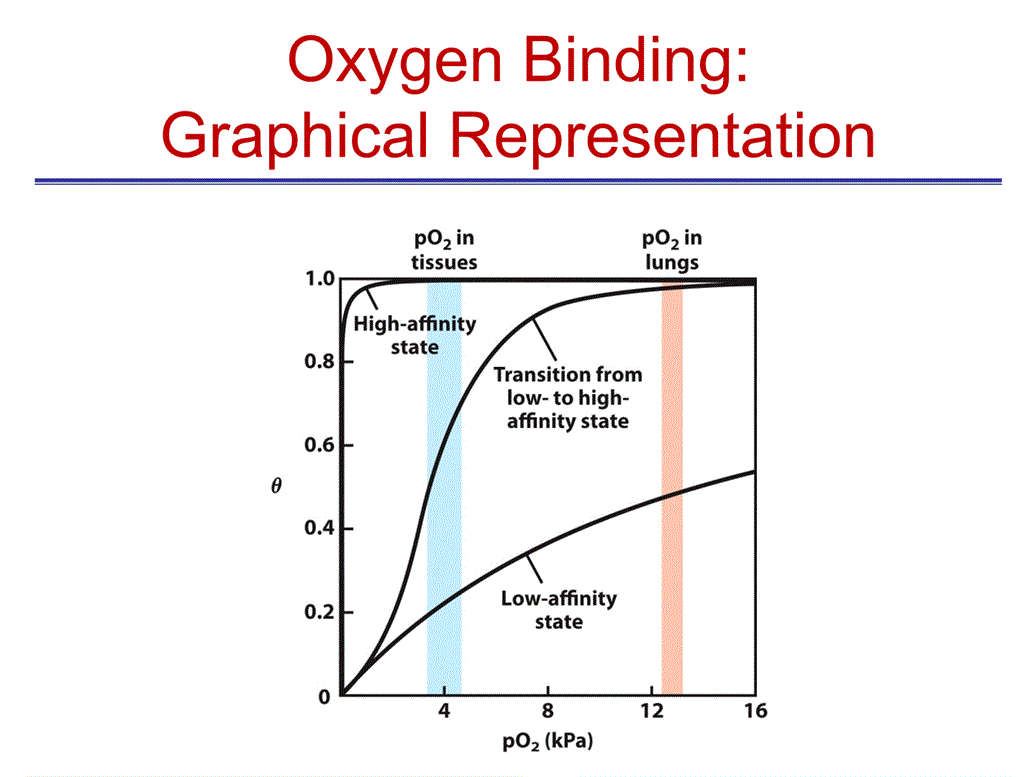
θ = Fraction of binding sites that are occupied by ligand
θ = [PL]/[P] + [L]
θ can be between 0 and 1
Kd = [L] when θ = 0.5
Ligand Binding
lock and key model
New Page