
Apuntes
3.2.1 Particles
Contenido del apunte (7)
Página 1
Constituents of the atom
The model of the atom:
proton
Mass: 1.67*10^-27kg
charge 1
electron
Mass: 9.11*10^-31 kg
charge: 1
specific charge = charge / mass
An isotope is an atom with the same number of protons but a different number of neutrons
Página 2
Stable and unstable nuclei
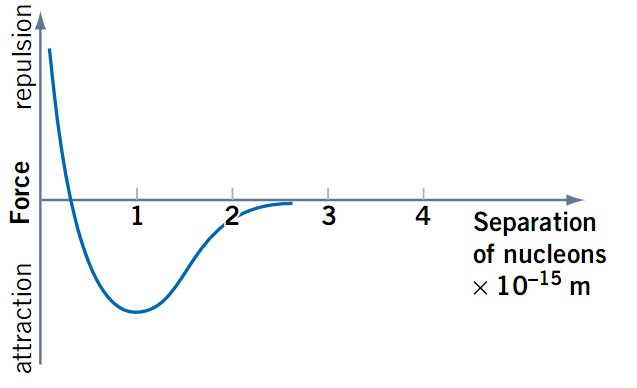
The strong nuclear force is what keeps nuclei stable.
It is repulsive at ranges less than 0.5 fm
attractive at ranges between 0.5 and 3 fm
and has a negligible effect at ranges greater than 3 fm
Which means that it holds the particles in the nucleus around 0.5 fm apart
Because protons are positively charged, they repel.
When combining the strong nuclear and electromagnetic forces we can determine if a nucleus is stable.
If there are too many neutrons in the nucleus, then they will force the protons to be further apart.
If the protons are pushed far enough apart then they will no longer be held together by the strong force, and will instead break apart
This is either:
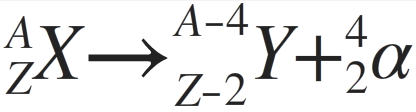
Alpha Decay
left with 2 nuclei and an alpha particle
Beta decay
left with 2 nuclei and a beta particle
it is either:


The neutrino was originally hypothesized to account for the imbalance in the energy of these equations.
Página 3
Particles, antiparticles and photons
For every type of particle, there is a corresponding antiparticle.
A particle and its antiparticle have:
The same mass
opposite charge
the same rest energy

Light can act like a particle. The particle of light is called a photon and has the equation:
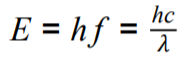
When a particle and a corresponding antiparticle meet, they are annihilated, and two photons with combined energy equal to the combined rest energy of the particles.
A single photon with enough energy can also become a particle and antiparticle.
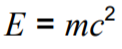
The equation for rest energy is:
Página 4
Particle interactions
there are four fundamental forces.
gravity
electromagnetic
weak nuclear
strong nuclear
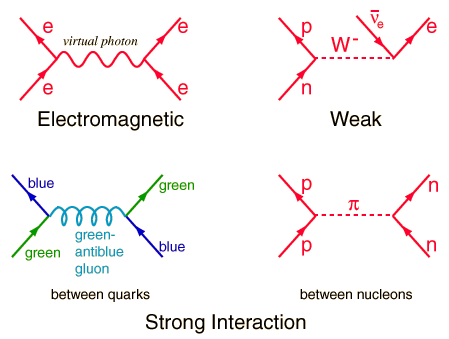
Particles interact through exchange particles.
The exchange particle for the electromagnetic force is the virtual photon
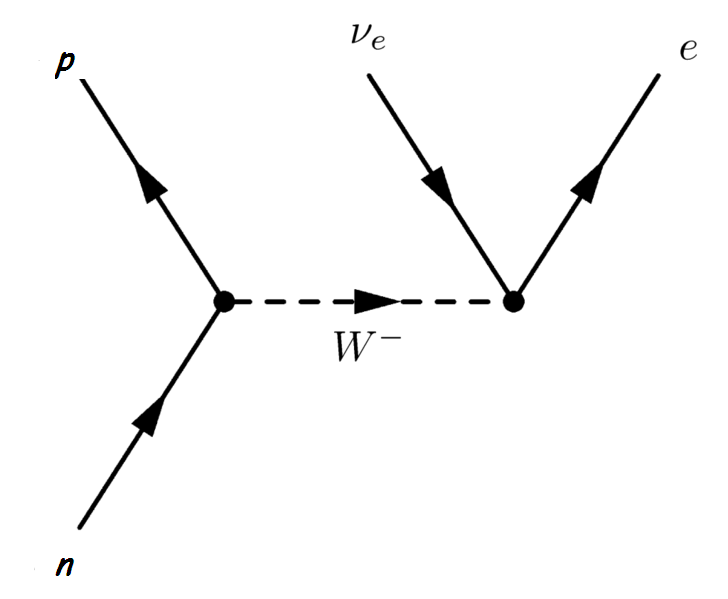
The weak interaction occurs in beta + and - decay, as well as electron-proton collision. The exchange particle is the W +/- boson
We use Feynman diagrams to represent these interactions
Página 5
Classification of particles
Hadrons
Hadrons are affected by the strong interaction
There are two types of hadrons:
Baryons
Proton
neutron
Mesons
pion
kaon
Each baryon has a baryon number of one, and antibaryons have a baryon number of -1
Baryon number is conserved in all interactions.
The proton is the only stable baryon, and all other baryons eventually decay into them.
The pion is the exchange particle for the strong interaction.
The kaon decays into the pion
Leptons
electron
muon
neutrino
Each lepton has a lepton number. +1 for leptons, and -1 for antileptons
Lepton number is conserved only in weak interactions.
Muons decay into electrons.
Strange Particles
Strange particles are produced through the strong interaction but decay through the weak interaction.
Strange number is conserved only in strong interactions and can change during weak interactions.
Página 6
Quarks and antiquarks
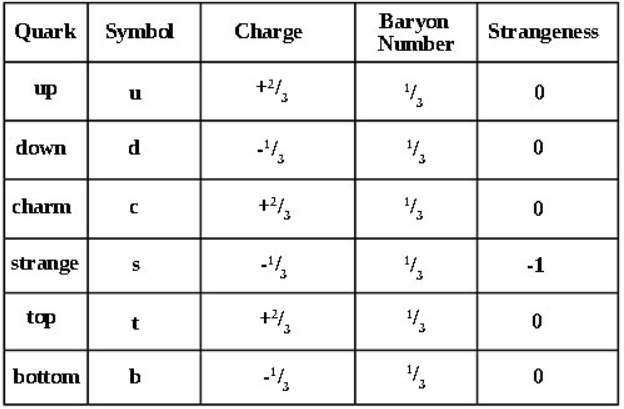
baryons are made from 3 quarks OR 3 antiquarks
leptons are made from a quark-antiquark pair
knowledge of charm, top, and bottom quarks is not needed
The decay of the neutron is:
Página 7
Applications of conservation laws
In beta+ and beta- decay, quark character can change
The conservation laws can be used to determine whether a reaction is possible or to predict the missing particles in a decay.
Energy and momentum are always conserved
Información
- Descripción
- A level (3.2 Particles and Radiation) Physics Apunte sobre 3.2.1 Particles, creado por Luke Hoskins el 09/01/2019.
- Creado por
- Luke Hoskins
- Visitas
- 2
- Valoración