
Apuntes
Delegation & Prioritization
Contenido del apunte (1)
Página 1
Guidelines for Prioritization, Delegation, and Assignment Decisions
Definitions
Prioritization
Deciding which needs or problems require immediate action and which ones could tolerate a delay in response until a later time because they are not urgent.
Delegation
Transferring to a competent individual the authority to perform a selected nursing task in a selected situation. The nurse retains the accountability for the delegation.
Assignment
The distribution of work that each staff member is responsible for during a given shift or work period.
Prioritization
Four P’s
Purpose
What is the patient’s outcome for care?
Picture
What does the patient look like now/what will his outcome or result be?
Plan
What are the patient’s priorities?
Part
Who will participated in the patient’s care/what will they be responsible for?
Criteria
Is it life threatening or potentially life threatening if the task is not done?
Would another patient be endangered if I do this now or leave this task for later?
Is this task or process essential to patient or staff safety?
Is this task or process essential to the medical or nursing plan of care?
Levels of Priority Setting
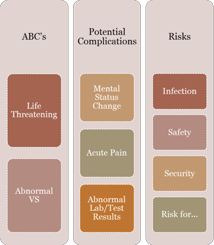
Ensure Patient/Caregiver Safety and Infection Prevention
First-Level Priority Problems
ABCs plus VS and Lab Valves concerns (high fever, hypertension, etc.)
EXCEPTION: CPR for cardiac arrest à begin compressions stat
Second-Level Priority Problems
Mental status change
Untreated medical problems requiring immediate attention
Acute pain
Acute elimination problems
Imminent risks
Third-Level Priority Problems
Health problems other than those at first two levels (health education, rest, coping
5 rights of Delegation & Assignment
Right circumstance
Rules and regulations based on area of practice
Practice Acts and BON
Nurse Practice Act
Factors to weigh in selecting task or activity
Potential for harm
Complexity of the task
Predictability/unpredictability of the outcome (rapid change in medical status)
Level of interaction/communication required with patient
Resources in equipment/personnel
Factors to weigh in selecting and delegating to specific delegate
Validation/verification of education and training
Normal assignments of the UAP
Patient conditions
Preferred patient results
Instability of patients immediately post-op or in the ICU requires more supervision
Right task
Nursing process or nursing judgment cannot not be delegated
Criteria for determining nursing activities
Knowledge and skills of the delegate
Verification of clinical competence by employer
Stability of patient’s condition
Service setting (resources), methods of communication, complexity and frequency of care, proximity and numbers of patients relative to staff
Cannot delegate: Ongoing assessment, interpretation or decision making
Right person
Licensure, certification, role description
Strengths and weaknesses
Support and lead the inexperienced
Right direction and communication
Relay instructions regarding the plan
Clear communication
Did the listener understand the communicated information?
Concise statements
Did you give the right amount of information? Not too much or too little?
Correct communication
Is information accurate & aligned with rules, regulations, & job descriptions?
Complete communication
Does the direction leave room for questions?
Right supervision and evaluation
RNs are responsible for the total care of client throughout entire shift regardless of delegation
Feedback Process
Ask for team member’s input
Give credit for accomplishments
Offer observations and concerns
Ask for ideas to resolve issues/concerns
Agree on a plan of action for the future
Prohibited Tasks for Delegation
Tasks not within the delegating/supervising nurses’ scope of practice
Nursing activities that include the use of the nursing process and require special knowledge, nursing judgment or skills
Initial assessment or any subsequent assessment
Determination of the nursing diagnosis or interpretations of nursing assessment
Establishment of the nurse care goals and development of the plan of care
Activities for which the UAP has not demonstrated competence
Evaluation of progression of plan of care
Delegation Summary
Guidelines
Can only delegate those tasks for which the nurse is responsible
Responsibility is determined
Nurse practice acts (defines scope of nursing practice)
Standards of care (established by organization)
Job description (defined by organization)
Policy statement (from organization)
REMEMBER – the RN delegates the task NOT the RESPONSIBILITY!
Staff mixes – think about the tasks that these individuals can and cannot do!
RNs
LPNs
UAPs
Support staff
Assignment – Describes the distribution of work that each staff member is to accomplish on a given shift or work period
Process
Determine nursing care required to meet patient’s needs
How complex is the patient’s required care?
What is the dynamic of patient’s status and their capability?
How complex is the assessment and ongoing evaluation?
What kind of infection control is necessary?
Are there any individual safety precautions?
Consider knowledge and abilities of staff members
Is there special technology involved in the care and who is skilled in its use?
How much supervision and oversight will be needed based on the staff's numbers and expertise?
How available are the supervising RNs?
Decide which staff person is best able to provide care
Can continuity of care be maintained?
Are there any personal reasons to allocate duties for a particular patient, or are there nurse or patient preferences that should be taken into account?
Determine assignments to increase efficiency
How will the physical location of patients affect the time and availability of care?
Is there an acuity rating system that will distribute care based upon a point or number system?
Información
- Descripción
- 1 (Exam 1) Med Surg Apunte sobre Delegation & Prioritization , creado por Brittnee Gonzalez el 02/06/2019.
- Creado por
- Brittnee Gonzalez
- Visitas
- 0
- Valoración