
Apuntes
PCR
Contenido del apunte (3)
Página 1
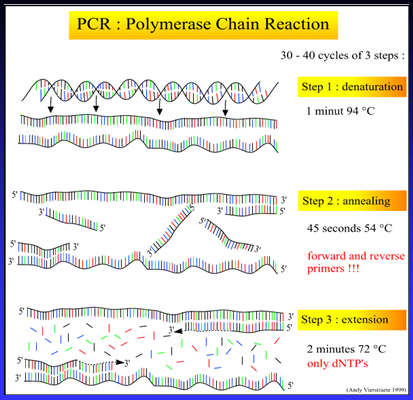
The PCR - amplify a sequence of DNA using a pair of oligonucleotide primers each complementary to one end of the DNA target sequence.
These are extended towards each other by a thermostable DNA polymerase in a reaction cycle –
Three steps:
Denaturation
Primer annealing
Polymerisation/elongation/extention
PCR is DNA replication in a test tube: PCR uses just one indispensable enzyme – heat resistant DNA polymerase – to amplify a specific fraction of the genome. High temperatures denatures DNA to single strands.
Sequence of the DNA of DNA/RNA must be known e.g. which organism are you looking for. Cannot ask for PCR without indicating the name of the organism.
Primers are 20 – 22 nucleotides long. Have a target sequence of 100 – 1000 bp (with 5000 as practical limit).
Have 10 – 12 Gs or Cs. They form 3 hydrogen bonds while As and Ts only have 2.
PCR products can be used as templates to sequence genes
Página 2
Other types of PCR
Multiplex:
More than one reaction/primers in the same tube
NB - Annealing temperature of primers must be in the same range
Detection of multiple products in one tube
Nested PCR:
2 set of primers: Larger product, Smaller product.
Second set of primers used on the first amplicon – shorter amplicon
Uses: e.g. increase sensitivity, to distinguish between species within a genus
RAPD PCR - Random amplified polymorphic DNA:
Use short random primers
Lower annealing temperature
Non-specific binding and amplification
Analysis and interpretation difficult
Microsatellites:
Use short tandem repeats 2, 3 or 4 bp – DNA fingerprinting
In situ PCR:
•PCR carried out in cells or fixed tissue on a slide - histology
Radio/fluorescence labelled PCR product use as probe to detect target
Página 3
Methods of PCR:
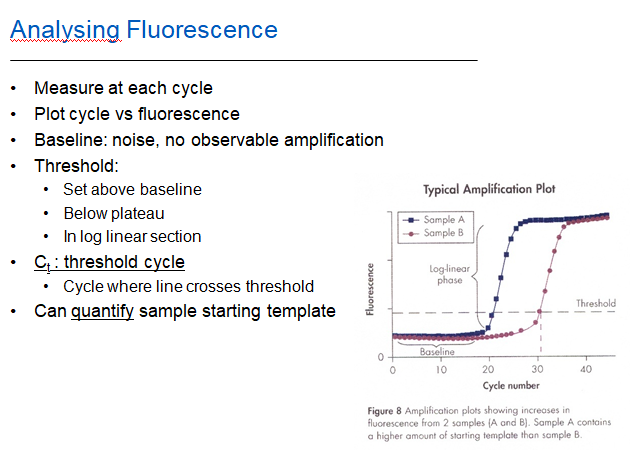
Real-time PCR (Quantitative PCR):
Detect amplification at each cycle
Monitor amplification online and in real-time
Quickly and accurately quantify results by either
Taqman Probe Principle:
Probe
Contains both fluorophore and quencher
Extension removes fluorophore
Taq DNA polymerase 5’ to 3’ exonuclease activity
Permits fluorescence
LAMP PCR:
Loop mediated isothermal amplification of DNA
Robust – ‘field PCR’
PCR done at a single temperature
Use more than 2 primers - multiple
Use intercalated dyes – measure e.g. fluorescence
Amplification in loops
Información
- Descripción
- TV1002 Apunte sobre PCR, creado por Erika Cobb el 09/09/2019.
- Creado por
- Erika Cobb
- Visitas
- 1
- Valoración