
Apuntes
The Sun- Inroduction
Contenido del apunte (1)
Página 1
The Sun - Introduction
The sun was placed into the heavens on the fourth day, by God, to provide light and heat to the Earth. Since Earth is just the right distance from the sun, we get just the right amount of heat and light.
The sun is a magnificent star! God put it just the right size and distance away from the Earth to maintain balance in the Earth of many different things. The sun provides heat energy keeping the Earth at just the right temperature for life of all sorts. It provides the energy that plants need to convert into glucose to sustain themselves and the animals. It provides the original energy for the plants to produce oxygen for people and other animals. The atmosphere and the movement of the winds that cool off the atmosphere are all powered by our sun.
Over the years many astronomers have gone blind due to studying the sun. It is thought that one of the reasons Galileo, who was the first astronomer to study this sun with a telescope, went blind was due to his constant staring at the sun.
In the late 1850s, scientists began studying the spectral lines that come from different elements. Spectral lines are the colored light that is emitted from gaseous elements being shined through spectroscopes. An example of a spectroscope is a prism. Different elements emit different spectral lines. Scientists were able to determine the composition of the sun based on the spectral lines. Scientists have discovered that the sun is made of about 92.1% Hydrogen and 7.8% Helium.
Spectral Lines
Today, scientists use the charged coupled device, or CCD, which is a type of image sensor in a digital camera, rather than film, to capture the spectra. The CCD is more sensitive to light by reacting to light with its photocells. When electrons hit the cells they collect in particular places. Depending on the amount of light the number of electrons will be collected. This enables astronomers to see the absorption spectra of the particular elements in the light from the stars. They can determine the composition of the stars from their spectra.
People that study the sun are called solar physicists. Solar physics is a specialty of astrophysics. Astrophysicists study the universe. Scientists have solved the problem of going blind by using a solar telescope. The solar telescope projects an image that it receives from the sun. Solar physicists use specialized glasses to look at the image.
In June of 2013, a satellite named IRIS (Interface Region Imaging Spectrograph) was launched by NASA. It is meant to study the part of the sun between the corona and the surface where ultraviolet originates. They want to understand how the energy moves from the surface of the sun to the lower part of the sun's atmosphere.
Properties of the Sun
The sun is a medium dwarf star. The sun is 865,000 miles (1,390,000) kilometers in diameter. Near the poles, the sun rotates in 36 days while the equator rotates on its axis once every 25.4 days. The temperature on the surface of the sun is about 5,500°C the temperature of its interior is estimated to be 15,000,000°C.
It is also 400 times larger than the moon and 400 times farther away. If the sun was an empty ball, you could put about 1 million Earths inside of it. The sun is so far away that the light coming from it takes 8.3 minutes to reach our eyes.
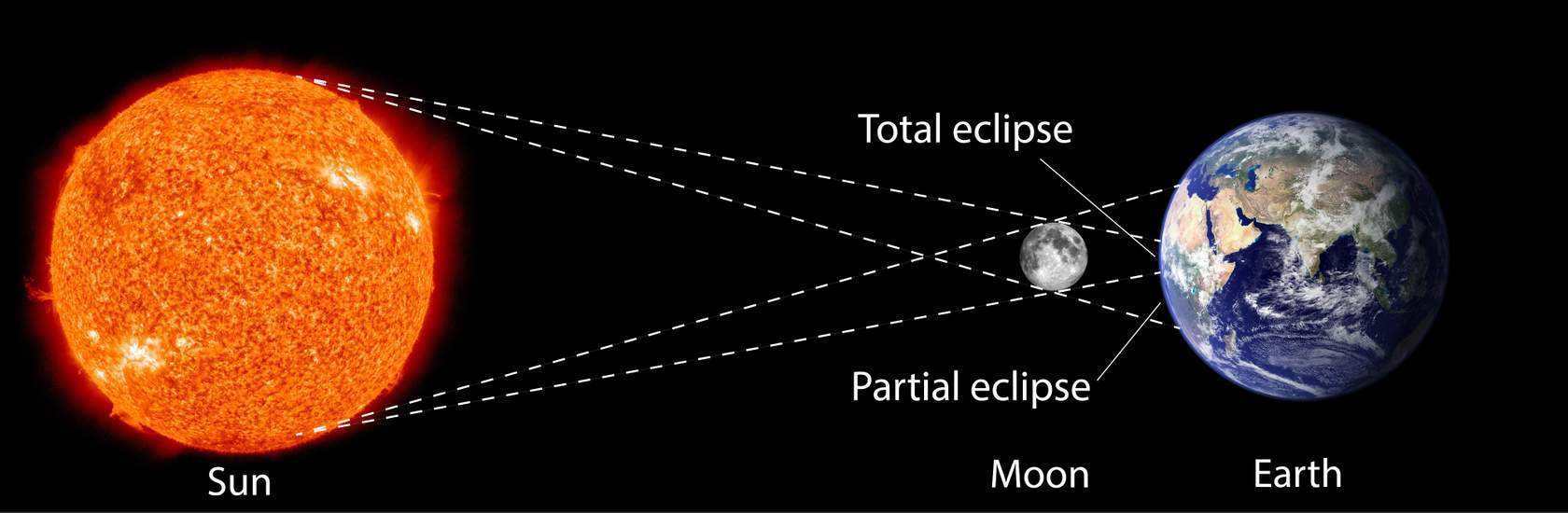
Solar eclipses occur when the shadow cast by the moon touches the Earth’s surface. When the moon is closest to the Earth, during its perigee, the shadow cast by the moon is just able to reach the Earth. The shadow is about 169 km. This shadow is the umbra. The penumbra is the secondary shadow cast by the moon.
If the moon completely blocks out the light from the sun leaving just a ring of light (the corona) around the edge, this is called a total eclipse of the sun. This is the only time scientists can see the corona.
If the moon passes in front of the sun and only partially blocks the light from the sun it is called a partial eclipse of the sun.
It is possible for the moon to block most of the sun leaving a ring of sun showing around the moon. This happens when the umbra of the moon doesn't quite hit the Earth. This is known as an annular solar eclipse. In this situation, the moon is farther away from the Earth at its apogee. The moon appears smaller to the observer on the Earth and does not completely block the sun. This occurs somewhere on the earth more often than a total eclipse.
Información
- Descripción
- 9th grade (Astronomy ) Science Apunte sobre The Sun- Inroduction, creado por Caleb Hadyka el 29/04/2021.
- Creado por
- Caleb Hadyka
- Visitas
- 0
- Valoración