
Apuntes
PLATES TECTONICS
Contenido del apunte (4)
Página 1
PLATE TECTONICS
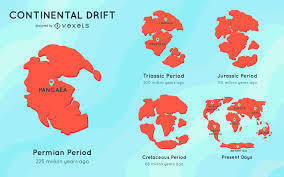
CONTINENTAL DRIFT
Alfred Wegener stated that land masses that are currently separated were joined together in the past and that continents slowly moved to their current location.
Wegener described the theory as at the end of Palaeozoic era all land was joined in a super-continent called Pangea. This broke up into various land masses which moved by sliding over the seafloor. The continents collided with the materials deposited at their margins folding them into mountain ranges. The continent moved because of the centrifugal force of the spinning of the Earth and the gravitational pull of the Sun and the Moon.
The evidences he used to justify his theory were : · Biogeography: by looking at a map you can see that the continents fit together. · Geology: mountain ranges are aligned on both sides, so they are made up of the same rocks and composition. · Palaeontology: same fossils of land species incapable of crossing oceans or sea. · Palaeoclimatology: sediments o glaciers of the same age, proves that they were all joined and close to the South pole.
However, many people were not convinced because he could not explain how the continents move.
THEORY OF PLATE TECTONICS
Is a theory that includes continental drift hypothesis and the expansion of the seafloor, and also the analyses the distribution of earthquakes and volcanoes.
In the 1960s a new theory emerged saying that the lithosphere moves over the asthenosphere. With the help of a sonar it could be seen the map of the seafloor, and it was discovered full geographic features such as continental slope, mid-ocean ridge, volcanic islands, abyssal plain, underwater volcanoes, rift, etc.
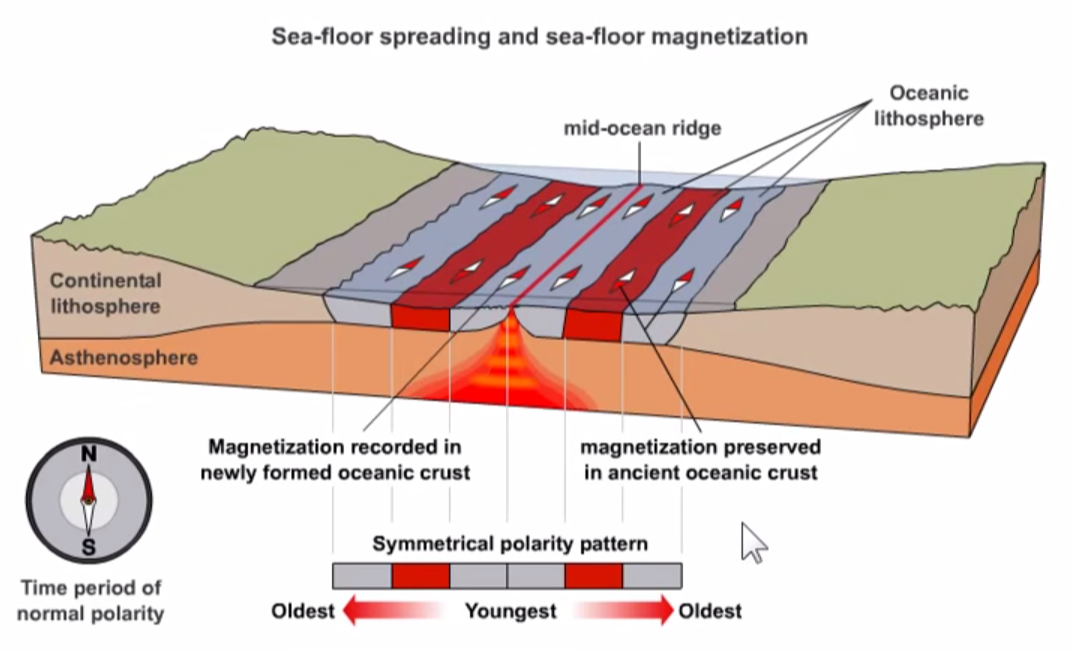
The rugged relief of the seafloor makes it impossible for continents to move across it , so the seafloor spreading hypothesis was proposed. This theory states that the seafloor rocks are younger than those of the continents as they are presented in bands with alternating magnetic polarity of their minerals, they are located symmetrically in either sides of the ridges.
The surface of the planet is a rigid layer broken up into lithosphere plates. Boundaries match the lines of instability where earthquakes and volcanoes occur.
It was accepted that the Earth's surface was in motion so the geologist look again at their interpretations of data concerning the location of volcanoes and earthquakes. They can be observed that they are located in along seismic belts. The earthquakes are close to te mid-ocean ridges demonstrated that these are exclusively shallow-focus.These reveals that destruction of the oceanic lithosphere occurs in the regions of deep focus earthquakes.
Página 2
Página 3
LITHOSPHERIC FEATURES
There are two types: The Continental Lithosphere and The Oceanic Lithosphere.
Plate boundaries
There are 3 types of lithospheric plate boundaries:
· Divergent boundaries: plate move away creating areas where magma rise up from the inside of the Earth y mean of volcanic eruptions creating new seafloor
· Convergent boundaries: the oceanic plate is moving underneath another plate, usually continental, destroying the seafloor.
· Passive boundaries: the plates move slide horizontally so margins where lithosphere is neither created nor destroyed.
CAUSES OF PLATE MOVEMENT
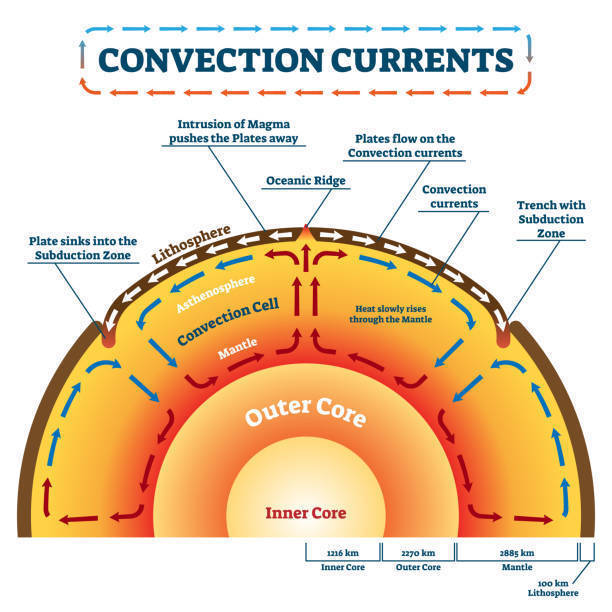
The high temperature inside the Earth are due to the residual energy from the formation of the planet and energy give off during the composition of radioactive elements. The differences in temperature between different layers of the planet causes rocks to move up and down by convection currents.
Página 4
RELIEF AS A RESULT OF LITHOSPHERIC ACTIVITY
Relief is the form of the solid surface of the Earth, which undergoes continual change because of the joint action of opposing forces. The external geological agent that modify the relief from the outside are wind, surface water, groundwater, glaciers, sea and living things.
Mountain ranges are natural elevations of the Earth's surface made of a folded and fractured rocks covering a large area. Depending on the origin they can be:
ANDES-LIKE
Formed when an oceanic plate slides below a continental plate compressing and folding the marine sediments. The friction of the subduction causes volcanoes and both shallow-focus and deep-focus earthquakes.
ALPES-LIKE
Formed when a mixed plate subducts below the margin of a continental plate. When subduction stops, the initial volcanic activity is reduced, there are only shallow-focus earthquakes.
Información
- Descripción
- 4º de ESO (GEOLOGÍA) Biología y Geología Apunte sobre PLATES TECTONICS , creado por Silvia Ballester el 23/05/2021.
- Creado por
- Silvia Ballester
- Visitas
- 0
- Valoración