
Plate Tectonics and Internal Processes
204 resources created by 175 users
This Plate Tectonics and Internal Processes page on GoConqr gathers community-made mind maps, quizzes, flashcards, notes and slide sets, from plate boundaries and convection currents to Wegener's continental drift, volcanoes and earthquakes. It's built for school students revising the topic and teachers after ready-made material. There are over 1,500 resources here, including more than 130 quizzes, over 900 mind maps and more than 400 flashcards, mostly at secondary level. Pick a resource, try a quiz to find your gaps, then make your own.
Top Plate Tectonics and Internal Processes resources
-
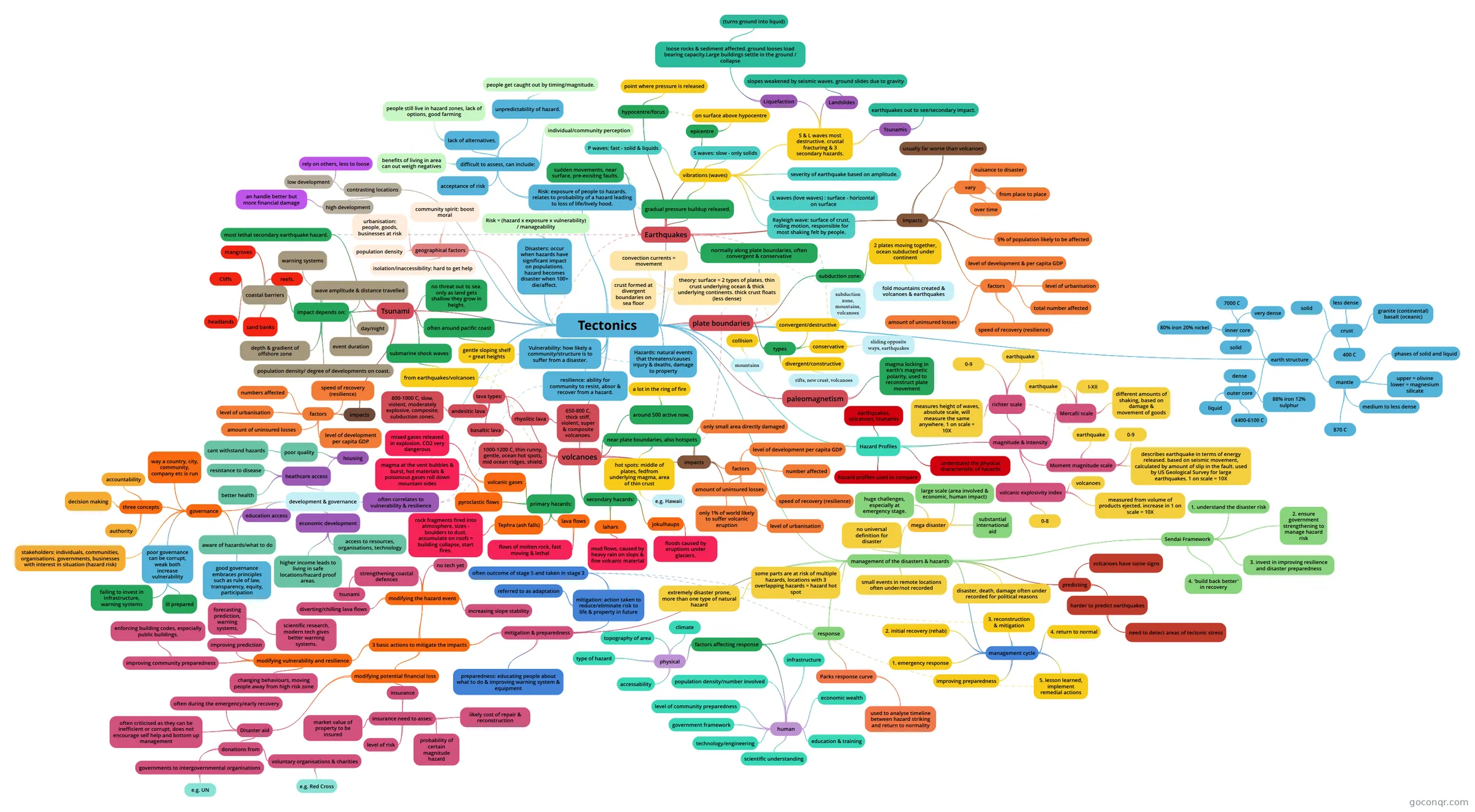 Mind map Tectonics
-
25 questionsRestless Earth Oceanic crust is denser yet thinner and mainly made up of basalt
-
14 questionsPlate Tectonics What currents are responsible for the movement of the earth's plates?
-
Mind map Plate tectonics, earthquakes and volcanoes Mind Map of Plate tectonics, earthquakes and volcanoes
-
15 questionsThe Earth Name the two categories of forces that shape the earth.
-
Mind map The structure of the Earth
-
19 cardsCycles inside the Earth How much layers does the Earth have?
-
6 questions3.- Plate tectonics: Geological features of convergent plate boundaries When 2 plates collide and one is pushed under the other, this process is called:
Quizzes
See all 33 quizzes-
25 questionsRestless Earth Oceanic crust is denser yet thinner and mainly made up of basalt
-
14 questionsPlate Tectonics What currents are responsible for the movement of the earth's plates?
-
15 questionsThe Earth Name the two categories of forces that shape the earth.
-
6 questions3.- Plate tectonics: Geological features of convergent plate boundaries When 2 plates collide and one is pushed under the other, this process is called:
-
5 questions4.- Plates moving due to convection in mantle What happens when we warm up water in a pot?
-
5 questions5.- Hawaiian islands formation How can you explain the volcanic activity of Hawaii?
-
6 questions6- Pangaea 1.- Due to the action of the mid-Atlantic rift, What continents are moving away from each other?
-
12 questionsVolcanoes and earthquakes what are the 4 layers of the earth ?
Mind maps
See all 72 mind maps-
Tectonics
-
Plate tectonics, earthquakes and volcanoes Mind Map of Plate tectonics, earthquakes and volcanoes
-
The structure of the Earth
-
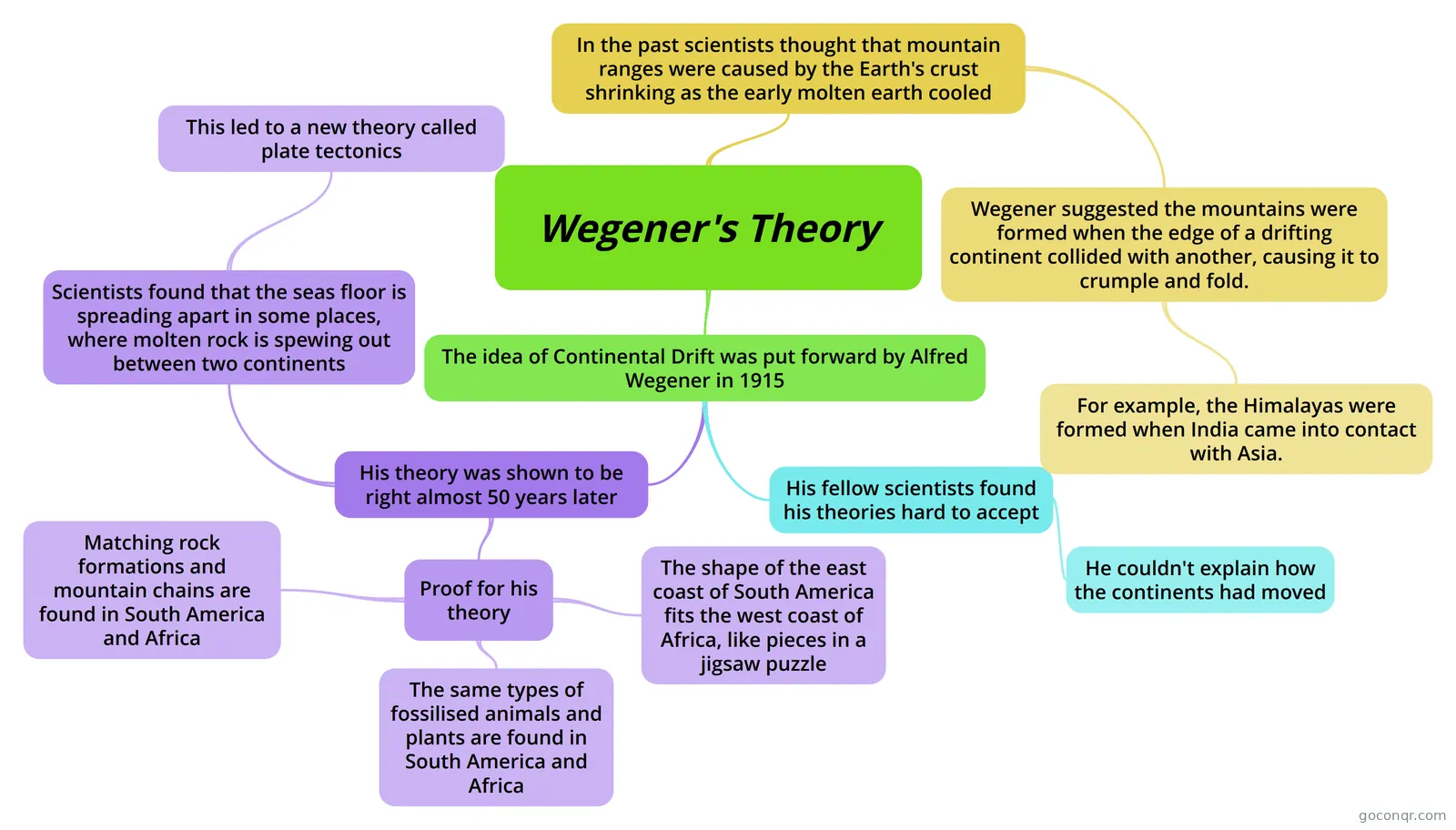 Wegener's Theory
-
Alfred Wegener's Theory of Continental Drift Run down of Alfred Wegener's theory of continental drift for P1.
-
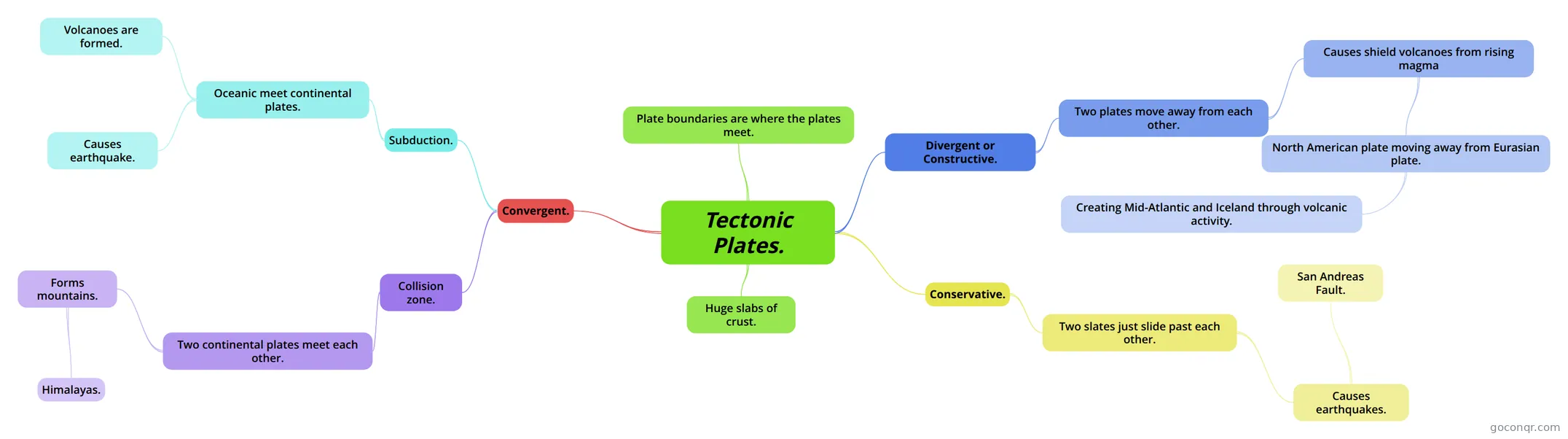 Tectonic Plates.
-
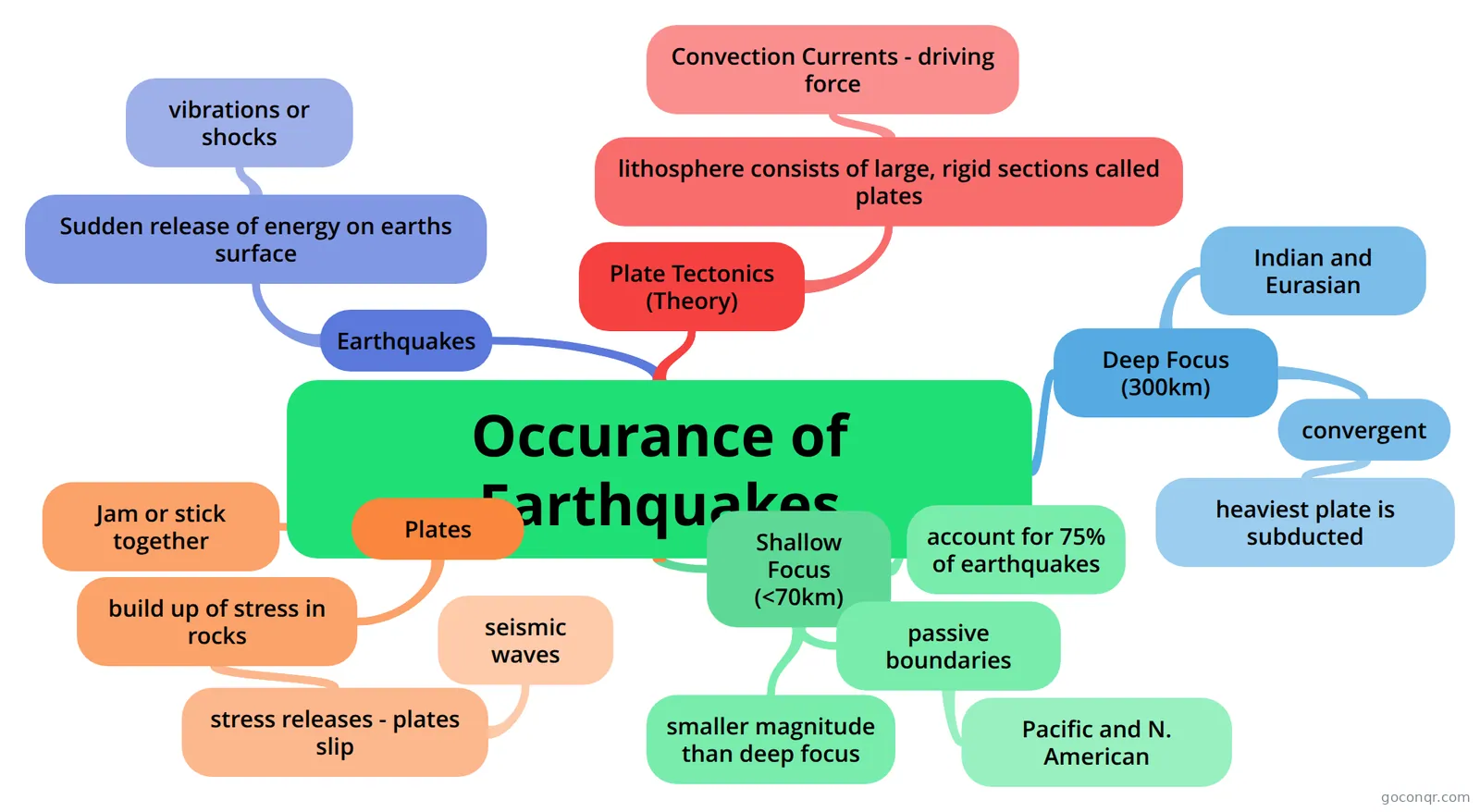 Occurance of Earthquakes
-
Plate Tectonics Learn about all types of Plate Tectonica
Flashcards
See all 77 flashcards-
19 cardsCycles inside the Earth How much layers does the Earth have?
-
7 cardsTectonic Plates Destructive plate boundaries - Volcanoes
-
26 cardsChapter 6 Science Test (7th Grade) Chapter 6 Science Test (7th Grade) by Irene Kim
-
7 cards7 Major Plates What plate is this?
-
18 cardsplate Tectonics Wegener proposed this hypothesis
-
61 cardsAQA A Geography Restless Earth The structure of the earth
-
138 cardsGeology 101 Final "Pangaea" refers to:
-
55 cardsScience Chapter 12 Recap from Provincial Workbook What is the continental drift theory?
Notes
See all 17 notes-
Plate Tectonics Plate tectonics is the study of the processes that cause the movement of the earth's plates and the landforms that result. The theory suggests that the earth's crust is broken into segments called plates. There are 7 ...
-
Processes at Plate Margins Destructive Plate Boundaries - Fold Mountains: Converging plate boundaries occur where two plates come together and collide. The effects of converging plates vary with the type of plate present, resulting in different...
-
Geography plate margins Plate Margins 3 main types of plate margins (most common) Constructive also known as divergent Conservative also known as transform Destructive also known as convergent Constructive
-
Sea Floor Spreading Sea floor spreading happens at mid-ocean ridges. Mid Ocean Ridges are mountain ranges underneath the ocean. In the middle of the ridge is a volcano. These volcanoes do not erupt the way volcanoes on ...
-
Tectonic plate boundaries Tectonic processes and activity Constructive/divergent plate margin Process 1) Two continental/oceanic plates diverge from each other (have to be the same density, hence two of the same plates are needed) which is con...
-
Plate Boundaries Oceanic-Oceanic Convergent Plate MarginThe slower or older/colder oceanic plate is carried downwards at the trench, into an area of higher temperature. The geothermal gradient increases with depth, so as the plate is ...
-
Drifting Continents Evidence for Continetal DriftA large land mass called Gondwanaland is believed to have existed about 250 Ma. This huge contintent included what are no South America, Africa, Antartica, India and Australia. As a single...
-
Geography - The Restless Earth - Earthquake in a MEDC - Japan CASE STUDY Japan Earthquake MEDC CASE STUDY Background · The earthquake happened on Friday 11th March 2011 and lasted for 5 minutes · An Earthquake warning was sent out about 1 minute before the earthquake hit. · The earthquake ...
Slides
More Geology and earth sciences topics
About Plate Tectonics and Internal Processes
GoConqr OriginalWhat this page covers
The resources here follow the Earth from the inside out. Some cover the layers and the crust, others plate boundaries, and others the hazards that follow. Many are labelled for GCSE Geography, with some mentioning A-level Geography, GCSE Science, GCSE Chemistry and NGSS.
- Structure: the flashcards in Cycles inside the Earth ask how many layers the Earth has and what they are made of.
- Boundaries: the Tectonics mind map sorts divergent, convergent and conservative margins, with subduction zones, rifts and new crust.
- History: the Wegener's Theory mind map explains why continental drift, proposed in 1915, was hard for other scientists to accept.
Where to start
Begin with the Tectonics mind map for the big picture, then read the Plate Tectonics note, which describes how the crust is broken into plates. Next, open the Tectonic Plates flashcards to learn the boundary types, including destructive and conservative margins and their diagrams.
Using quizzes and maps together
Read a map first, then test yourself. The Plate Tectonics quiz asks what drives plate movement, and the answer points to convection currents in the mantle. The Restless Earth quiz checks crust types, such as oceanic crust being denser and thinner. If you miss a question, go back to the matching map branch and read it again.
- Scan a mind map.
- Take a quiz on the same idea.
- Review the flashcards for the terms you missed.
- Return to the quiz a few days later.
Where it sits
This unit belongs to the Plate Tectonics and Internal Processes strand in Geology and earth sciences. It focuses on forces inside the Earth. The quiz called The Earth contrasts these endogenic forces with exogenic ones such as weathering, which helps you see the boundary of the topic.
Your next step
Teachers can pull slide sets such as Types of Plate Boundary into a lesson. Students can pick one quiz today and see how it goes, then adapt any map to suit their own notes.
Frequently asked questions
Which resource should I open first?
Start with the Tectonics mind map. It lays out the boundary types, from divergent and convergent to conservative, along with subduction zones, mountains, volcanoes and rifts. After that, read the Plate Tectonics note and try the Plate Tectonics quiz to check what has stuck.
What do the mind maps on this page cover?
The mind maps cover the structure of the Earth, plate boundaries, Wegener's continental drift, earthquakes and volcanoes, and tectonic hazards. There are over 900 of them, so you can compare several versions of the same topic and pick the layout that makes most sense to you.
Are the resources free to use?
Yes. Every resource listed here is free to open, study and take, with no account needed. They were made by GoConqr users rather than by GoConqr itself. Because the community built them, it is worth comparing a couple of resources on the same topic.
Which levels and exams do these suit?
Most of the material is at secondary level, so it suits school students. Listed resources mention GCSE Geography, A-level Geography, GCSE Science, GCSE Chemistry and NGSS. Teachers can also use the slide sets and notes as ready-made classroom material.
Can I test myself on specific ideas?
Yes. There are more than 130 quizzes. Some are narrow, such as the quizzes on the Hawaiian islands formation, Pangaea, and convection in the mantle. Others are broader, like the Restless Earth Quiz. Pick a narrow one when you want to target a gap.
What if I cannot find what I need?
Try another title, since many resources use names like Restless Earth, Tectonic Plates or Plate Boundaries for similar content. If nothing fits, a free account lets you save quiz scores and make your own quizzes, mind maps, flashcards and notes.