
Apuntes
Microarray - created from Mind Map
Contenido del apunte (1)
Página 1
genomics and genome sequencing<br><br><ul><li>• The enAre human genome has now been sequenced
∼this involves 3 billion (US) base pairs of DNA
• This encodes 20,000 – 25,000 protein-coding gene sequences
~60% of human genes have spliced variants (2.7 on average)
∼there are about 100,000 different polypepAdes encoded in
human genome
• The funcAons of &gt;75% of these gene sequences are currently
unknown
Genomes and Genome Sequencing
High throughput roboAcs have revoluAonised how we study
the role and interacAons of these genes efficiently</li></ul>
applications of technology and genome discovery<br><br><ul><li>Genome Discovery
High throughput genome sequencing of uncharted species of any kind
to study microbial biodiversity, ecology, and evoluAon. </li></ul>
transcriptomics<br><br><ul><li>The study of the total mRNA / ncRNA content of an
organism &amp; or its consAtuent cells and Assues
simultaneously </li><li>This technology has improved/accelerated research in
medical, biotechnology, biosecurity, horAculture,
agriculture, aquaculture etc over the last 2 decades.</li></ul>
principle of microarray-labelled cDNA<br><br><ul><li>making cDNA flueorescent we design a prode, add flourescently labelled cDNA, hybirdise, laser excite and then detect </li></ul>
printing a typical array
Cahllenge
what can be compared?<br><br><ul><li>• Cancer research: Tumour / normal
• Complex diseases: Disease / non-diseased
• Time sequence
• Cell division
• Development
• Different Assues/bio-specimen
• Biodiversity / biosecurity
• Microbial species/ environmental samples
• Agricultural genomes
• Vine varietals
• Yeast species in beer </li></ul>
avaliable technologies
Case Study 1<br><br><ul><li>1. Cardiac hypertrophy can lead to heart failure.
2. Growth of heart can be:
i) physiological eg postnatal, chronic exercise
ii) pathological eg pressure/volume overload, myocardial
infarcAon (MI).
3. Pathological condiAon is associated with fibrosis and cardiac
dysfuncAon (increased morbidity and mortality) </li></ul>
technology
human genome
microarrays in studying canditate genes in disease/biological problems<br><br><ul><li>Candidate genes (genome scans, SNP chips)
∼possible disease-causing genes are idenAfied.
∼pedigree collected with linkage analysis </li><li>• PopulaAon studies (case-control, genome scans, SNP chips )
∼predisposiAon and severity of a disease, confounding factors
eg lifestyle, environmental factors. </li><li>• FuncAonal models (toxicology &amp; physiology, usually animals)
∼observaAon of phenotype vs treatment extrapolated to human
diseases. </li><li>• Gene expression (in situ hybridisaAon, microarray &amp; qRT-PCR)
∼quanAficaAon of mRNA, ncRNA copies </li><li>• Post-Genomics era:
∼Proteomics, pharmacogenomics, metablonomics, personalised
medicine, everything ‘omics’ </li></ul>
candidate genes
population studies
functional models
gene expression
microarrays
gene for which association with syndrome X reported
reversibility
DNA hybridisation<br><br><ul><li>DNA hybridization generally refers to a molecular biology technique that measures the degree of genetic similarity between pools of DNA sequences. It is usually used to determine the genetic distance between two organisms.</li></ul>
treatment<br><br><ul><li>labelled red to represent treatment</li></ul>
control<br><br><ul><li>labelled green </li></ul>
quantification according to fluorescence<br><br><ul><li>if more treatment quantified, red output, if more control wuantifies, green output, uf equal, yellow spot </li><li>each dot has DNA from a different gene and is ~11 microns </li></ul>
quantifying copies<br><br><ul><li>nrighter flourescence = high amount of mRNA no fluro = no mRNA </li></ul>
1st gen spotted array
what is printed on an array<br><br><ul><li>• SyntheAc short DNAs “oligonucleoAdes”
– (Greek “oligo, a few)
• PCR copies of DNAs
• Customised/designer oligonucleoAdes
• Anything that can hybridise…
• Other types of microarrays: protein, Assue etc</li></ul>
oli
oligonucleotides
PCR copies of DNAs
designer oligonucleotides
anything that can hybirdise
other types of microarrays
spot genes with changed expression
computational challenges<br><br><ul><li>Raw data files:
1. Spoxed array text file is ~30,000 kb excl image file ~30,000kb
2. Affymetrix array dx file is ~1Gb incl chip file
3. Agilent array text file is ~750Mb
• ComputaAonal power to compress data for analyses.
• StaAsAcs: mulAple comparison and modelling will require more
substanAal power.
* New sequencing technology – to sequence the whole genome
- Illumina Hiseq, Hiseq X Ten, MiSeq, NextSeq
- PacBio RS, NanoPore, Ion Torrent
- Roche 454 deep sequencing (whole genome sequencing)
eg Sequencing 20 million bases per 5 hour run
Terabytes of data (1000Gb) </li></ul>
moores law<br><br><ul><li>number of transistors on a chip will double every 18 months</li></ul>
SNPs
cHG
promoter
exon/splice variants
microRNA/IncRNAs
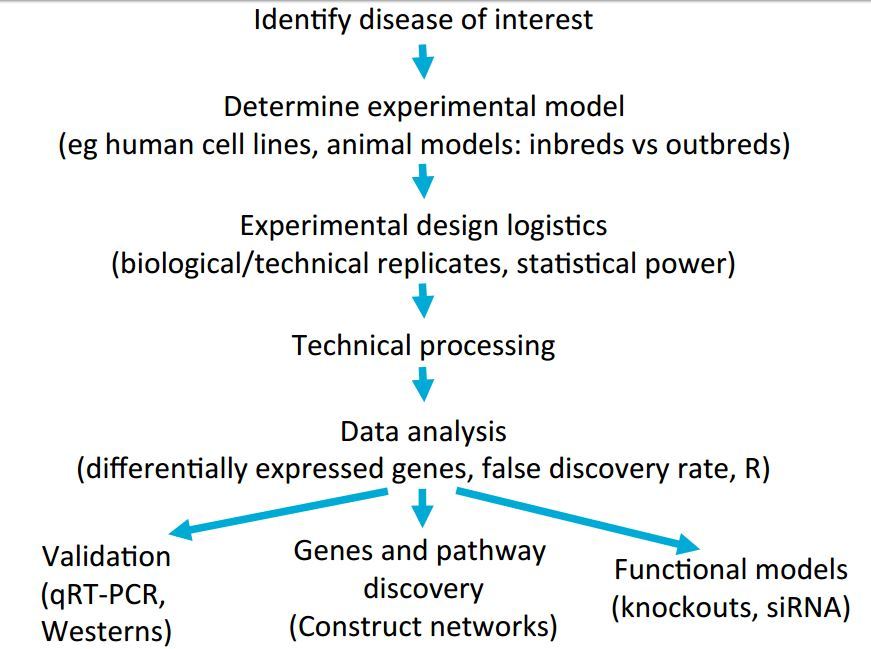
strategies for transcriptome based experiment
cardiac hypertrophy
shortening phenotype and gene function
validation of miR-34a expression
PI3K p110α<br><br><ul><li>PI3K p110α allows the heart to enlarge in response to
physiological sAmuli while maintaining normal or
enhanced funcAon</li><li>PI3K regulates cardiac
fibrosis - dnPI3K showed
increased fibrosis. </li><li>Gene expression of a
number of extracellular
matrix- and fibrosisrelated
genes were
upregulated in dnPI3Ks. </li></ul>
6 mouse model<br><br><ul><li>Transgenic mice with consAtuAvely acAve
(ca) PI3K mutant have 6.5 fold increase in
PI3K acAvity and 20% heart weight/body
weight raAo
§ Tg with dominant negaAve (dn) PI3K
mutant: 77% decreased PI3K acAvity and
HW/BW raAo is reduced by ~20%
§ Myocardial infarcAon (MI) performed at 4
months of age – occlusion of lec anterior
descending coronary artery.
§ Sham operaAon involved open chest
surgery. </li></ul>
dosage scheme for LNA-antimiR
presence of caP13K<br><br><ul><li>caPI3K-consAtuAvely acAve ↑ PI3K acAvity
dnPI3K-dominant negaAve ↓ PI3K acAvity </li><li>Presence of caPI3K rescues cardiac funcAon in the myocardial infarcAon (MI) seÄng. </li></ul>
regulating microRNA
hierarchal clustering showing distinct expression<br><br><ul><li>Gene signature reflected disAnct
cardiac stress in the 6 mouse
models assayed.
Significant &amp; InteresAng Enriched
GO terms:
§ Mitochondrial inner membrane
§ Oxidoreductase acAvity
§ Lipid metabolic processes
§ Electron transport
§ Collagen </li></ul>
delivery
technical considerations
advantages
disadvantages
Información
- Descripción
- final Molecular Biology 2 Apunte sobre Microarray - created from Mind Map, creado por Madelene Smith el 17/06/2016.
- Creado por
- Madelene Smith · jun 2016
- Actualizado
- 18 jun 2016
- Visitas
- 4
- Historial
-
- Creado por Madelene Smith · 17 jun 2016
- Copiado a Apunte por Madelene Smith · 17 jun 2016
- Valoración