
Apuntes
3. Energy
Contenido del apunte (3)
Página 1
3. Moving vehicles have kinetic energy and energy transformations are an important aspect in understanding motion
Energy and Work
Energy is the ability to do work
Work is the transfer of energy, often caused by the action of a force
Both energy and work are scalar quantities - magnitude, but no direction
They are both measured in joules (J)
1 joule in the energy required to give a mass of 1 kg an acceleration of 1m/s^2 for a distance of 1 m
Forms of energy include: kinetic (energy associated with the motion of a body) , potential (energy possessed by an body due to its position or configuration), heat (thermal), light (electromagnetic), sound, chemical potential, electrical and nuclear
When energy is converted from one form to another, a little energy is usually 'lost' as it is converted into non-useful forms, usually heat or sound
Efficiency is a measure of the percentage of energy converted into useful forms
3.3 - The Law of Conservation of Energy
Define the law of conservation of energy
The law of conservation of energy states that energy cannot be created or destroyed; it can only be transformed or transmitted
A falling apple begins with gravitational potential energy, which gradually decreases and is transformed into kinetic energy. Overall, the apple has not gained or lost any energy, but has been transformed from gravitational potential energy to kinetic energy
The generation of electricity using hydropower begins with gravitational potential energy, which is gradually converted into kinetic energy as the water falls onto the turbine of the generator. The generator then converts the kinetic energy into electrical energy
When fireworks explode, chemical potential energy is converted into kinetic, heat, sound and light energy
Página 2
3.1 - Work
Identify that a moving object possesses kinetic energy and that work done on that object can increase that energy
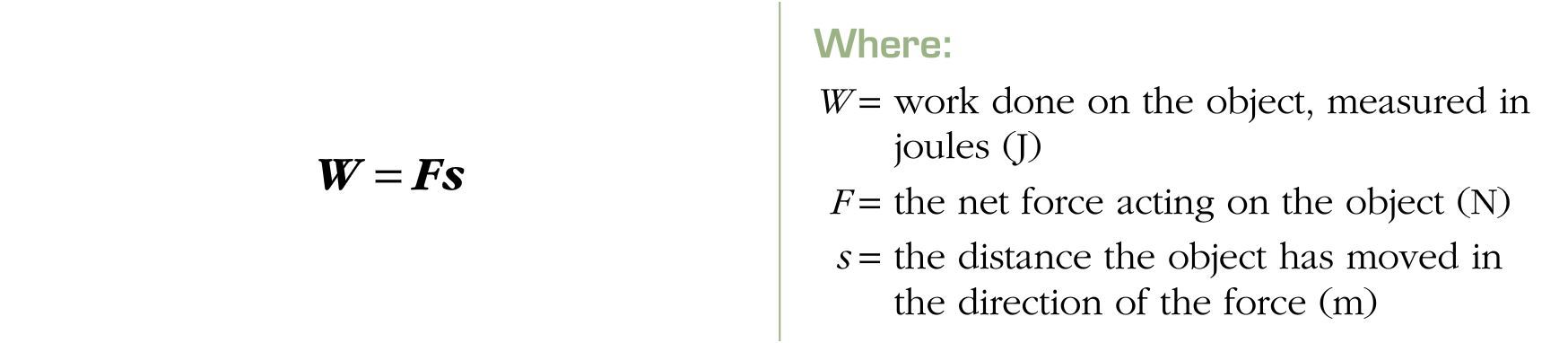
Mechanical work is the product of the net force of an object and the distance the object moves in the direction of the applied force
The force acting on the object and the distance moved must be in the same direction
3.1P - Kinetic Energy
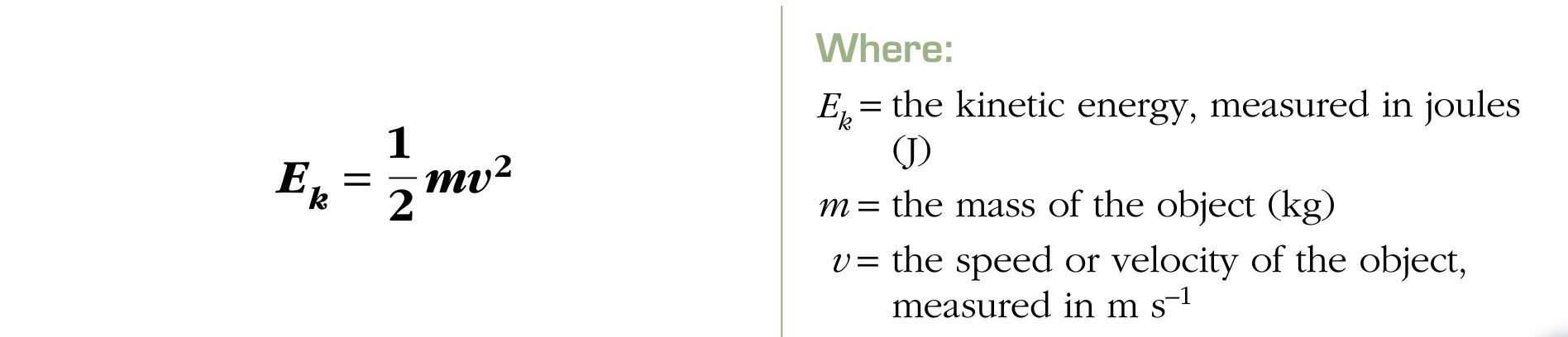
Solve problems and analyse information to determine the kinetic energy of a vehicle and the work done using the formulae: E=mv^2/2 and W=Fs
Kinetic energy is the form of energy associated with the motion of a body, and is a scalar quantity
The amount of energy a body possesses is directly proportional to the mass of the object and the square of the speed of the object
An increase of speed in an object will dramatically increase its kinetic energy
Página 3
Gravitational Potential Energy
This is the energy possessed by a body due to its position above a surface
This can be calculated by using GPE = mgh, where GPE is the gravitational potential energy in joules, m is the mass of the body in kg, g is the acceleration due to gravity in m/s^2 (usually 9.8) and h is the height above the surface in m.
3.2 - Collisions
Describe the energy transformations that occur in collisions
A collision is a mechanical interaction between two or more objects that results in an exchange of energy
It can be direct, involving physical contact, or indirect, where the transfer of energy occurs via the action of fields
Elastic collisions are collisions that conserve the total kinetic energy of the system, ie, the total kinetic energy of the objects involved in the collision is the same after the collision as it was before - it conserves total kinetic energy
However, a perfect elastic collision is rare due to the rarity of 100% efficient energy transfers, as a little energy is usually 'lost' as it is converted to non-useful forms of energy, usually sound or heat
One example of perfect elastic collision is the collision between gas molecules
Inelastic collisions are collisions during which the total kinetic energy of the system is not conserved - some kinetic energy is lost and is converted into other forms of energy
A car smashing into a pole is an example of an inelastic collision - the car begins with a large amount of kinetic energy, which no longer exists when the car stops. The total kinetic energy is not conserved, but converted into other forms of energy such as sound and the deformity of the car
3.2P - Vehicle Collisions
Analyse information to trace the energy transfers and transformation in collisions leading to irreversible distortions
Due to the law of conservation of energy, the missing kinetic energy during an inelastic collision must be accounted for
In traffic collisions, this means that the kinetic energy will be converted into sound, heat and damage to the vehicle
The damage results in the disfiguration of the vehicles involved, and even the injury to people in the vehicle
The more inelastic the collision, the fore kinetic energy is converted and more damage will result
Información
- Descripción
- Year 12 (2. Moving About) Physics Apunte sobre 3. Energy, creado por Phillip Kristyono el 02/05/2017.
- Creado por
- Phillip Kristyono
- Visitas
- 0
- Valoración