
Apuntes
Chemistry Regents - Bonding Theories and Polar Bonds Notes
Contenido del apunte (1)
Página 1
Molecular Orbit
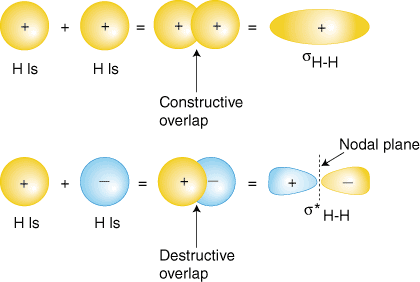
When two atoms combine, this model assumes that their atomic orbitals
overlap to produce molecular orbitals,
or orbitals that apply to the entire molecule
Just as an atomic orbital belongs to a
particular atom, a molecular orbital belongs to a molecule as a whole
A
molecular orbital that can be occupied by two electrons of a covalent bond is
called a bonding orbital.
VSEPR Theory
The
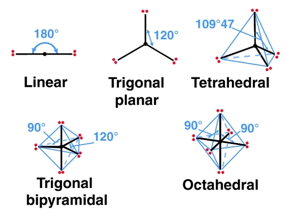
valence-shell electron-pair repulsion theory, or VSEPR theory, explains the three-dimensional shape of molecules.
According
to VSEPR theory, the repulsion between electron pairs causes molecular shapes
to adjust so that the valence-electron pairs stay as far apart as possible.
Molecular shapes:
Polar Bonds and Molecules
Bond Polarity
When the atoms in the bond pull equally, the
bonding electrons are shared equally, and the bond is a nonpolar covalent bond
A polar
covalent bond, know also as a polar
bond, is a covalent bond between atoms in which the electrons are shared
unequally
The more
electronegative atom attracts electrons more strongly and gains a slightly
negative charge. The less
electronegative atom has a slightly positive charge
0.0-0.4 --> nonpolar covalent
0.4-1.7 --> polar covalent
1.7 – 4 --> ionic
Polar Molecules
In a polar
molecule, one end of the molecule is slightly negative and the other end is
slightly positive
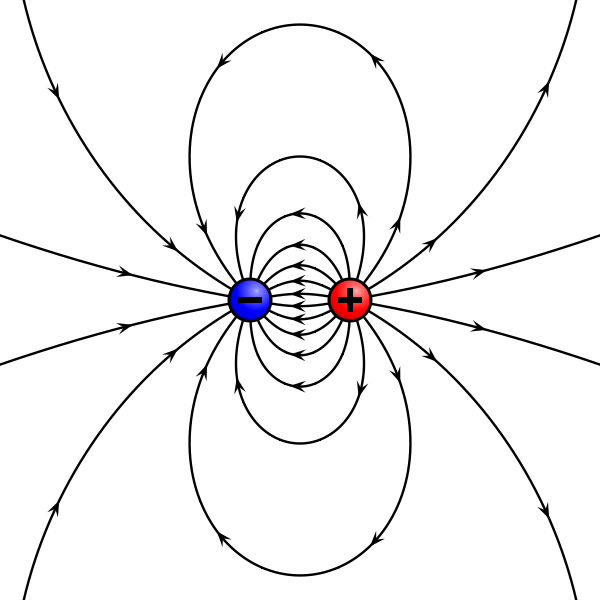
A molecule that has two poles is called a
dipolar molecule, or dipole
When
polar molecules are placed between oppositely charged plates, they tend to
become oriented with respect to the positive and negative plates
Attractions Between Molecules
Intermolecular
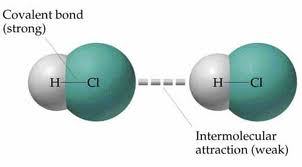
attractions are weaker than either ionic or covalent bonds
The two weakest attractions between molecules
are collectively called van der Waals
forces
Van der Waals forces consist of dipole
interactions and dispersion forces
Dipole
interactions occur when polar molecules are attracted to one another
Dispersion
forces - the weakest of all molecular interactions, are caused by the motion
of electrons
Hydrogen
bonds are attractive forces in which a hydrogen covalently bonded to a very
electronegative atom is also weakly bonded to an unshared electron pair of
another electronegative atom
Intermolecular Attractions and Molecular Properties
A solid in which all of the atoms are covalently
bonded to each other is called a network
solid.
Melting a
network solid would require breaking covalent bonds throughout the solid
Bonding Theories
Información
- Descripción
- Bonding Theories and Polar Bonds Notes for the Chemistry Regents
- Creado por
- Ali Kane
- Visitas
- 2.589
- Etiquetas
- Valoración