
Apuntes
Individual Differences lecture 1
Contenido del apunte (10)
Página 1
What is Individual Differences Psychology?
In what ways are we different from each other?
How much are we different from each other?
Why are we different from each other?
What are the consequences of being different from each other?
How are we constrained, and how much, by our biological predispositions (e.g. being liberal politically)
Ind diffs means Human IDs
Though animal research helps explain human IDs
3 types of IDs: personality, Ability, beliefs
personality and traits
Abilities
beliefs and attitudes
There is typically some stability in people in all these three domains
e.g
some who is
anxious, forgiving, sociable, affectionate
very intelligent, with excellent spatial memory
liberal, suspicious of authority
will probably show this over an extended period of many years
Página 2
ID: genetic variation and behaviour
Genetic variation in the vasopressin receptor 1a gene (AVPR1A) associates with pair-bonding behaviour in humans (Wallum et al, 2008)
Basically if both your copies of this gene are a particular varient allele... your marriage is of poorer quality
why? How might we go about trying to understand romantic and parental love?
The neural correlates of maternal and romantic love (Bartels and Zeki, 2004)
fMRI studies in humans 'recently fallen in love'
neuroimaging subtraction technique:
Task activation pattern minus control pattern= 'core' activation specifically relating to task
To restate the premise:
Looking at my romantic partner: associated cognitions and feelings
minus
looking at another's romantic partner :associated cognition and feelings
=
core brain activations underlying romantic love
Bartels and Zeki (2004) Neuroimage 21(3): 1155-66
"both types of attachment activated regions specific to each, as well as overlapping regions in the brain's reward system that coincide with areas rich in oxytocin and vasopressin receptors"
'ok that is a bit reductionist, but its at least based on humans in love, and human mothers, why bother looking at animals?'
“Both types of attachment [ie maternal and romantic love] activated regions specific to each, as well as overlapping regions in the brain's reward system that coincide with areas rich in oxytocin and vasopressin receptors.” Bartels and Zeki (2004): abstract
Ok, but how do we know so much about brain's reward system and areas rich in oxytocin and vasopressin receptors?
Mainly from animal work!! E.g. Bartels and Zeki cite a key review by Insel and Young in Nature Neuroscience Reviews in 2001.
Let’s look at work of Young and others…
Página 3
Animal Models: monogamous prairie vole
these voles form a life long pair bond.. after one mating/cohabitation episode
links betw. pair bonding and biparental care? yes but not always
Links between pair bonding and biparental care
is it necessary? there are many successful mammalian species without biparental care.
But what if you wanted to make a species evolve…
whose brain was so complicated and capable of such intelligence and adaptability that it takes an individual
c.13 years to become fairly independent, and c.20 years to fully mature
Imagine the resources and time that would need to be devoted to the young of such a species!
Male and female team up as economic unit?
Prairie voles show a monogamous social structure in nature. their close related meadow voles are solitary and polygamous
<5% of mammals are monogamous. This structure typically implies:
a) lasting pair bonds between adult males
b) both males and female care for offspring
Oxytocin (OT) and vasopressin (VP) as prosocial neuropeptides
involved in pair bonding and parental behaviour
in both sexes, but rough but useful generalisation:
OT more important in females
VP more important in males
OT and VP work in part with reward systems in forebrain regions such as the ventral pallidum, caudate, putamen, and nucleus accumbens
OT summary
Oxytocin can be summarised as ‘prosocial’, promoting
Maternal and paternal behaviour
Attachment in young
Social recognition
Sexual behaviour
Pair bonding and social bonding (i.e. adult affiliation)
Empathy and Theory of mind (humans)
Interpersonal warmth & Trust (humans)
Reduces anxiety (cautious social distance?)
[Read about links between the evolution of maternal behaviour and adult sexual behaviour.]
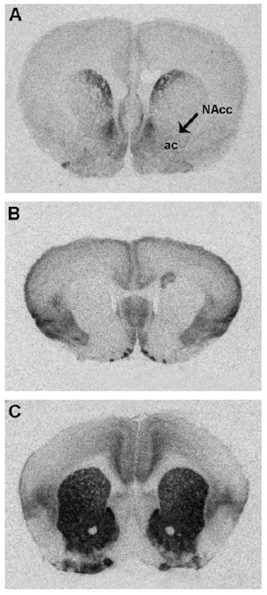
Oxytocin promotes adult pair bonding: oxytocin receptor density is increased in monogamous vole
OT receptor density in nucleus accumbens (Nacc) and Caudate and Putamen and prefrontal cortex is clearly much higher (black staining) in the prairie vole compared to rat and mouse (which are not monogamous
A= rat
B= mouse
C= prairie vole
Thus more OT receptors may predispose to pair bonding? better comparison?
Página 4
What if you blocked OT receptors?
Partner preference test
Cohabitation period - Bring together a male and female vole together for a fixed cohabitation period (c. 18-24 hours.) Observe. They may mate (check for mating.) Subject may be male or female. Partner and stranger = opposite sex.
Typically female in oxytocin studies, male in vasopressin studies
Test period - Then observe interactions over a test period (e.g. 3 hours) Ask eg. How much time do these sexual partners spend side-by-side? Then compare to ‘stranger’ vole who has not mated with subject.
Observations should be scored blind to experimental group
Página 5
OT and VP in mating behaviour
Oxytocin is released during: e.g.
Prairie vole mating
In rats & sheep during vaginocervical stimulation
In human sexual behaviour (not much studied)
Some evidence in ♀ for positive relationship between:
subjectivity intensity of orgasm &
oxytocin release
OT and VP release peak at different times
Página 6
pair bonding in voles its not just OT
Vasopressin is also involved (especially important in males♂)
And oxytocin interacts with other neurotransmitter systems and brain regions, e.g.
Dopamine and Opioids in ventral forebrain
Try to consider in your reading the idea of the relationship between attachment and reward
Página 7
VP in males
Enhanced partner preference in a promiscuous species by manipulating the expression of a single gene. Lim et al, 2004
the species: the meadow vole
the gene: VP v1a receptor
Use huddling together as an index of partner affiliation
Normally, meadow voles don’t huddle much...
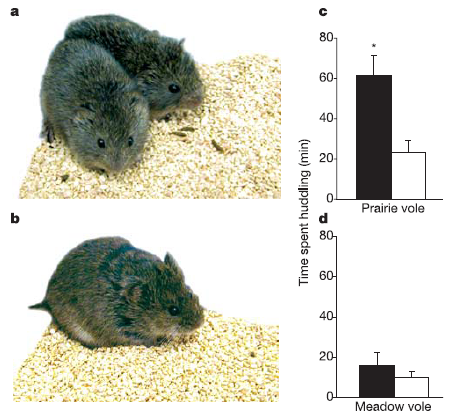
Figure 1 Comparison of behaviour in prairie and meadow voles.
A, B) Although prairie voles and meadow voles are similar in physical appearance, prairie voles are highly affiliative as depicted here in ‘huddling’ side by side (a), whereas meadow voles are solitary (b).
C, D) Partner preference test.
After mating and cohabitating with a female, a male prairie vole tended to spend significantly more time in contact with the partner (filled columns) than the stranger (open columns) (P , 0.05, Student’s t-test) (c), whereas meadow voles do not form partner preferences and spent relatively little time huddling with either female (d).
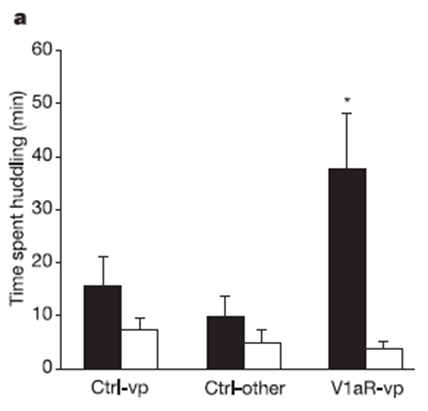
Ctrl-vp: increased control gene injected into ventral pallidum
ctrl-other: increased vasopressin V1aR gene injected into 'wrong areas'
V1aR-vp increased vasopressin V1aR gene injected into ventral pallidum
Página 8
Let's turn to humans and marriage
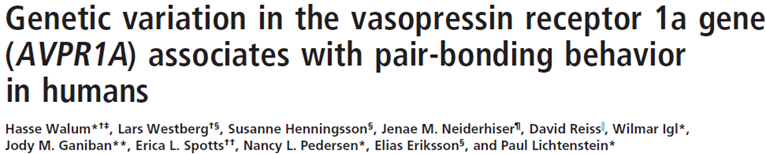
This is the same gene that Larry Young’s group
overexpressed in meadow vole males…
and made meadow voles more ‘monogamous’
So what happens in humans if you have different versions of this vasopressin receptor 1a gene?
Might this influence human romantic partnerships?
[Not this lecture but:
AVPR1A variation has also been associated with autism spectrum disorders]
Partner Bonding scale’ questionnaire [next slide]
Consisting of 13 items overall, drawn from
Dyadic adjustment scale (DAS) (7 items)
Support Seeking and Giving (SSG) assessment (5 items)
Marital instability scale (MIS) (1 item)
Serious Marital Threat question
Has subject experienced marital crisis or threat of divorce during the last year? (from a Life Events questionnaire)
Marital status
Married or cohabiting? (all couples had to have been together for 5 years)
What does your female ♀ partner think?
Various questions from Dyadic adjustment scale
(Affection, consensus, cohesion, satisfaction)
Women in relationships with men who have 1 or 2 ‘334’ alleles say that their relationship is of lower quality
Than those women with men who have ZERO ‘334’ alleles
Effect size modest, with affection being most affected by the 334 allele
(Cohen’s d = 0.20).
Results Summary:
If you are a male ♂ with one or two copies of the risk allele:
You are less likely to get married
(an objective fact)
You are more likely to experience a serious threat to your relationship
(your self-report)
You show a less-bonded pattern of relationship with your partner
(your self-report)
Your female partner reports less quality in the relationship
Particularly regarding affection
Finally, no significant effects for female polymorphisms of the AVPR1a gene
Some interpretation:
Differences in romantic partnership behaviour may owe in part to genes relating to vasopressin (this just one gene)
Animal models’ usefulness: Striking conservation of gene function, promotes pair bonding, particularly the male of the pair
While the effect sizes seem relatively modest bear in mind:
i) This was a study of couples together for at least 5 years. Perhaps many men with 334 allele aren’t typically in a relationship, or only in short ones. Thus the present study may underestimate the way in which the 334 allele predisposes against ‘marriage’
ii) ‘Marriage’ is rather complex. E.g. consider influence of Drive, Duty, conscientiousness, and religious and cultural beliefs.
Página 9
OT and human couples
Intranasal OT increases positive communications and reduces cortisol levels during couple conflict Ditzen
Subjects given oxytocin show more positive than negative behaviour
Romantic love and sexual desire in close relationship Gozanga 2006
Subjects:
25 young women recount and relive a positive emotion regarding love or infatuation with their male partners present (typically 2 minutes long)
Blood drawn from subjects during this and earlier baseline condition, later tested for oxytocin content
(& other conditions not relevant here)
Scorers observe non-verbal behaviour in women:
Affiliative (romantic), e.g. affirmative head nods, Duchenne smiles, leaning towards partner
Sexual, e.g. lip licking, lip puckering, tongue protrusions
Romantic display strongly correlates with Oxytocin release!
To be precise:
Duration of romantic displays as % of duration of romantic episode narration… (~ 2 minutes)
correlated positively with increase in oxytocin relative to first baseline
Página 10
Summary
Oxytocin and vasopressin are 2 neuropeptides that have a wide array of PROSOCIAL functions; they enhance pair bonding,
particularly oxytocin in females, and vasopressin in males.
The Vasopressin receptor is more strongly expressed in the monogamous prairie vole than the polygamous vole and other rodents.
Overexpression in the polygamous vole promotes ‘monogamous’ behaviour.
Variation in this same gene in male humans is tied to variation in the quality of human romantic relationships.
Variation in release of oxytocin strongly predicts romantic displays by human females.
Basically, variation in OXT and VASP are linked to variation in human pair bonding.
Next week:
Less on voles, more on humans, focus on parenting and empathy
Información
- Descripción
- Prosocial behaviour 1: Module intro, oxytocin, vasopressin, pair bonding and romantic love
- Creado por
- Daniel Widjaja · mar 2018
- Actualizado
- 20 mar 2018
- Visitas
- 1
- Valoración