
Test
BVetMed3: The Diagnostic Approach to CV Disease
Este test tiene tipos de pregunta que se abren en el reproductor de siempre.
Preguntas del test (62)
1Which of the following is NOT a reason for heart failure occurring?
- APump failure
- BVolume Overload
- CPressure Overload
- DArrhythmias
- EDiastolic Heart Failure
- FHypertrophy
2Coronary vascular disease can be attributed to which main cause of heart failure?
- APump failure
- BVolume Overload
- CPressure Overload
- DArrhythmia
- EDiastolic Failure
3Which of the following cardiovascular diseases primarily result in volume overload?
- APatent Ductus Arteriosus
- BDilated Cardiomyopathy
- CHypertension
- DArrhythmia
- EPericardial Effusion
4Mitral insufficiency can result in which main cause of heart failure?
- APump failure
- BVolume Overload
- CArrhythmia
- DDiastolic Failure
- EPressure Overload
5Pulmonic and aortic stenosis can lead to which main cause of heart failure?
- APressure Overload
- BArrhythmia
- CVolume Overload
- DPump Failure
- EDiastolic Failure
6Hypertrophic cardiomyopathy and pericardial effusion can result in which main cause of heart failure
- ADiastolic failure
- BArrhythmia
- CPump Failure
- DVolume Overload
- EPressure Overload
7Which of the following diseases results in BOTH diastolic failure and pump failure?
- APericardial effusion
- BDilated cardiomyopathy
- CHypertrophic cardiomyopathy
- DCoronary vascular disease
- EChronic Anaemia
8Which of the following adaptive responses works to decrease the volume in circulation?
- AAngiontensin II
- BADH
- CNatriuretic peptides
- DAldosterone
9A drop in cardiac output results in a
- Aa decrease in parasympathetic activity and an increase in sympathetic activity
- Ban increase in parasympathetic activity and a decrease in sympathetic activity
- Ca decrease in both parasympathetic activity and sympathetic activity
- Dan increase in both parasympathetic activity and sympathetic activity
10Which of the following is NOT a trait of norepinephrine?
- Apositive chronotrope
- Bpositive inotrope
- Cvasoconstriction
- Dnegative luisitrope
11The release of which of the following will increase circulating fluid volume WITHOUT increasing the sodium concentration?
- AAngiontensin II
- BADH
- CAldosterone
- DNatriuretic peptides
12Increased levels of which of the following is seen as major a "biomarker" of heart failure?
- AProstaglandins
- BADH
- CNatruiretic peptides
- DIntracellular calcium
13Which of the following would result in concentric hypertrophy?
- AAortic stenosis
- BMitral regurgitation
- CPatent Ductus Arteriosus
- DArrhythmia
14Which of the following results in eccentric hypertrophy?
- APump failure
- BVolume Overload
- CPressure Overload
- DArrhythmia
- EDiastolic failure
15Which of the following is NOT a consequence of disturbing the Starling equilibrium?
- AVenous occlusion
- BVasculitis
- CHyperproteinaemia
- DLymphoedema
16Forward heart failure is
- AInadequate output at normal pressures
- BAdequate output at abnormal pressures
- Cinadequate output at abnormal pressures
17What is the correct order of a physical exam of the cardiovascular system?
- Aobservation > palpation > percussion > auscultation
- Bobservation > percussion > palpation > auscultation
- Cobservation > percussion > auscultation > palpation
- Dobservation > auscultation > palpation > percussion
18Tissue perfusion can be estimated via
- Amucous membrane color
- Bcapillary refill time
- Cpalpating the precordium
- Drespiratory rate
19Which is not an artery site to check for a pulse in a horse?
- AFacial artery
- BTransverse Facial artery
- CMedian Artery
- DDigital Artery
- ECoccygeal artery
20Percussion is used to detect
- Athe apex beat
- Bpulse intensity
- Careas of dullness
- Dvenous congestion
21The apex of the heart can be auscultated on the
- Acaudal, left side
- Bcranial, left side
- Ccaudal, right side
- Dcranial, right side
22This is the left hand side of a horse. Label what you would auscultate at each site.
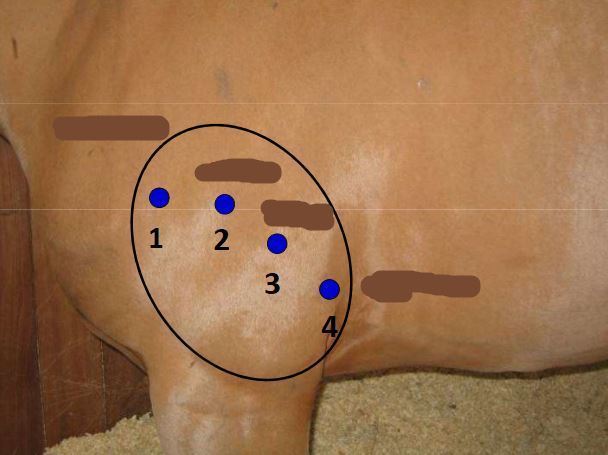
- Apulmonic
- Baortic
- Cmitral
- Dapex beat
- EPulmonic
- FAortic
- GMitral
- HApex Beat
- IPulmonic
- JAortic
- KMitral
- LApex Beat
- MPulmonic
- NAortic
- OMitral
- PApex Beat
23When would you hear a murmur due to mitral insufficiency?
- Asystole
- Bdiastole
24When would you hear a systolic murmur, if a heart beat is described as "lub-dub"?
- ABetween lub and dub
- BAfter the dub
- CBoth between the lub and dub, and after the dub
25On auscultating a dog's heart, you hear a systolic murmur on the apex of the left side. This suggests
- Amitral insufficiency
- Btricuspid insufficiency
- Cventricular septal defect
- Daortic/pulmonic stenosis
- Emitral stenosis
- Faortic/pulmonic insufficiency
26On auscultating a dog's heart, you hear a systolic murmur on the base of the left side. This suggests
- AMitral Insufficiency
- BTricuspid Insufficiency
- CAortic/Pulmonic Insufficiency
- DAortic/Pulmonic Stenosis
- EVentricular Septal Defect
- FMitral Stenosis
27What type of murmur would suggest pulmonic insufficiency?
- AA diastolic murmur at the base of the left side
- BA systolic murmur at the base of the left side
- CA systolic murmur at the cranial border
- DA diastole murmur at the apex of the left side
- EA diastolic murmur at the cranial aspect of the right side
28On auscultation, you hear a heart murmur that is louder than S1 and S2 but you cannot palpate any precordial thrill. How would you grade this murmur?
- AGrade 1
- BGrade 2
- CGrade 3
- DGrade 4
- EGrade 5
- FGrade 6
29At what grade would you possibly hear a heart murmur radiate in a particular direction?
- AGrade 1
- BGrade 2
- CGrade 3
- DGrade 4
- EGrade 5
- FGrade 6
30What type of murmur can radiate dorsally?
- AAortic
- BPulmonic
- CMitral
31A gallop sound during auscultation suggests
- Apoor systolic contraction of the ventricle
- Bpoor diastolic relaxation of the ventricle
- Ca mitral murmur
- Dan aortic murmur
32Which of the following is a loop diuretic?
- AFurosemide
- BSpironolactone
- CChlorothiazide
- DAmiloride
33Which of the following could NOT be used to correct increased preload?
- AFurosemide
- BACE Inhibitor
- CPimobendan
- DDigoxin
34Which of the following is NOT a risk of diuresis?
- AHypovolaemia
- BHypertension
- CRAAS Stimulation
- DElectrolyte disturbance
35Which of the following is NOT a balanced vasodilator?
- AGlyceryl trinitrate
- BACE inhibitor
- CPimobendan
- DNitroprusside
36Which of the following would reduce the regurgitation associated with mitral insufficiency?
- Aglyceryl trinitrate
- Bfurosemide
- Cspironolactone
- Dpimobendan
37Which of the following would indicate the use of digoxin?
- AAtrial fibrillation
- BHypertrophic cardiomyopathy
- CMitral insufficiency
- DAortic stenosis
38What would an aortic "flow" murmur sound on auscultation?
- Acrescendo-decrescendo between S1 and S2
- Bdecrescendo after S2
- Cplateau between S1 and S2
- Dplateau between S2 and S3
39Which is FALSE regarding aortic flow murmurs?
- Arelatively rare
- Busually below grade 3
- Conly has local radiation
- Doften seen in fit horses
40What would a functional mitral valve regurgitation sound like?
- Acrescendo-decrescendo between S1 and S2
- Bplateau between S1 and S2
- Cdecrescendo after S2
- Dcrescendo after S2
41What is the point of maximum intensity (PMI) of pathological mitral regurgitation?
- Aleft 3rd intercostal space
- Bleft 4th intercostal space
- Cleft 5th intercostal space
- Dleft 6th intercostal space
42What type of pathological regurgitation is plateau-shaped, radiates craniodorsally and has a PMI at the right 4th intercostal space?
- AAortic regurgitation
- BMitral regurgitation
- CTricuspid regurgitation
- DPulmonary regurgitation
43What shape does an pathological aortic regurgitation murmur have?
- Acrescendo-decrescendo between S1-S2
- Bplateau between S1-S2
- Cdecrescendo between S1-S2
- Ddecrescendo after S2
44A bounding or "hyperkinetic" arterial pulse is a sign of significant heart disease in
- Amitral regurgitation
- Btricuspid regurgitation
- Caortic regurgitation
45What is the most common form of valve pathology?
- AEndocardiosis
- BValve prolapse
- CRuptured chordae tendineae
- DBacterial endocarditis
46Ruptured chordae tendinae is more common with the
- Aaortic valve
- Bmitral valve
- Cpulmonary valve
- Dtricuspid valve
47Which of the following often can cause sudden death or acute cardiac failure?
- Avalve prolapse
- Bruptured chordae tendineae
- Cchanges in ventricular size
- Dhypovoaemia
48What is the most common congenital cardiac defect in large animals?
- Aventricular septal defect
- Bpatent ductus arteriosus
- Cvalve dysplasia
49Ventricular septal defects are in the [blank_start]dorsal[blank_end] part of the septum.
- Adorsal
- Bventral
- Ccranial
- Dcaudal
50The intensity of a murmur associated with a ventricular septal defect is [blank_start]inversely[blank_end] proportional to the size of the defect.
- Ainversely
- Bdirectly
51With ventricular septal defects, a [blank_start]RHS[blank_end] murmur is associated with a [blank_start]LV to RV[blank_end] shunt.
- ARHS
- BLHS
- CLV to RV
- DRV to LV
52With ventricular septal defects, a LHS murmur is associated with a
- Afunctional pulmonic stenosis
- Bfunctional aortic stenosis
- Cdegenerative pulmonic stenosis
- Ddegenerative aortic stenosis
53For VSD murmurs, a left hand side murmur's shape is [blank_start]crescendo-decrescendo[blank_end] has a grade of [blank_start]3-6[blank_end] and has wide radiation.
- Acrescendo-decrescendo
- Bplateau
- Cdecrescendo
- Dcrescendo
- E3-6
- Fless than 3
54For VSD murmurs, a right hand side murmur's shape is [blank_start]plateau[blank_end] has a grade of [blank_start]3-6[blank_end] and has wide radiation.
- Aplateau
- Bcrescendo-decrescendo
- Ccrescendo
- Ddecrescendo
- E3-6
- Fless than 3
55Lymphosarcoma in cattle can result from
- ABovine Leukaemia Virus (BLV)
- BBVDV
- CLeptospira spp.
- DBovine Herpes Virus 1
56Which is FALSE regarding pericardial effusions in horses?
- AThey tend to be idiopathic
- BIn cases of pericarditis, they tend to develop fibrinous effusions
- CEVA can develop into pericarditis
- DPrognosis tends to be poor even with treatment
57Bacterial endocarditis mainly affects which area of the heart in ruminants?
- ATricuspid
- BPulmonic
- CMitral
- DAortic
- ETricuspid and Pulmonic
- FMitral and Aortic
58Bacterial endocarditis usually affects which area of the heart in horses?
- ATricuspid and pulmonic
- BTricuspid
- CPulmonic
- DMitral
- EAortic
- FMitral and Aortic
59Which of the following develops secondary to pulmonary hypertension?
- Acor pulmonale
- Bbacterial endocarditis
- Cruptured chordae tendineae
- Dmitral valve disease
60Which of the following is NOT a sign of right-sided heart failure?
- Asubcutaneous oedema
- Bjugular venous distension
- Cdyspnoea
- Dtachypnoea
- Epulmonary oedema
- Ftachycardia
61Which of the following diseases is associated with catheters in horses?
- AThrombophlebitis
- BCor pulmonale
- CBacterial endocarditis
- DLymphosarcoma
62Where does exercise-induced pulmonary haemorrhage originate?
- Acaudodorsal lung lobes
- Bcraniodorsal lung lobes
- Ccaudoventral lung lobes
- Dcranioventral lung lobes
Información
- Descripción
- El usuario ha eliminado su información de asignaturas Test sobre BVetMed3: The Diagnostic Approach to CV Disease, creado por Usuario eliminado el 13/04/2019.
- Autor
- Usuario eliminado
- Idioma
- English
- Visitas
- 8
- Historial
- Creado el 13 abr 2019 · actualizado el 13 abr 2019
- Etiquetas
- Valoración
- Aún sin valoraciones Valora este test