
Apuntes
Phonology
Contenido del apunte (1)
Página 1
Phonology
How sounds work together in a language- like, where they occur in a crafted sentence, the interaction between sounds
Phonological Knowledge
This is knowing what kind of sounds work together in a language, like 'srep' isn't really possible in english, but 'snep' is even though neither are actual words. Sounds are either DISTINCTIVE or CONTRASTIVE.
A PHONE is the smallest unit of sound- it's like a millimeter. Physical.
A
A PHONEME is the smallest unit of sound that might bring about change in a word: /m/ in mat, /b/ in bat. It's how one stores sound in their mind and separate from how sounds actually works in speech. Abstract.
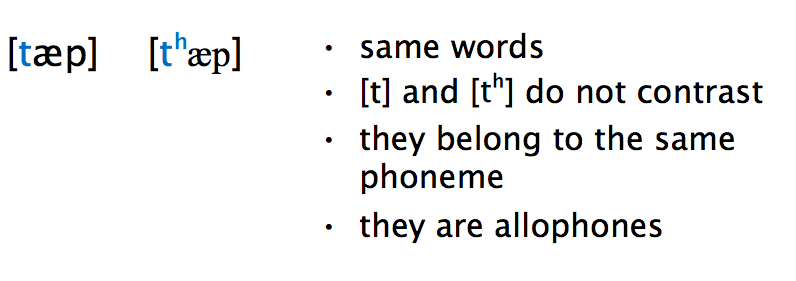
An ALLOPHONE is a variant of a Phoneme: [pʰ] is an allophone of phenome /p/
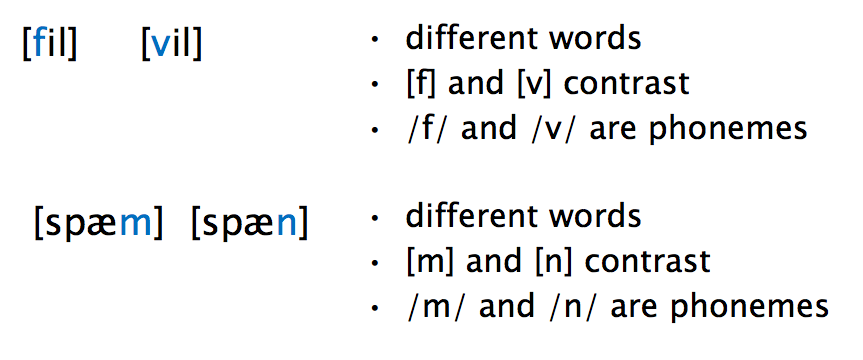
A MINIMAL PAIR: two words that differ by one phone in the same place but have completely different meanings:
[fil] [vil]
[sæn] [sæm]
[kɹik] [krʊk]
HOW
HOW TO TELL IF THING IS PHENOME OR ALLOPHONE
If you change one sound in the word, does it change the meaning of the word? If not, then it's the two words contrast and are different phenomes
CONTRASTIVE DISTRIBUTION
When changes in sound result in changes in meaning (phenomes)
COMPLIMENTARY DISTRIBUTION
When sounds don't occur in the same phonological environment (allophones). As shown below:
FREE VARIATION
When sounds occur in the same environment without changing meaning (allophones). As shown to starboard:
Every language has specific contrasts
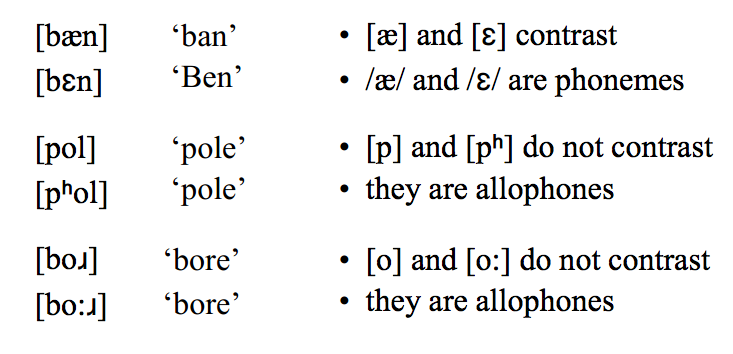
Basically, if the phone is weird looking and not normal IPA, 99% chance it's an allophone.
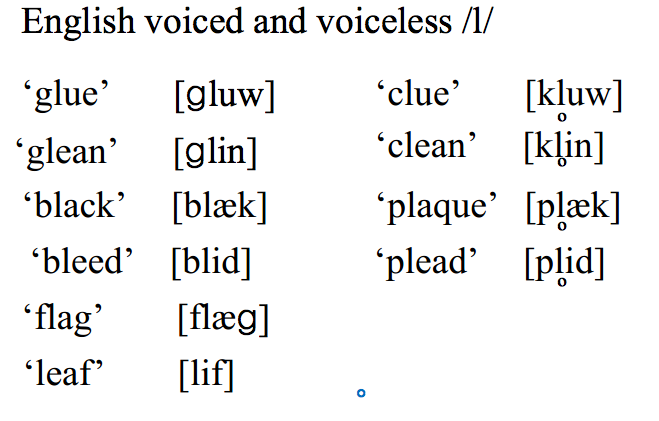
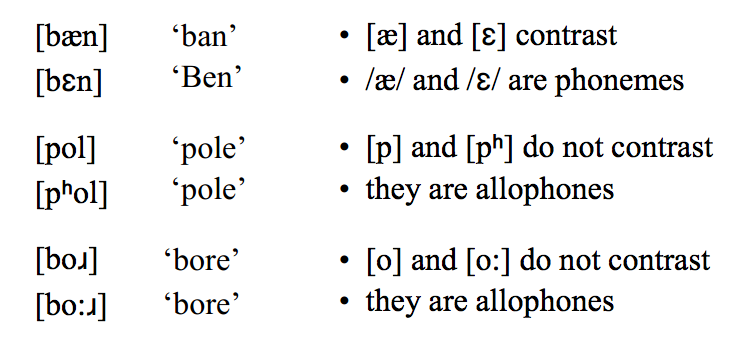
IN
IN CONCLUSION: Phones are physical, phonemes are abstract. Allophones are variants of phonemes. Allophones follow rules and are thus predictable.
is The Phonological Rules map between the phonemic and phonetic levels. It 'translates' phonemes into speech sounds and is apart of linguistic knowledge.
FOR
FORMAL NOTATION
X to Y
C __ D
In layman's terms: X becomes Y when it comes in between C and D.
NATURAL CLASS
A group of sounds in a language that share one or more articulatory property to the exclusion of all other sounds in that language.
Ex: /t/ and /d/: both voiceless alveolar oral stops.
-The ways that sound can change
-can classify rules according to process
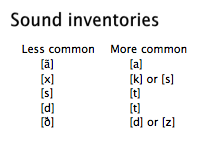
Some sounds are more common than others
Le
Less common sounds imply more commons sounds:
[x] implies [k]
voiced stops imply voiceless stops
Phones and Shit
Distributions
Phonological Rules
Phonological Processes
Implicational Laws
Información
- Descripción
- Linguistics Apunte sobre Phonology, creado por emberwing el 02/11/2013.
- Creado por
- emberwing · nov 2013
- Actualizado
- 3 feb 2018
- Visitas
- 759
- Etiquetas
- Valoración