
Biochem Gluconeogenesis
Diapositivas del conjunto (23)
-
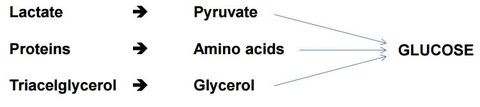
- -Gluconeogenesis (GNG) is a metabolic pathway that
- generates GLUCOSE from non-carbohydrate carbon
- substrates such as pyruvate, lactate, glycerol, and
- glucogenic amino acids
- When Blood Glucose level is reduced Gluconeogenesis takes place in liver
-
-
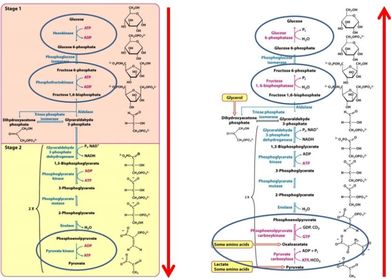
- regulating steps are
- glycolysis: hexokinase from glucose to g6p
- phosphofructo kinase from F6P to F 1,6 BP
- Pyruvate kinase from PEP to pyruvate
- gluconeogensis
- basically in the same steps but by different enzymes
- G6P'ase, F-1,6-BP'ase and but only differnt thing is the PEP----->oxaloacetate-------->pyruvate
- PEP carboxylase pyruvate carboxylase
-
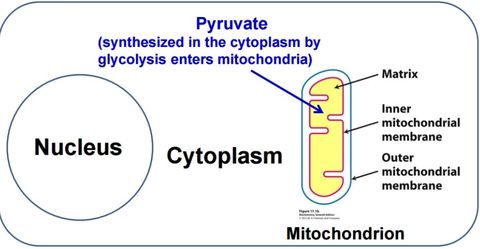
Pyruvate: the starting point Of Gluconeogenesis
- Pyruvate
- (synthesized in the cytoplasm by
- glycolysis enters mitochondria
-
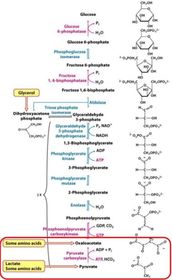
Step 1.a. Gluconeogenesis: pyruvate to oxaloacetate
- Enzyme: Pyruvate decarboxylase.
- Energy: One ATP molecule used.
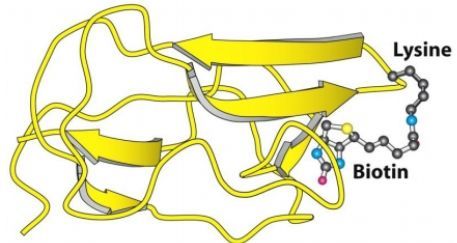
- Biotin is a covalently attached
- prosthetic group, which serves as
- a carrier of activated CO2
- .
-
Pyruvate carboxylase and Biotin
- Biotin is attached to
- pyruvate carboxylase by a
- long, flexible chain at the
- latter’s C-terminus.
- (attach @lysine?)
-
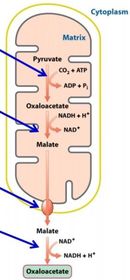
Step 1.b. Oxaloacetate to Malate to Oxaloacetate
- Pyruvate carboxylase: mitochondrial.
- Other gluconeogenesis enzymes: cytoplasmic
- 1. Oxaloacetate is reduced by an NADH linked
- malate dehydrogenase to malate
- inside the mitochondrion.
- 2. Malate is transported to cytosol. (out of mitochondria)
- 3. Malate is reoxidized to oxaloacetate by an
- NAD+-linked malate dehydrogenase in the
- cytoplasm
-
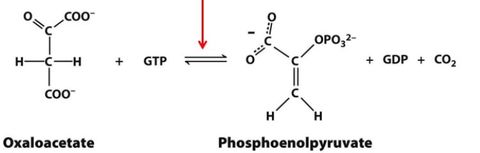
Step 1.c: Oxaloacetate to Phosphoenolpyruvate
- 1. Oxaloacetate is decarboxylated and phosphorylated to yield phosphoenolpyruvate (PEP) , at the expense of the high phosphoryl-transfer potential of GTP
- 2. Enzyme: phosphoenolpyruvate carboxykinase (PEPCK
-
From phosphoenolpyruvate to Fructose 1-6 bisphosphate
- All reactions are reversible
- under intracellular conditions.
- Therefore when conditions
- favor gluconeogenesis, the
- reverse reactions will take
- place until the next
- irreversible step is reached
-
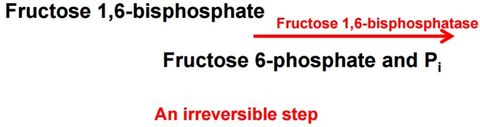
Conversion of Fructose 1,6-bisphosphate into Fructose 6-phosphate and orthophosphate
- *An irreversible step
-
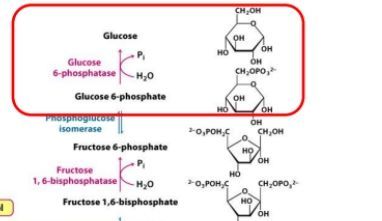
- Glucose 6-phosphate to Glucose
-
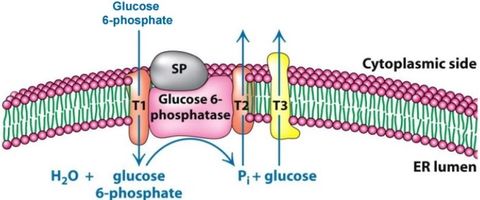
Generation of free glucose is an important control point
- 1. Free glucose is generated in liver (and less in kidney).
- 2. Glucose 6-phosphate is transported to the lumen of
- the endoplasmic reticulum.
- 3. Glucose 6-phosphatase converts Glucose 6-
- phosphate to free glucose.
- 4. Two glucose transporters carry glucose to cytoplasm
-
Six high-transfer-potential phosphoryl groups are spent in synthesizing glucose from pyruvate
- 2 Pyruvate + 4 ATP + 2 GTP + 2 NADH + 6 H2O =========>>>>>>
- Glucose + 4 ADP + 2 GDP + 6 Pi + 2 NAD+ + 2H+
-
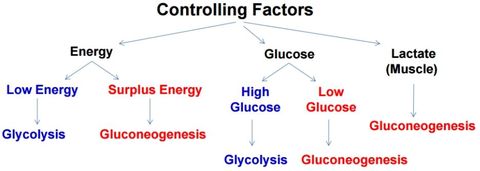
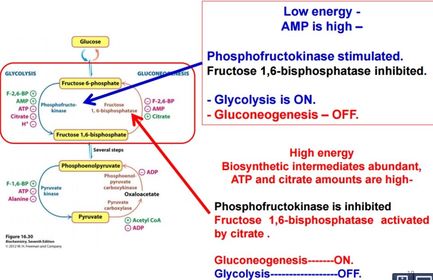
Glycolysis and gluconeogenesis are coordinated
- The amounts and activities of the distinctive enzymes of
- each pathway are controlled to keep one pathway active and
- one inactive at the same time.
-
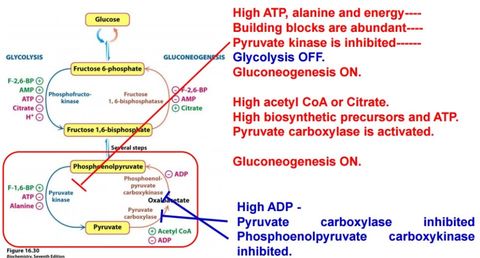
- Pie de imagen: high energy, high resources for energy turns convert those things back to glucose.
-
-
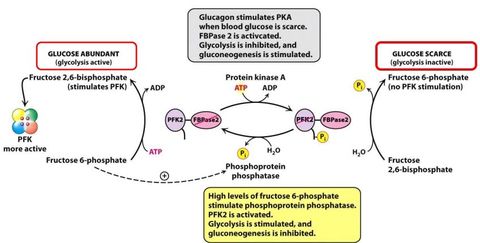
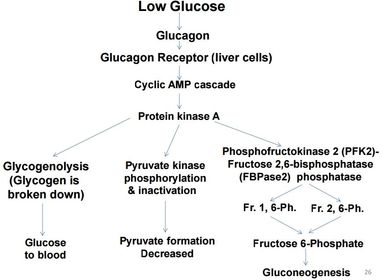
- From Glucose-> G6P ->F6P
- To go to glycolysis, using PFK you go to F-1,6-BP
- for gluconeogenesis PFK2, F-2,6 BP'ase
- Bifunctional enzyme PFK2 - FBPase2 plays a major role in
- Deciding Glycolysis vs Gluconeogenesis.
-
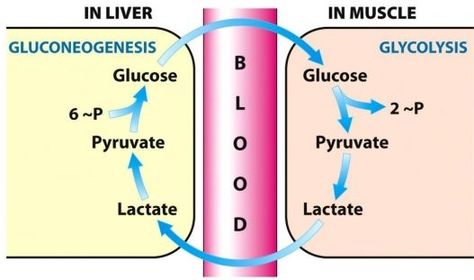
Lactate formed by contracting muscle is used by other organs
- Pyruvate formation --> Reduced to Lactate -->Diffuse into Blood and
- then to other organs
- from leg muscle, lactate enter cardiac muscle cells.
- Lactate is converted to pyruvate and
- metabolized by
- TCA cycle to generate ATP.
- More circulating glucose available for active muscle cells
-
Lactate formed by contracting muscle is used by other organs:
- Fate 2: In the liver
- Cori cycle: Contracting skeletal muscle supplies lactate to
- the liver, which uses it to synthesize and release glucose.
- Thus, the liver restores the level of glucose necessary for
- active muscle cells, which derive ATP from the glycolysis.
-
Gluconeogenesis of Alanine formed by contracting muscle
- Alanine is generated in the muscle
- when the carbon skeletons of
- some amino acids are used as
- fuels. The nitrogens from these
- amino acids are transferred to
- pyruvate to form alanine.
- The reverse reaction takes
- place in the liver:
- Alanine generates Pyruvate that
- enters Gluconeogenesis
-
Interplay between Glycolysis and gluconeogenesis
- During a sprint:
- In leg muscle:
- Glucose metabolized anaerobically
- to lactate or (aerobically to CO2
- and H2O)
- In cardiac muscle:
- Lactate can be converted into
- pyruvate and used as a fuel, along
- with glucose, to power the
- heartbeats to keep the sprinter’s
- blood flowing.
- In the liver: Gluconeogenesis, will
- take place rapidly to ensure that
- enough glucose is present in the
- blood for skeletal and cardiac
- muscle, and other tissues.
- Glycogen, glycerol, and amino
- acids are other sources of energy
-
-
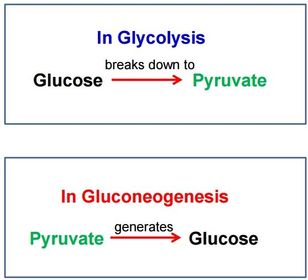
- Gluconeogenesis
- 1. Gluconeogenesis generates glucose from noncarbohydrate
- carbon substrates such as pyruvate,
- lactate, glycerol, and glucogenic amino acids.
- 2. Gluconeogenesis helps maintain blood glucose levels.
- 3. Gluconeogenesis bypasses the three virtually
- irreversible reactions of glycolysis.
- 4. Glycolysis and gluconeogenesis are coordinated in
- liver, muscle and other organs to maintain blood
- glucose level.
Información
- Descripción
- Diapositivas sobre Biochem Gluconeogenesis, creado por proud08 el 10/10/2015.
- Creado por
- proud08 · oct 2015
- Actualizado
- 1 sep 2016
- Visitas
- 10
- Valoración