
Electricity
Diapositivas del conjunto (12)
-
- power = current x voltage
- energy = power x time
- energy = current x voltage x time
- Current in amps = charge in coulombs / time in seconds
- Voltage = current x resistance
- electric current is the rate of flow of electric charge
- 1 volt = 1 joule per coulomb
-
-
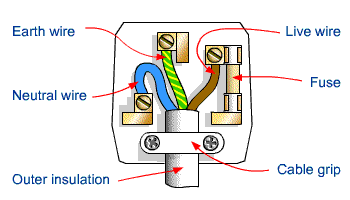
- Safety Features:
- Insulation
- Double insulation - wiring insulated and cased in plastic or other insulating material
- Earth Wire - provides a very low resistance path for current in the event the live wire touches the case.
- Fuses - ceramic heat proof tubes with a thin wire designed to melt when certain current exceeded breaking the circuit.
- Circuit breaker - do the same as fuses but don't need to be replaced and reset by pressing a button
-
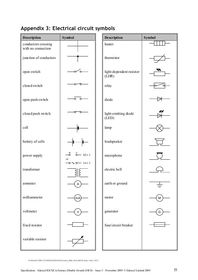
- Current is measured using an ammeter placed in series with the component through which the current passes.
- Voltage is measured using a voltmeter placed in parallel with the component through which the current passes.
-
- Same current flows through all the components
- Any break in the circuit stops current flowing
- If the lamps are identical they will get an equal share of the voltage and be the same brightness
- Current can split / take two routes
- I = I1 + I2
- If the lamps are identical the current will divide equally - same voltage + brightness
- If the lamps are not identical the current will not divide equally
- If one of the lamps blows the other will be unaffected but the current supplied by the battery will half
-
- For metal wires, current varies in proportion to the voltage as long as the wire doesn't get hot.
- Different wires allow different sized currents to flow for a given voltage; some wires allowed current to flow easily while others didn't
- Resistance is measured in ohms
- A component with a resistance of 1 ohm will pass a current of 1 Amp when a voltage of 1 volt is applied across it
- There are fixed resistors and variable resistors. Resistors have many uses such as lamp dimmers, speed control in slot car games and volume control in audio equipment
-
- Thermistors:
- Resistance changes with change in temperature
- Resistance decreases as temperature increases
- Used in temperature sensing circuits
-
- Light-Dependent resistors (LDR)
- Resistance changes with the amount of light shining on the LDR
- More light means less resistance
- Used in light sensitive circuits like those to turn on street lights in the dark
-
- Diodes and Light emitting diodes (LEDs)
- Only allow current to flow in the direction of the arrow (circuit symbol)
- That is because in one direction they have little resistance and in the other very high resistance.
- LED's light up when a current passes through them
- Diodes control the direction in which current can flow in a circuit and are used in power supplies for DC equipment
-
Current voltage graph - resistor
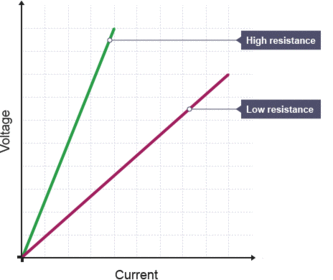
- Resistors and wires obey Ohm's law - current is proportional to voltage and the graphs are straight lines which pass through the origin.
-
Current voltage graph - filament lamp
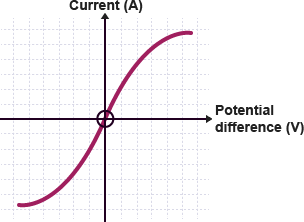
- The filament lamp is a metal wire but it gets very hot. The resistance of a metal increases with temperature so the graph curves.
-
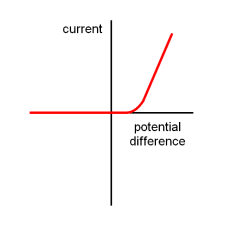
- Diodes have a very high resistance when the voltage is applied in the 'wrong' direction - shown by the horizontal line when the voltage is negative.
- When the voltage is applied in the right direction, when it reaches about 0.7 volts the resistance drops to a small value - the graph curves and becomes very steep
Información
- Descripción
- iGCSE Physics Diapositivas sobre Electricity, creado por pink-polarbear el 12/04/2016.
- Creado por
- pink-polarbear · abr 2016
- Actualizado
- 15 ago 2018
- Visitas
- 3
- Valoración