
Fichas
Th2L01 Nucleic acids (FC)
Fichas del conjunto (86)
- 1PharmacogenomicsWhen our DNA sequence determines whether you respond to a particular drug treatment
- 2WHO studied virulent (Smooth) and non-virulent (Rough) strains of Streptococcus pneumonia in mice and demonstrated the principle of transformationGriffith (1928)
- 3What is the concept of transformationModification of a cell or bacterium by the uptake and incorporation of exogenous (foreign) DNA
- 4What is the transforming factor in eukaryotic geneticsDNA
- 5Which radioisotope is used to label protein35S can be used to label protein (no sulphur in DNA)
- 6Which radioisotope is used to label DNA32P can be used to label DNA (no phosphorus in protein)
- 7WHO experimented with radioactively lableled bateriophages (virus that infects bacteria) showing that DNA is the transforming factorHershey and Chase (1952)
- 8What are the strongest type of bondscovalent
- 9What binds with adeninethymine (DNA) and uracil (RNA)
- 10What binds with guaninecytosine
- 11A molecule that can be written as several resonance structures of approx. equal energy have greater _________ than those without resonance structuresstability
- 12Sugar in sugar-phosphate unit is attached to how many phosphatestwo
- 13What charge to phosphates carrynegative
- 14What are the purinesguanine, adenine
- 15What are the pyrimidinescytosine, thymine, uracil
- 16Nitrogenous base with two ring structurepurines
- 17Nitrogenous base with single ring structurepyrimidines
- 18What is the nucleic acid composition9 purine or 6 pyrimidine atoms + amine (NH2) + methyl (CH3) or carbonyl (C=O) group
- 19How is uracil different from thymineOnly found in RNA
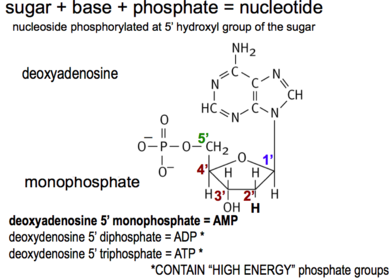
Demethylated form of thymine - 20What makes up a nucleotidesugar, base, phosphate
- 21What does ATP stand fordeoxydenosine triphosphate
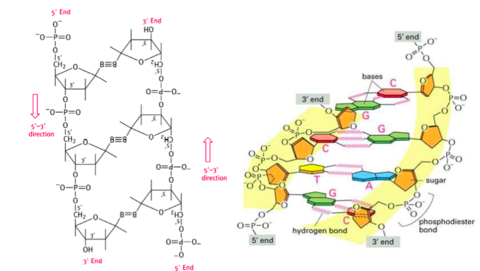
- 22Nucleotides can be attached to WHAT of other nucleotides3' OH groups
- 23Nucleotide attachments are catalysed by what enzymepolymerases
- 24At 3' 5' - phosphodiester bonds are formed liberating what moleculeinorganic pyrophsphate (PPi)
- 255' end of polynucleotide chains containphosphate
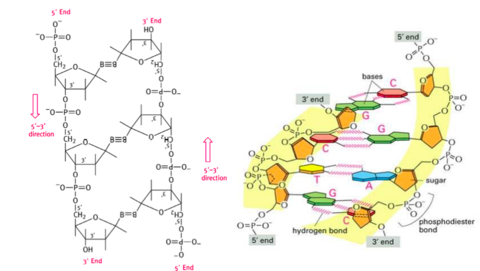
- 263' end polynucleotide chains containhydroxyl group
- 27Criteria for DNA structure (3)○ capable of storing info.
○ replication mechanism
○ capable of mutation - 28Who solved that DNA has a three dimensional structureWatson and Crick (1953)
- 29Whose experimental findings that served as basis for Watson and Crick's hypothesesChargaff and Franklin & Wilkins
- 30What are Chargaff's rules (1947) (3)○ the amount of guanine = cytosine (G=C)
○ the amount of adenine = tyrosine (A=T)
○ the composition of DNA varies from one species to another, with respond to relative amount of A, G, T and C bases (hint to molecular diversity) - 31Percentage of bases in humans30.9% A; 29.4% T; 19.9% G; 19.8% C
- 32Who discovered that DNA was helical and the molecule has a diameter of 2 nm and makes a complete turn on the helix every 3.4 nm i.e. RNA has a regular, repeating structure; helical structure; width and spacing of nitrogenous basesFranklin and Wilkin
- 33What is the intronucleotide distance0.34nm
- 34What is the distance of one full twist of DNA in nt. and nm10 nucleotides per turn; 3.4nm
- 35What is the diameter of the helix2.0nm
- 36DNA strands are whatin anti-parallel
- 37Bases are ________ to the helical axisperpendicular
- 38Information in DNA is stored as whata sequence of bases
- 39Who discovered: ○ Replication mechanism of DNA - semi-conservative ○ One DNA strand acts as a template for the building of a new strand in replication ○ The parent molecule unwinds and the two new daughter strands are assembled based on base-paring rules (semi-conservative)Mesleson and Stahl (1958)
- 40Compression of DNA is mediate by whatproteins
- 41What is the chromosome compositionDNA + protein
- 42Number of chromosomes in humans46; 22 pairs and XX or XY
- 43Number of nucleotide pairs in humans3 x 10^9
- 44Meters of DNA in every nucleus1.8m
- 45Diameter of nucleus5 micro meters
- 46What is the building block of chromatinNucleosome
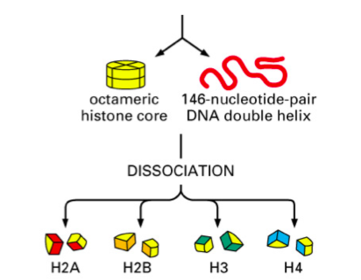
- 47What is nucleosome146bp of DNA wrapped around a protein core of 8 histones which are chromosomal proteins
- 48What are the 8 histones2x (H2A, H2B, H3, H4)
- 49What is special about H1 (histone)○ Not part of nucleosome
○ Helps assemble nucleosomes into the 30nm fibre
○ Non-chromosomal protein; changes that path DNA takes as it exists the nucleosome core, allowing it to become more compact - 50What is chromatin fibremany nucleosomes packed together; arranged as loops; form chromosome scaffold
- 51What is linker DNADNA between nucleosomes (up to 80 nt)
- 52What is the composition of a histoneMade of up a high proportion of positively charged amino acids (lysine and arginine)
- 53What about histone composition is important to DNA structureThe positive charge helps the histones bind tightly to the negatively charged sugar-phosphate backbone; their amino acid sequence is highly conserved amongst eukaryotes
They also have a long N-terminal amino acid tail which influences chromatin structure - 54What is condensing chromatin30nm fibre is folded into a series of loops, which are further condensed to produce interphase chromosomes
- 55What is the net result of packaging chromatinEach DNA molecule has been packaged into a mitotic chromosome that is 10K shorter than its extended length
- 56What are chromatin-remodelling complexesProteins that use ATP hydrolysis to change the position of DNA wrapped around the nucleosome
- 57What is the main role of chromatin-remodelling complexesloosening the chromosomal DNA by pushing it along the histone core, this repositioning (sliding) of the nucleosome, exposes the DNA to other DNA-binding proteins
- 58What is the role of RNA polymeraselinks together the growing chain of RNA nucleotides during transcription, using a DNA strand as a template.
- 59What is the role of Histone acetyltransferase (HAT)Recruit transcriptional co-activators, act in large complexes, recruit RNA polymerase, turn on gene expression
Lead to the uncoiling of chromatin - 60What is the role of Histone deacetylase (HDAC)remove acetyl groups from histones, which closes chromatin conformation and decreases gene expression
- 61What is HeterochromatinDNA that is densely packed around histones
- 62Describe the genes in heterochromatinThe genes in heterochromatin are generally inaccessible to enzymes and are turned off
- 63What is EuchromatinDNA that is loosely packed around histones
- 64Describe the genes in EuchromatinThis DNA is more accessible to enzymes and the genes in euchromatin can be activated if needed.
- 65What is Methylationchemical modification of DNA makes that gene less likely to be expressed
- 66Number of human genes23,000
- 67Average size of a gene (in bases)2,000 bases
- 68Humans genes make up about how many nts.4.6 x 10^7 nucleotides
- 69What are exonsGenome expressed sequence of DNA
- 70Where are exons foundin mature DNA
- 71What are intronsSequence of DNA that is not involved in coding for a protein
- 72Where are introns foundimmature DNA
- 73What is repetitive DNANucleotide sequences, usually noncoding, that are present in many copies in a eukaryotic genome
- 74What are the untranscribed regions near genesca. 2% of non-coding regions of DNA
Areas flanking genes, esp. at the 5' end are important regulatory elements that control the production of mRNA - 75What are two kinds of Retrotransposable elementsLINES and SINES
- 76What are LINESViral retrotransposable elements
Long Interspersed Elements - 77What are SINESNon-viral retrotransposable elements
Short Interspersed Elements - 78What is Satellite DNAshort sequences of DNA that are tandemly repeated as many as 10 million times in the DNA
- 79Where is most satellite DNA locatedin the telomeres
- 80What is the role of satellite DNAstructural properties of DNA
- 81What is the clinical significance of satellite DNAProvides genetic fingerprint
Used in paternity testing and forensic science - 82Uncharacterised/junk DNA is whatnon-coding
- 83Human genome size3 billion bp
- 84Amoeba genome size22x larger than human
670 billion bp - 85What is the key structure difference between deoxyribose and riboseIn DNA H' is at the 2' position
In RNA OH' is at the 2' position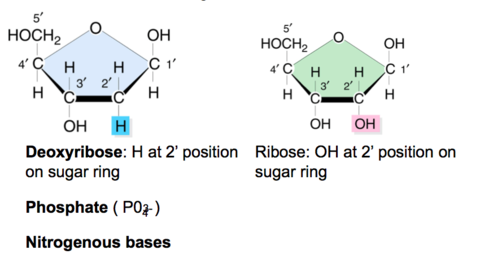
- 86DNA forms ________ outside biological symptomssponatenously
Información
- Descripción
- El usuario ha eliminado su información de asignaturas Fichas sobre Th2L01 Nucleic acids (FC), creado por Usuario eliminado el 26/08/2016.
- Creado por
- Usuario eliminado · ago 2016
- Actualizado
- 27 ago 2016
- Visitas
- 22
- Historial
-
- Creado por Emma Allde · 18 ago 2016
- Copiado por Emma Allde · 26 ago 2016
- Valoración