
Apuntes
Functions and Divisions of Nervous System
Contenido del apunte (5)
Página 1
The 3 (overlapping) functions of the nervous system:
Sensory Input - The information gathered by all the sensory receptors, about changes inside and outside body.
Integration - The process of analysing and interpreting sensory input and deciding a response at each moment.
Motor Output - Activation of effector organs (muscles and glands) to cause a response.
The principal parts of nervous system:
Central Nervous System (CNS)
Peripheral Nevrvous System (PNS)
Página 2
Central Nervous System
Consists of brain and spinal cord, occupies dorsal body cavity
Functions:
Intergrating and control center of nervous system.
Interprets sensory input and dictates motor output based on reflex, current conditions, and past experience.
Página 3
Peripheral Nervous System
All the parts of the nervous system outside the Central Nervous System (CNS). Consists mainly of nerves (bundles of axons) which extend to and from brain and spinal cord.
Carry impulses to and from:
brain - cranial nerves
spinal cord - spinal nerves
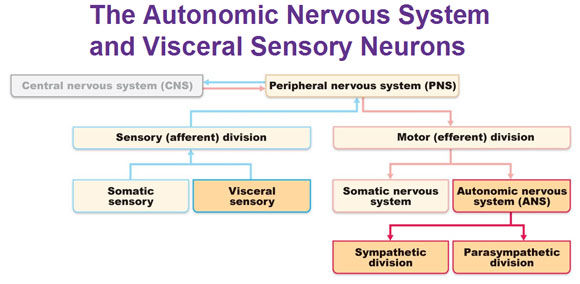
Subdivisions of Peripheral Nervous System (PNS):
Sensory/ Afferent division
Motor/ Efferent division
Sensory/ Afferent Division (af'er-ent = carrying toward)
Functions:
Consists of nerve fibers (axons) that convey impulses to the central nervous system (CNS) from sensory receptors throughout the body.
Keeps Central Nervous System (CNS) constantly informed of events going on inside and outside body.
Two types:
Somatic (soma = body) sensory fibers - convey impulses from the skin, skeletal muscles, and joints
Visceral sensory fibers - convey impulses from visceral organs (organs within the ventral body cavity)
Motor/ Efferent Division (ef'er-ent = carrying away)
Functions:
Consists of nerve fibers (axons) that convey impulses from the central nervous system (CNS) to effector organs (muscles & glands).
Impulses activate muscles to contract and glands to secrete.
Brings about a motor response
Two parts:
Somatic Nervous System - consists of somatic motor nerve fibers that conduct impulses from CNS to skeletal muscles. Also referred to as voluntary nervous system because it allows us to consciously control our skeletal muscles
Autonomic Nervous System (ANS) (autonomic = a law unto itself) - consists of visceral motor nerve fibers which regulates smooth muscles, cardiac muscles, and glands. We cannot control activities of smooth muscles, cardiac muscles, and glands so Autonomic Nervous System (ANS) is also called the involuntary nervous system. Has two subdivisions, sympathetic division and parasympathetic division.

Página 4
Página 5
Información
- Descripción
- List the basic functions of the nervous system. Explain the structural and functional divisions of the nervous system
- Creado por
- Sabith Iqbal · oct 2016
- Actualizado
- 25 oct 2016
- Visitas
- 287
- Etiquetas
- Valoración