
Apuntes
E6: Water Treatment (UNMODIFIED)
Contenido del apunte (1)
Página 1
Anthropogenic Sources:
Human waste
Fertilizers
Industrial Waste (70% = Untreated)
Interesting Facts:
If we continue this trend, by 2020, there will be 30 million environmental refugees in China
Primary Pollutants: Main Categories
Heavy Metals
Dioxins
Pesticides
PCBs
Nitrates
Organic Matter
Heav
Heavy Metals:
Cd2+
Zinc/ Mine
Ni-Cad Batteries
Yellow pigments
Pb2+
Lead pipes
Older paints
Automobile batteries
Leaded gasoline
Hg
Fungicides
Mercury Thermometers
Button batteries
Dioxins
What is it?
A product of incineration of wastes containing organochloro compounds
Pesticides:
DDT:
What is it?
A potent insecticide (banned, but is still in use by many countries)
Paraquat
What is it?
Herbicide used to control weed growth in crops
PCBs (Polychlorinated Biphenyls)
What is it?
Used as insulators in electrical transformers and capacitors (due to high electric resistance)
NO3-
Causes acid rain
Used as artificial fertilizers
Organic
Organic Matter
Raw sewage
Decomposition products
Agricultural runoffs
Why do that?
Sources of clean freshwater = rapidly depleted due to pollution and overuse
Arid regions lack access to freshwater (therefore resort to using seawater)
Why can't we use saltwater?
Seawater contains approximately 3.5% dissolved salt
Unable to drink and use for both agricultural and industrial processes (dehydration of cells and corrosion of equipment)
Meth
Method 1: Multistage Distillation
Process:
Incoming cold seawater is heated by steam under high pressure to >100˚C
Water evaporates under lower pressure and water vapor is cooled by incoming cold seawater to condense it --> heat released can preheat the seawater
Hot saltier water passed on to the next chamber
An even lower pressure in the next chamber allows water to evaporate at a lower temperature; followed by condensation
Process repeats
Process repeated again to the third chamber that has a further reduced pressure
Distillate collected and used as drinking
Pros:
Energy needs reduced when heat released during condensation heats incoming seawater
Desalination plants built near thermal power generating plants can use waste heat to heat system
Cons:
High energy requirements (use of fossil fuels for heating seawater generates GHGs)
Possibility of thermal pollution due to heated water
Corrosion in pipes due to hot salt water may introduce copper contaminants into the water outflow
Metho
Method 2: Reverse Osmosis
Background Info:
Osmosis refers to the flow of water from one solution to another across a semipermeable membrane
When 2 solutions are separated by a semipermeable membrane, water will naturally move from a solution with low solute concentration to a solution with a high solute concentration
Reverse Osmosis:
Using the osmosis theory, but have to reverse it to get desirable effects (i.e. move from a solution with a high solute concentration to a solution with low solute concentration)
Must use pressure to disrupt the natural flow of osmosis
Semipermeable membrane has microscopic pores that are only big enough for water molecules to pass through
To maximize the desalination process, the semipermeable membrane is coiled inside a cylindrical pressurized vessel
Pros:
Less energy is required to generate pressure than to heat water
Little thermal heating reduces production of GHGs
Cons:
Membranes must be cleaned to reduce build up of salts, and cleaning chemicals may enter the environment
Bacteria can breed on membranes
Expensive process
Aims of Wastewater Treatment:
Reduce hazardous materials
Reduce BOD
Kill microorganisms
3 Main Stages:
Primary Sewage Treatment: Removal of Solid materials and initial reduction of BOD (due to organic matter); Physical Treatment
Secondary Removal Sewage Treatment: Removal of oxygen demanding wastes; Biological methods
Tertiary Sewage Treatment: Removal of heavy metals, nitrates and organic compounds
Primary Water Treatment:
GOAL: To remove solid materials and reduce some of BOD
Process:
Filtration Screen (removal of large solids e.g. sticks, paper, plastics, etc.)
Grit Chamber (small rocks, stones and sand settle to the bottom)
Sedimentation chamber (Suspended solids settle out, flocculation* process increases settling out, sludge forms)
END DESTINATION OF WASTE: Landfill Sites
END RESULT OF PRIMARY TREATMENT:
Undrinkable
Removal of 30-40% of the BOD
*Flocculation:
Gelatinous precipitate attracts small suspended particles, forming large clubs ("flocs") that settle more easily
Secondary Water Treatment:
GOAL: To further reduce BOD via bacterial activity and aeration (bacteria effectively decompose organic materials in the presence of high oxygen levels)
Method: Activate Sludge Process
Waste water from primary treatment enters
Aeration tank contains aerobic bacteria + oxygen (therefore begin the aerobic decomposition of organic matter process)
Settling tank (with activated sludge containing bacteria returned to aeration bank)
Clean effluent to tertiary treatment
END RESULT:
Removal of >90% of BOD
Tertiary Water Treatment
GOAL: Removal of phosphates, heavy metals, nitrates and organic compounds
Method 1: Precipitation Reactions to remove phosphates and heavy metals
Addition of aluminum or calcium ions to remove phosphates [
Addition of sulfide ions to remove many heavy metals [
Method 2: Activated Carbon beds to Remove Organic Compounds
Organic compounds adhere to granules of carbon as water flows over the bed
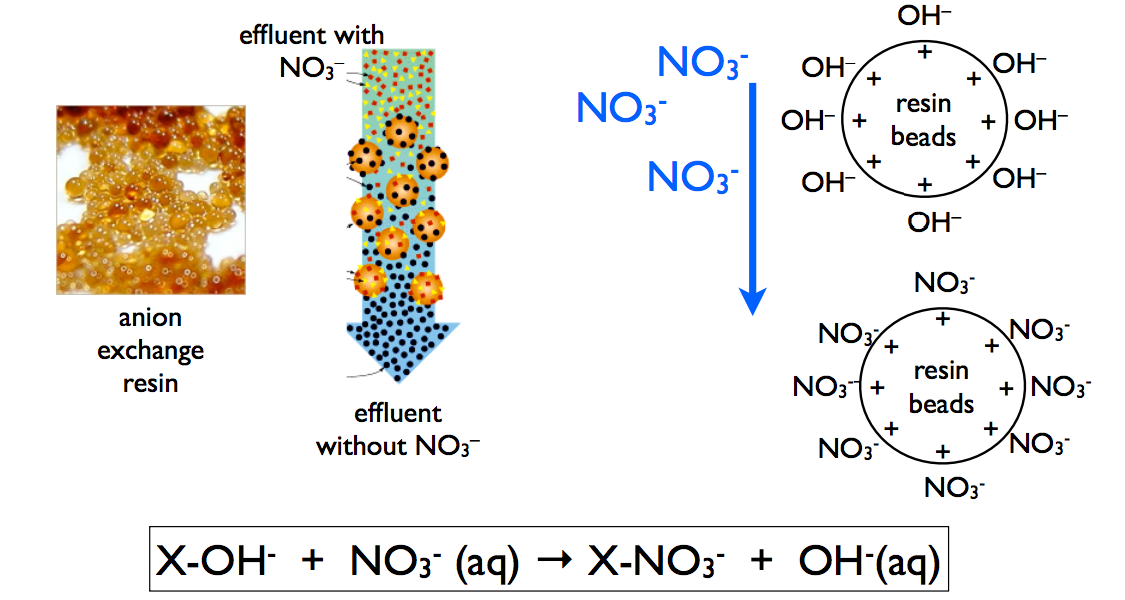
Method 3: Ion Exchange to Remove Nitrates (since nitrates cannot be precipitated out of solutions)
Use anion exchange resin (resin exchanges with hydroxide ions since NO3 = easier to react with)
See illustration
Method 4: Removal of Nitrates biologically
Denitrifying bacteria in an anaerobic environment to convert NO3- into N2 and H2O
Primary Water Pollutants
Freshwater from Seawater
Waste Water Treatment
Información
- Descripción
- IB (E: Environmental Science (UNMODIFIED)) Chemistry Apunte sobre E6: Water Treatment (UNMODIFIED), creado por IBMichelle el 07/04/2014.
- Creado por
- IBMichelle · abr 2014
- Actualizado
- 7 mar 2018
- Visitas
- 121
- Etiquetas
- Valoración