
Apuntes
FRENCH-grammar
Contenido del apunte (21)
Página 1
Future Tense-
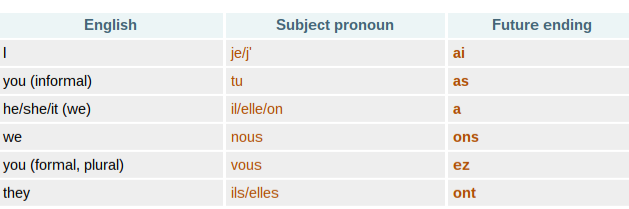
Most verbs form the future tense from the inf. Some verbs are irregular in they way they form the future stem (the first part), but the endings are always the same.
-er verbs
travailler
je travaillerai
tu travailleras
il/elle travaillera
nous travaillerons
vous travaillerez
ils/elles travailleront
-ir verbs
partir
je partirai
tu partiras
il/elle partira
nous partirons
vous partirez
ils/elles partiront
-re verbs
attendre
je attendrai
tu attendras
il/elle attendra
nous attendrons
vous attendrez
ils/elles attendront
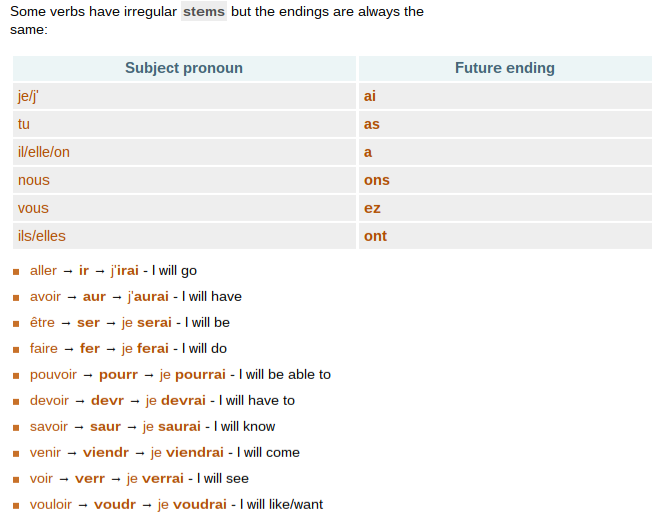
irregular verbs
aller-----j'irai
avoir----j'aurai
etre----- je serai
faire-----je ferai
pouvoir----je pourrai
venir-----je viendrai
voir----je verrai
Página 2
Emphatic pronouns
moi-me nous-we/us e.g. je suis d'accord avec lui c'est pour qui, lag glace?
toi-you vous-you
lui-he, him eux-they/them
elle-she/her elles-they/them
Questions in the present tense
Est-ce que tu as fini tes devoirs?
Qui a fini ses devoirs?
Tu as fini tes devoirs?
As-tu fini tes devoirs?
Reflexive verbs
je me suis leve(e)
tu t' es leve(e)
il s' est leve
elle s' est levee
on s' est leve(e) (s)
nous nous sommes leve(e) (s)
vous vous etes leve (e) (s)
ils se sont leves
elles se sont levees
Página 3
Back to Basics: Present tense
For example: je joue au foot – I’m playing football or I play football on va en ville - we're going into town or we go into town
Take the ending off the verb infinitive: parler → parl choisir → chois vendre → vend

Página 4
The three most irregular are avoir (to have), être (to be) and aller (to go) and are perhaps the most crucial to know, since they are used to form other tenses.

I go, I’m going → je vais
we are → nous sommes or on est
you have, you’re having → tu as or if plural, vous avez
Página 5
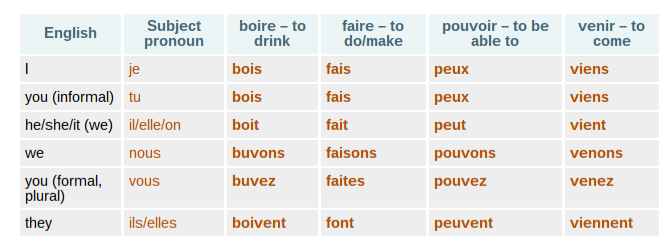
we drink → nous buvons
he does → il fait
they can → ils peuvent
we are coming → nous venons or on vient
Depuis is used with the present tense to say how long something has been happening. For example:
j'apprends le français depuis cinq ans - I've been learning French for five years
j'habite en Angleterre depuis 2005 - I've been living in England since 2005
It is also used to imply something is still going on, eg:
j’attends le train depuis une heure - I’ve been waiting for the train for an hour (and still am waiting)
Página 6
Auxiliary verbs
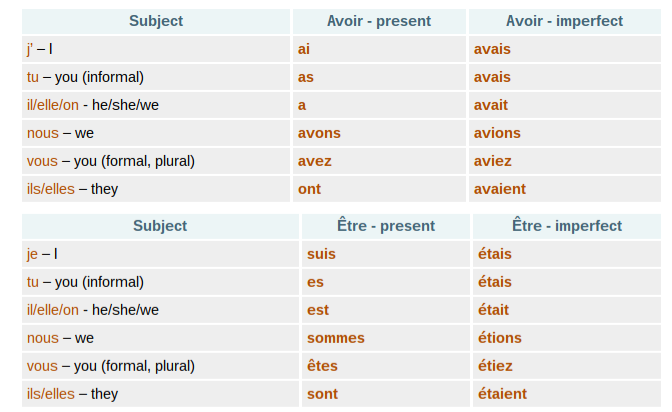
Auxiliary verbs are most commonly used when forming the perfect and pluperfect in French and they come from avoir and être. They are called auxiliaries because they support the main verb you want to write in a past tense.
You will either use them in their present or imperfect tense form, and add on a past participle.
j’ai fait mes devoirs - I did my homework
j’avais fait mes devoirs - I had done my homework
il est parti en vacances - he went on holiday
il était parti en vacances - he had gone on holiday
Página 7
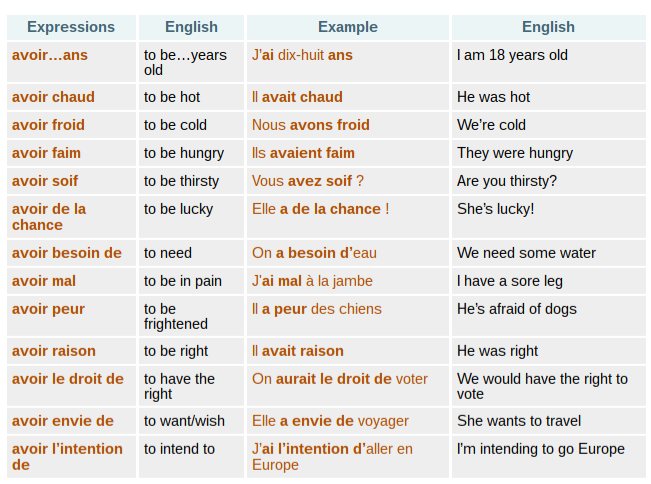
Avoir -
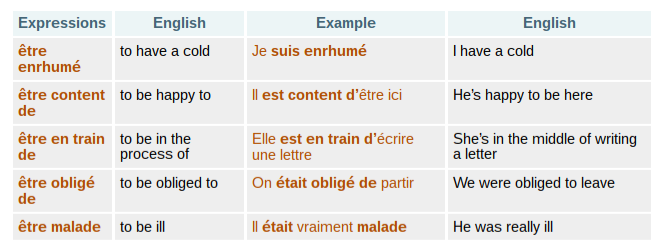
Etre
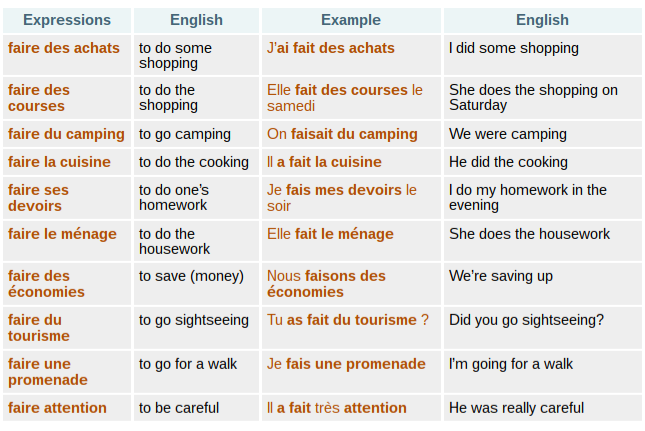
Faire-
Página 8
Perfect tense-
The perfect tense is used to talk about something that happened in the past - an action that is completely finished, eg: she watched TV, she has watched TV.
The perfect tense is sometimes used with time phrases such as:
Página 9
How to form the perfect tense
You need two parts to form the perfect tense:
the present tense of avoir or être – this is known as an auxiliary verb
the past participle of the main verb
A past participle is when you take the infinitive of the verb (ie a verb taken straight from the dictionary ending in -er, -ir, -re) and you change it into the past, eg:
to watch → watched
to finish → finished
to sell → sold
How to make a past participle for regular verbs used with avoir:
Choose the verb you want to use.
For verbs ending in -er, take off -er and add -é:
parler (to speak) → parl + é → parlé = spoken
For verbs ending in -ir, take off -ir and add -i:
choisir (to choose) → chois + i → choisi = chosen
For verbs ending -re, take off -re and add -u:
vendre (to sell) → vend + u → vendu = sold
How to form the perfect tense with avoir
Once you have formed your past participle, you need to select the correct part of avoir you want to use.
1. You must choose a part of avoir in the present tense, eg:
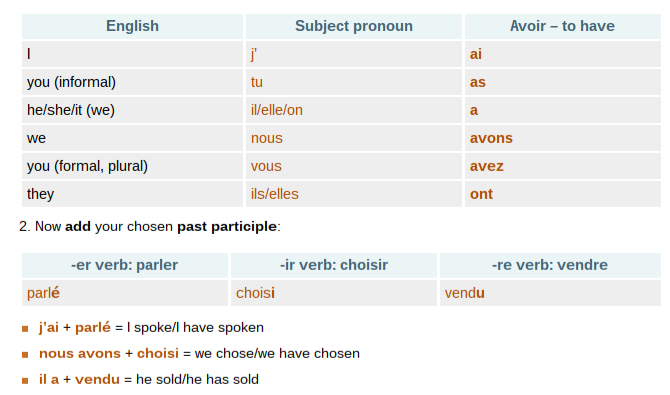
Common irregular past participles used with avoir for the perfect tense
Many common verbs don’t follow the rule for how to form a past participle,
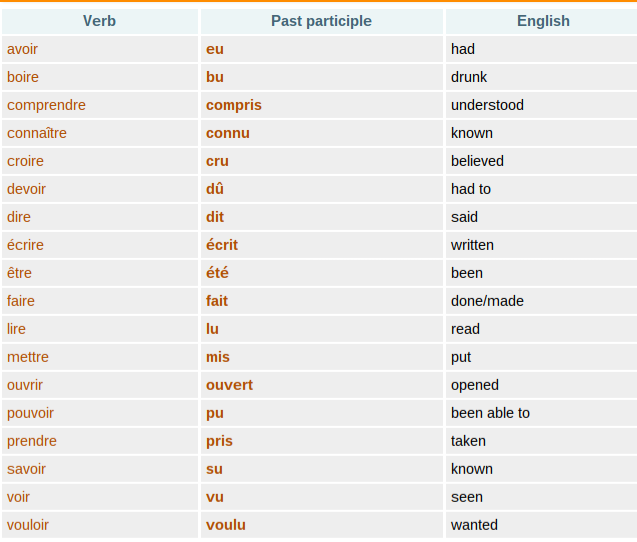
j’ai vu - I saw
tu as pris - you took
nous avons voulu - we wanted
Página 10
Forming the perfect tense with être
The perfect tense is used to talk about something that happened in the past. It's an action that is completely finished. Some verbs take être to form the perfect tense.
You need to consider three things to form the perfect tense with être:
the correct part of the present tense of être
the past participle of the main verb
the correct agreement, ie is the subject pronoun feminine/masculine or plural?
Agreement
When you form the perfect tense with être, the past participle agrees with the subject of the verb (the person doing the action).
If the subject pronoun is feminine and singular, you need to add -e to the past participle of the main verb → allée.
If the subject pronoun is masculine plural, add -s to the past participle of the main verb → allés.
If the subject pronoun is feminine plural, add -es to the past participle of the main verb → allées.
So the perfect tense of aller (to go) is:
je suis allé(e) - I went
tu es allé(e) - you went (informal)
il est allé - he went
elle est allée - she went
on est allé(e)(s) - we went
nous sommes allé(e)s - we went
vous êtes allé(e)(s) - you went (formal, plural)
ils sont allés - they went (all male or mixed)
elles sont allées - they went (women only)
To sum up, you must choose the correct part of être, add the past participle and add the correct agreement, for example:
je suis sortie de la banque - I left the bank (feminine)
je suis sorti de la banque - I left the bank (masculine)
il est né en 2007- he was born in 2007
elle est née en 2007 - she was born in 2007
nous sommes tombés par terre - we fell onto the ground (males or mixed)
elles sont tombées par terre - they fell onto the ground (only women)
Página 11
The imperfect tense-
The French imperfect tense is a past tense that indicates an ongoing state of being, or a repeated or incomplete action
The imperfect tense is used to describe things in the past:
quand j'étais en Australie, il faisait beau tout le temps - when I was in Australia, the weather was nice all the time
comment était ton voyage ? - how was your trip?
qu'est-ce que tu faisais pour aider à la maison ? - what did you do to help at home?
il y avait beaucoup de monde dans le restaurant - there were lots of people in the restaurant
The imperfect tense is also used to talk about things that used to happen regularly in the past:
quand j'étais petite, je jouais tous les jours - when I was little, I used to play every day
avant, je faisais du sport tous les matins - I used to do sport every morning
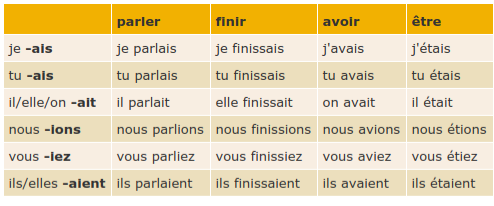
Forming the imperfect tense
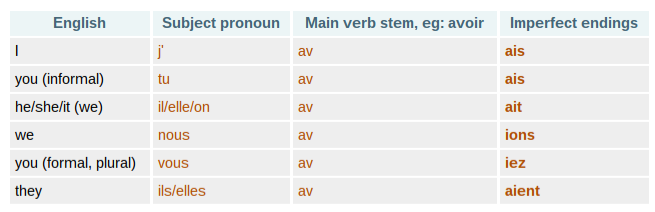
There are three steps to form the imperfect tense of all verbs:
Take the nous form of the present tense, eg: for avoir → nous avons
Then drop the nous and the -ons from the end, so that we are left with the stem, eg: av
Finally choose the appropriate subject pronoun (ie the person you are talking about) and add the imperfect endings from the table below:
Exceptions to the rule
There are exceptions, for example être starts differently (so you can't use nous sommes) but the endings are all the same. The stem for être is ét-:
j'étais - I was
tu étais - you were (informal)
il/elle/on était - he/she/we were
nous étions - we were
vous étiez - you were (formal, plural)
ils/elles étaient - they were
Note that the endings for the imperfect tense are always the same.
Verbs like manger add an extra -e before -a, -o, -u. You take it from nous mangeons and it becomes:
je mangeais
tu mangeais
il/elle/on mangeait
nous mangions
vous mangiez
ils/elles mangeaient
Remember that the -e is removed in the nous and vous forms
With verbs like commencer, the last -c becomes -ç before -a, -o, -u. Nous commençons - BUT NOT in the nous and vous forms:
je commençais
tu commençais
il/elle/on commençait
nous commencions
vous commenciez
ils/elles commençaient
Useful verbs in the imperfect tense
There are several verbs that you will use often to talk about what something was like (giving a description).
Être is a verb commonly used for the imperfect tense, for example:
j'étais - I was → j'étais fatigué - I was tired
nous étions heureux - we were happy
C'était (meaning it was) + an adjective can be used to give your opinion on something:
c'était fantastique ! - it was great!
c'était difficile - it was difficult
Note that c'est is a useful set phrase in the present tense meaning 'it is'. Here it is used in its past form - c'était. C'/Ce are treated like il/elle/on when adding endings.
You'll often need to use avoir too:
j'avais - I used to have/I had → j'avais mal à la gorge - I had a sore throat
il y avait - there was → il y avait beaucoup de monde - it was packed/very busy
Note that il y a is a useful set phrase for describing situations. It means there is/there are in the present tense. Here it is used in its past form - il y avait.
You may also use faire:
je faisais - I used to do
il faisait - it was (usually for the weather)
You will also use aller:
j'allais - I used to go
Página 12
When to use the imperfect tense and the perfect tense Perfect or imperfect?
These two past tenses are used for different purposes in French: let's look at when you would use one or the other!
You would use the perfect to talk or write about something which took place once in the past: 'I went to France last year'.
You would use the imperfect to talk or write about something which took place regularly: 'I used to visit my granny every Saturday'.
You would also use the imperfect to talk about something which went on for a time: 'I was listening to my new CD'.
The imperfect tense and the perfect tense are often used together.
The imperfect describes what was going on/what was happening but is interrupted by the perfect (ie something that has suddenly happened):
je mangeais quand tu as telephoné - I was eating when you called
il faisait beau quand tu es arrivé - it was sunny when you arrived
Página 13
regular and irregular verbs, including reflexive verbs
all persons of the verb, singular and plural
negative forms
interrogative forms
modes of address: tu, vous
impersonal verbs (il faut)
verbs followed by an infinitive, with or without a preposition
Tenses:
present
perfect
imperfect: avoir, être and faire
other common verbs in the imperfect tense (R)
immediate future
future (R)
conditional: vouloir and aimer
pluperfect (R)
passive voice: present tense (R)
imperative
present participle.
Página 14
Pluperfect-
The pluperfect is used to talk about actions further back in the past - events that had happened:
elle avait habité en France avant de venir en Angleterre - she had lived in France before coming to England
It's also used to report what somebody said:
« Marie est partie en vacances » - "Marie has gone on holiday" → il a dit que Marie était partie en vacances - he said that Marie had gone on holiday
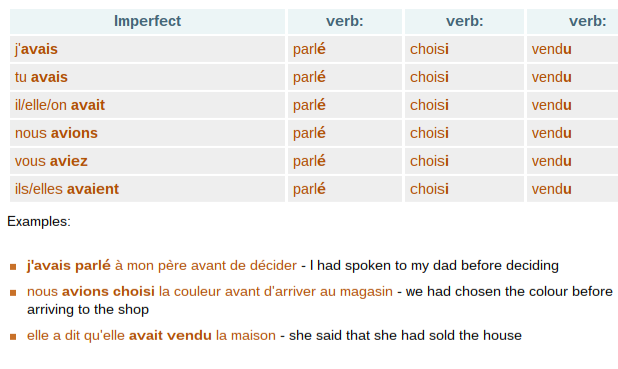
To form the pluperfect, use the imperfect tense of avoir or être and add the past participle of the main verb.
j'avais mangé avant de partir - I had eaten before leaving
Using the pluperfect tense of regular verbs with avoir
Using the pluperfect tense of verbs with être
Also you need to make sure the past participle agrees with the subject pronoun, for example, être with aller (to go):
j'étais allé(e)
tu étais allé(e)
il était allé
elle était allée
on était allé(e)(s)
nous étions allé(e)s
vous étiez allé(e)(s)
ils étaient allés
elles étaient allées
Here are a few example sentences:
j'étais allée en France avant de partir à l'université - I had gone to France before leaving for university
ils ont dit qu'elle était rentrée très tard - they said that she had come back very late
vous étiez déjà parties quand je me suis levé - you had already left by the time I got up
Página 15
Using the immediate future
The immediate future tense is also used to talk about what is going to happen in the future. It is easy to formulate.
You need:
The present tense of the verb aller + the infinitive of the main verb.
How to form the immediate future
The immediate future requires two steps:
1. Use the present tense of aller
You must select the correct part of aller that you need. For example:
je vais - I'm going
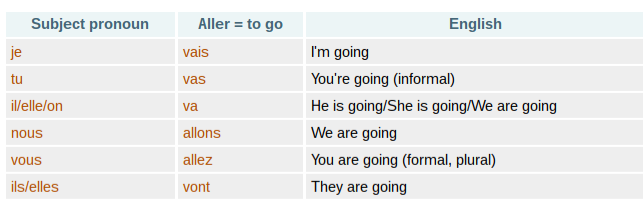
. Then simply add your infinitive
regarder la télévision ce soir - to watch television tonight
You combine the correct part of aller with the infinitive and you get the immediate future:
je vais regarder la télévision ce soir - I'm going to watch TV tonight
More examples:
tu vas + jouer au basket → tu vas jouer au basket ? - are you going to play basketball?
ils vont + partir en vacances → ils vont partir en vacances - they're going to go on holiday
elle va + aller au cinéma → elle va aller au cinéma - she's going to the cinema
Página 16
The Conditional tense-
The conditional tense is used to talk about what would happen in the future:
It is often used with the following expressions:
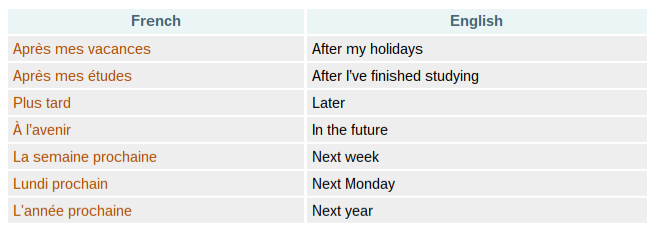
après mes vacances, j’aimerais voyager en Australie - I'd like to travel to Australia after my holidays
How to form the conditional tense
To form the conditional tense, we need to add the imperfect endings to the future stem (ie with regular -er and -ir verbs the endings are added directly to the infinitive of the verb, and with regular -re verbs, take the final -e off the infinitive and add the endings).
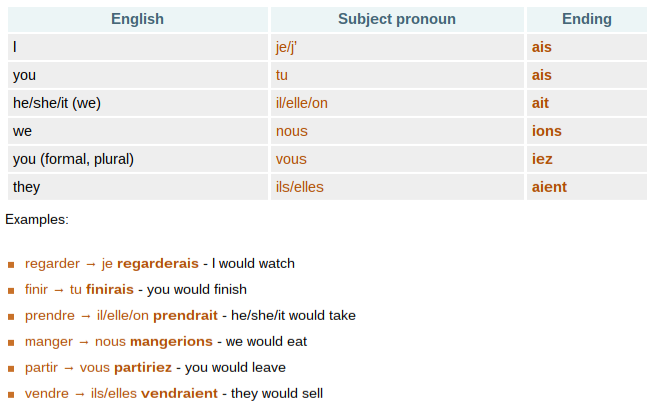
Irregular verbs and the conditional tense
The irregular verbs are the same in the conditional tense as they are in the future tense:
aller → ir → j'irais - I would go
avoir → aur → j'aurais - I would have
être → ser → je serais - I would be
faire → fer → je ferais - I would do
pouvoir → pourr → je pourrais - I would be able to
devoir → devr → je devrais - I would have to
savoir → saur → je saurais - I would know
venir → viendr → je viendrais - I would come
voir → verr → je verrais - I would see
vouloir → voudr → je voudrais - I would like
Further examples:
il pourrait se connecter à internet - he would be able connect to the internet
vous devriez partir à midi - you should leave at midday
Other uses of the conditional tense
The conditional is often used to say what would happen if something else occurred. This is formed using si meaning if and the imperfect tense:
si j'étais riche, j'achèterais une grosse voiture - if I were rich, I would buy a big car
si j’avais beaucoup d’argent, je ferais le tour du monde - if I had lots of money, I would travel the world
It's also used to talk about intentions or ambitions:
je voudrais être docteur - I would like to be a doctor
j'aimerais aller en Australie - I would like to go to Australia
Página 17
Asking questions-
In French, you can ask a question in several different ways.
1. You can simply raise your voice in a questioning way:
tu as faim ? - are you hungry?
elle est fatiguée ? - is she tired?
2. You can use est-ce que at the start of a phrase:
est-ce que tu as faim ? - are you hungry?
est-ce qu'elle est fatiguée ? - is she tired?
3. You can change the order of the subject and verb:
as-tu faim ? - are you hungry?
est-elle fatiguée ? - is she tired?
All are perfectly acceptable ways to ask a question.
What if the verb ends in a vowel?
If the verb ends in a vowel with il/elle/on, you need to add -t when you change the order around:
a-t-il faim ? - is he hungry?
joue-t-elle au tennis ? - does she play tennis?
In the perfect tense, you turn the avoir and être part around and add a hyphen:
as-tu parlé à Paul ? - have you spoken to Paul?
êtes-vous allés au restaurant ? - did you go to the restaurant?
In the immediate future tense, you turn the aller part around and add a hyphen:
vas-tu parler à Paul ? - are you going to speak to Paul?
allez-vous manger des frites ? - are you going to eat chips?
)ther common question words
You can also use question words at the start of a question. Where there is a subject pronoun in the sentence, the verb goes directly after the question word used – ie you invert the verb and the subject pronoun. For example:
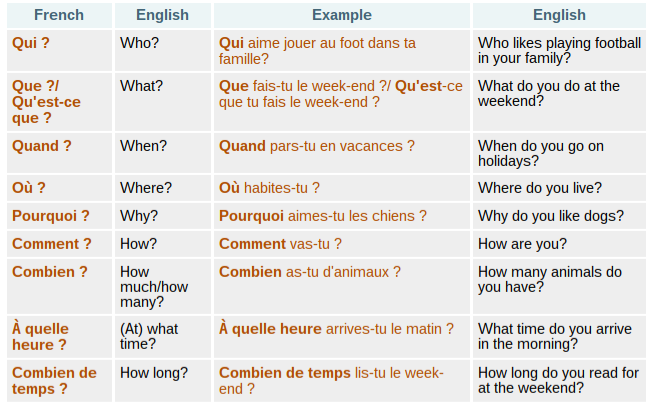
Página 18
Negative -
The negative form ne ... pas means 'not' and it forms a sandwich around the main verb of a sentence to turn it from a positive into a negative, for example:
(positive) vous visitez Paris demain - you are visiting Paris tomorrow → (negative) vous ne visitez pas Paris demain - you’re not visiting Paris tomorrow
(positive) je jouais au foot - I was playing football → (negative) je ne jouais pas au foot - I wasn't playing football
Remember that ne becomes n' before a vowel or silent -h, for example:
(positive) tu habites à Poitiers ? - you live in Poitiers? → (negative) tu n’ habites pas à Poitiers ? - you don’t live in Poitiers?
(positive) j’aime la musique pop - I like pop music → (negative) je n’aime pas la musique pop - I don’t like pop music
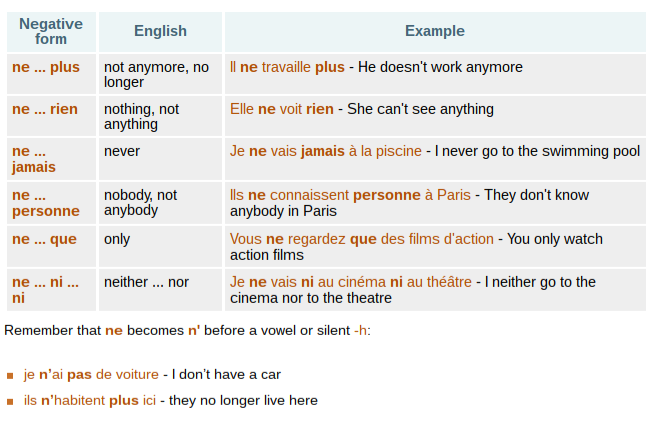
Using negatives with the perfect tense
In the perfect tense the negative forms go around the initial part of avoir or être:
je n'ai pas parlé à Marie - I haven't spoken to Marie
elle n’est pas allée à la fête - she didn’t go to the party
When two verbs are used together in a sentence, the ne ... pas goes around the first:
il ne peut pas aller au cinéma - he can't go to the cinema
je ne vais plus manger de viande - I'm not going to eat meat anymore
<
>
Página 19
Reflexive verbs-
Reflexive verbs in French are verbs which mean an action done to oneself, for example, laver means 'to wash', but se laver means 'to get washed' or literally ‘to wash oneself’.
That's why in the infinitive form the verb has se in front of it and this needs to change as we talk about other people doing the action just as in English – he has a wash/he washes himself or we are having a wash/we wash ourselves.
How to form a sentence using a reflexive verb
Reflexive verbs follow the normal formation patterns and many are regular -er verbs. They just have an extra pronoun.
Here’s an example with se laver in the present tense:
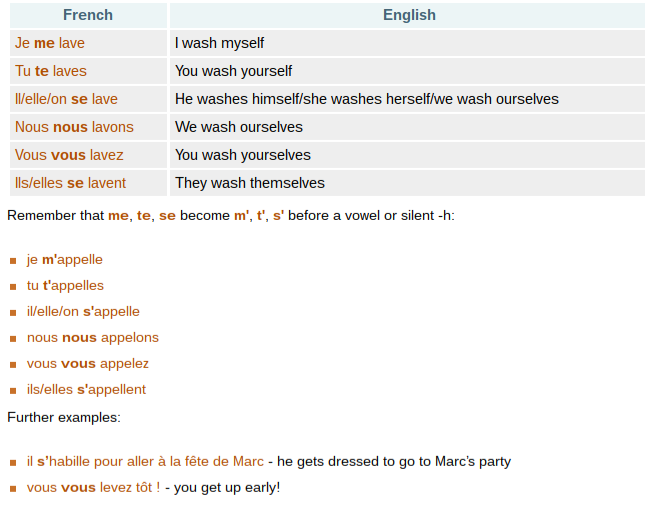
Reflexive verbs and the perfect tense
All reflexive verbs form the perfect tense with être and therefore just as in normal past tense sentences, the past participle agrees with the subject (feminine subject add -e, plural add -s and feminine plural add -es).
In the perfect tense, the reflexive pronoun always goes before the auxiliary verb, ie before the part of être being used:
je me suis lavé(e)
tu t'es lavé(e)
il s'est lavé
elle s'est lavée
on s'est lavé(e)(s)
nous nous sommes lavé(e)s
vous vous êtes lavé(e)(s)
ils se sont lavés
elles se sont lavées
e me suis levée à huit heures - I got up at 8.00
elle s’est bien amusée - she had fun
ils se sont réveillés très tôt - they woke up really early
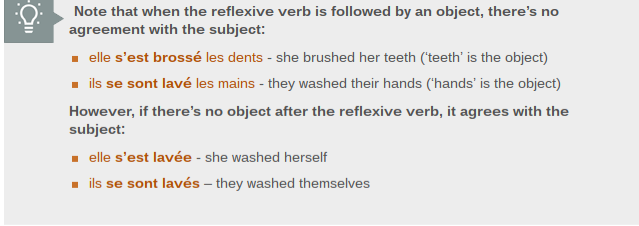
Questions and the reflexive pronoun
In questions, the reflexive pronoun goes before the verb:
Comment t'appelles-tu ? - What's your name?
À quelle heure vous êtes-vous couchés ? - What time did you go to bed?
Est-ce qu’elle se lève à 7h ? - Does she get up at seven o’clock?
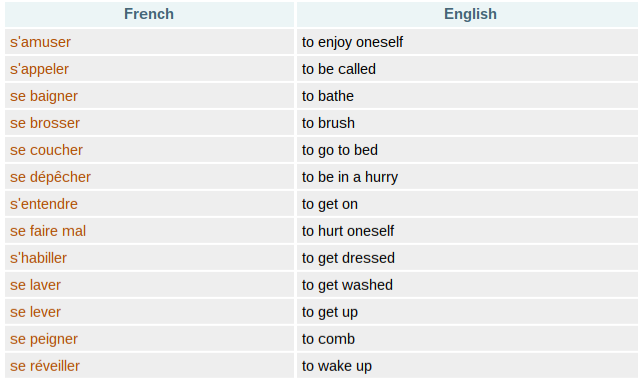
Common reflexive verbs
Here are some useful reflexive verbs:
Página 20
The Imperative-
The imperative is a used to convey a command, suggestion, request or instruction, for example:
get up! → lève-toi !
close the door → ferme la porte
add 100g of flour → ajoutez 100g de farine
How to form the imperative
To form the imperative, drop the tu, vous or nous and keep the verb in the present tense:
prendre: tu prends → prends ! - take!
faire: vous faites → faites ! - do/make!
aller: nous allons → allons ! - let's go!
partir: tu pars → pars ! - leave!
With -er verbs, take the final -s off the tu form of the verb:
tu regardes → regarde ! - look!
tu manges → mange ! - eat!
Reflexive verbs in the imperative
With reflexive verbs in the tu form, the te changes to toi, but you must add a hyphen:
tu te lèves → lève-toi ! - stand up!
tu t'assieds → assieds-toi ! - sit down!
Making suggestions
If you want to suggest doing something, use the imperative form of nous:
allons à la piscine ! - let's go to the swimming pool!
prenons un taxi ! - let's take a taxi!
Negative imperatives
The imperative is often used in the negative. Just place the negative forms around the verb:
ne regarde pas la télé ! - don't watch TV!
ne mangez pas ça ! - don't eat that!
ne viens plus chez moi ! - don't come to my place anymore!
n'allez plus au parc ! - don't go to the park anymore!
Página 21
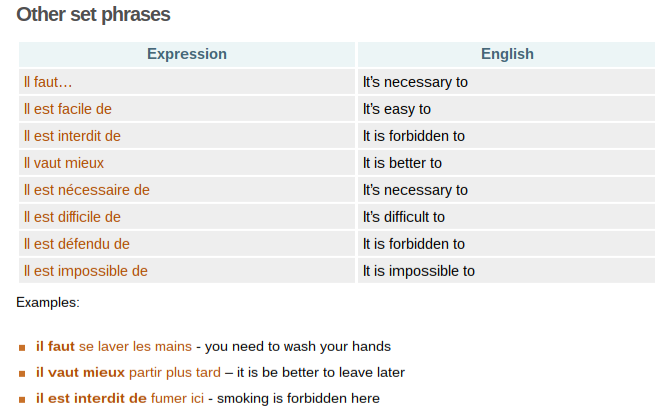
Impersonal verbs and expressions - il faut, il y a Impersonal verbs are in the third person and start with ‘il’ as they are general statements not related to a particular person.
Impersonal verbs and expressions in French
Some verbs in French are always used in the third person. This means they always start with il as they are impersonal. In other words, they are general statements not related to any particular person.
They are set phrases. Therefore the subject pronoun they start with never changes and they are only ever conjugated (changed into a different tense) in the third person. For example:
il fait beau - it’s nice (weather)
il faisait beau - it was nice (weather)
il a fait beau hier - it was nice yesterday (weather)
il fera beau demain - it will be nice tomorrow (weather)
Weather phrases
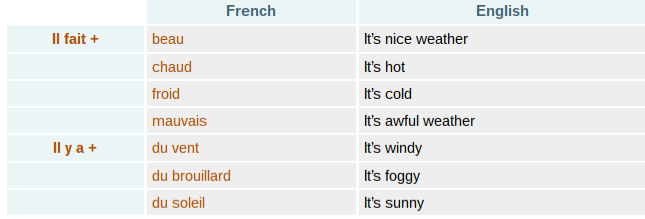
There is also:
il gèle - it’s freezing
il neige - it’s snowing
il pleut - it’s raining
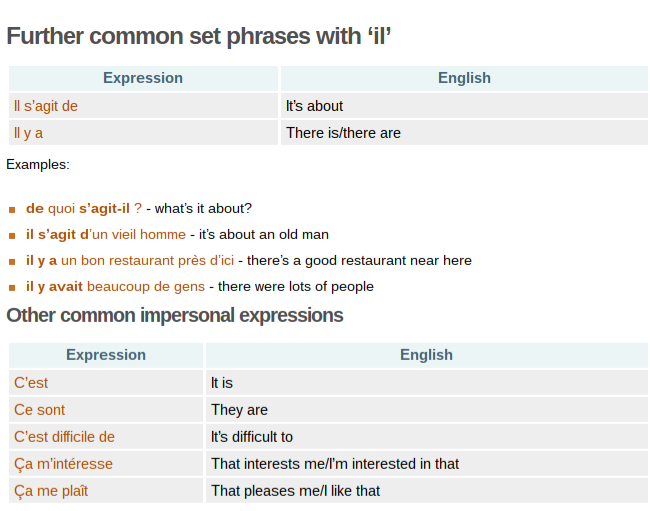
c’est difficile de tout savoir – it’s hard to know everything
ça m’intéresse d’apprendre une autre langue – I’m interested in learning another language
ça me plaît d’aller en vacances avec lui – I’m pleased to go on holidays with him
Información
- Descripción
- Notes on grammar chapter 3
- Creado por
- Annie Loizides · mar 2017
- Actualizado
- 6 mar 2018
- Visitas
- 1.368
- Valoración