
Test
Biology 243: Midterm #1 Quiz
Este test tiene tipos de pregunta que se abren en el reproductor de siempre.
Preguntas del test (102)
1Using Chargaff's rules, you can determine that the DNA of an organism that contains
10% cytosine would contain [blank_start]40%[blank_end] adenine.- A40%
- B20%
- C30%
- D60%
- E70%
2If protease treatment in Avery et al.'s experiment only prevented the transformation of
bacteria, what would have been the conclusion of these researchers?- ARNA is the genetic/hereditary material.
- BDNA is the genetic/hereditary material.
- CProteins are the genetic/hereditary materials
- DProteins and RNA are the genetic/hereditary materials.
- EProteins and DNA are the genetic/hereditary materials.
3In the DNA sequence 5'–TGAC–3', the phosphodiester linkage between the guanine and
the adenine connect:- Athe 3' end of the guanine to the 5' end of the adenine.
- Bthe 5' end of the guanine to the 1' end of the adenine.
- Cthe 3' end of the adenine to the 5' end of the guanine.
- Dthe 5' end of the guanine to the 2' end of the adenine.
- Ethe 2' end of the adenine to the 3' end of the guanine.
4The two strands of the DNA can be denatured or separated by breaking the [blank_start]Peptide Bonds[blank_end]
- APeptide Bonds
- BIonic Bonds
- CHydrogen Bonds
- DPhosphodiester Bonds
- EMetallic Bonds
5Which of the following is NOT part of the Watson-Crick model of the structure of DNA?
- ABase pairing occurs in the interior of the DNA molecule which is hydrophobic
- BPurines bind to pyrimidines
- CComplementary base pairing allows DNA to form a long polymer
- DThe two DNA strands have antiparallel orientation
- EDNA forms a double helix
6DNA is wrapped around histones, which contain many copies of the positive amino acids lysine and arginine. These positive amino acids neutralize the negative charge of the [blank_start]ribose sugar[blank_end] of the DNA wrapped around the histone.
- Aribose sugar
- Bhydroxyl group
- Cnitrogenous base
- Dphosphate group
- EAll of the options
7Arrange the following genetic terms in order from smallest to largest.
[blank_start]Genome[blank_end], [blank_start]gene[blank_end], [blank_start]nucleotide[blank_end], [blank_start]nucleoside[blank_end]- AGenome
- BGene
- CNucleoside
- DNucleotide
- Egene
- Fnucleotide
- Gnucleoside
- Hnucleotide
- Igenome
- Jgene
- Knucleoside
- Lgenome
- Mgene
8Which one of the following is not true of genes?
- AAre made of deoxyribonucleotides
- BPart of the genome that produces RNA molecules
- COnly codes for proteins
- DAre found on chromosomes and plasmids in prokaryotes
- EFunctional unit of hereditary
9Which type of molecule is adenosine?
- ANitrogenous base
- BDeoxyribonucleotide
- CRibonucleotide
- DRibonucleoside
- EPurine
10Integrase is an enzyme that functions to insert the viral genome into the host chromosome. The most likely outcome as a result of treating bacteriophages with an integrase inhibitor is:
- AHigher rate of infection
- BIncreased circularization of viral DNA
- CLower rate of lysogeny
- DElimination of the lytic cycle
- EHigher content of viral DNA in the host genome
11The distinct phenotypes exhibited between two siblings are due to different [blank_start]alleles[blank_end]
- Aalleles.
- Bgene expression.
- Cgenotypes.
- Dgenomes.
- Eall of the options.
12When a mixture of debris from killed virulent bacteria and living non-virulent bacteria are injected into mice:
- AThe mice survive because the virulent bacteria are killed.
- BThe mice survive because none of the living bacteria are virulent.
- CThe mice survive because the virulent bacteria are transformed into non-virulent bacteria.
- DThe mice are killed because the non-virulent bacteria are transformed into virulent
bacteria. - EThe mice are killed because the virulent bacteria are revived
13Analysis of the genome of a new algal cell reveals a tetraploid genome containing a total
number of 28 chromosomes. The number of unique chromosomes in this organism is [blank_start]7[blank_end]- A7
14Which one of these is not part of a chromosome?
- AUracil
- BNucleosome
- CDeoxyribonucleic acid
- DHistone
- EPhosphate
15The genome of a prokaryote consists of a:
- ADouble-stranded circular DNA molecule
- BSingle-stranded circular DNA molecule
- CDouble-stranded circular RNA molecule
- DSingle-stranded linear RNA molecule
- EDouble-stranded linear DNA molecule
16Below is a structure of [blank_start]thymine[blank_end], a [blank_start]pyrimidine[blank_end] base
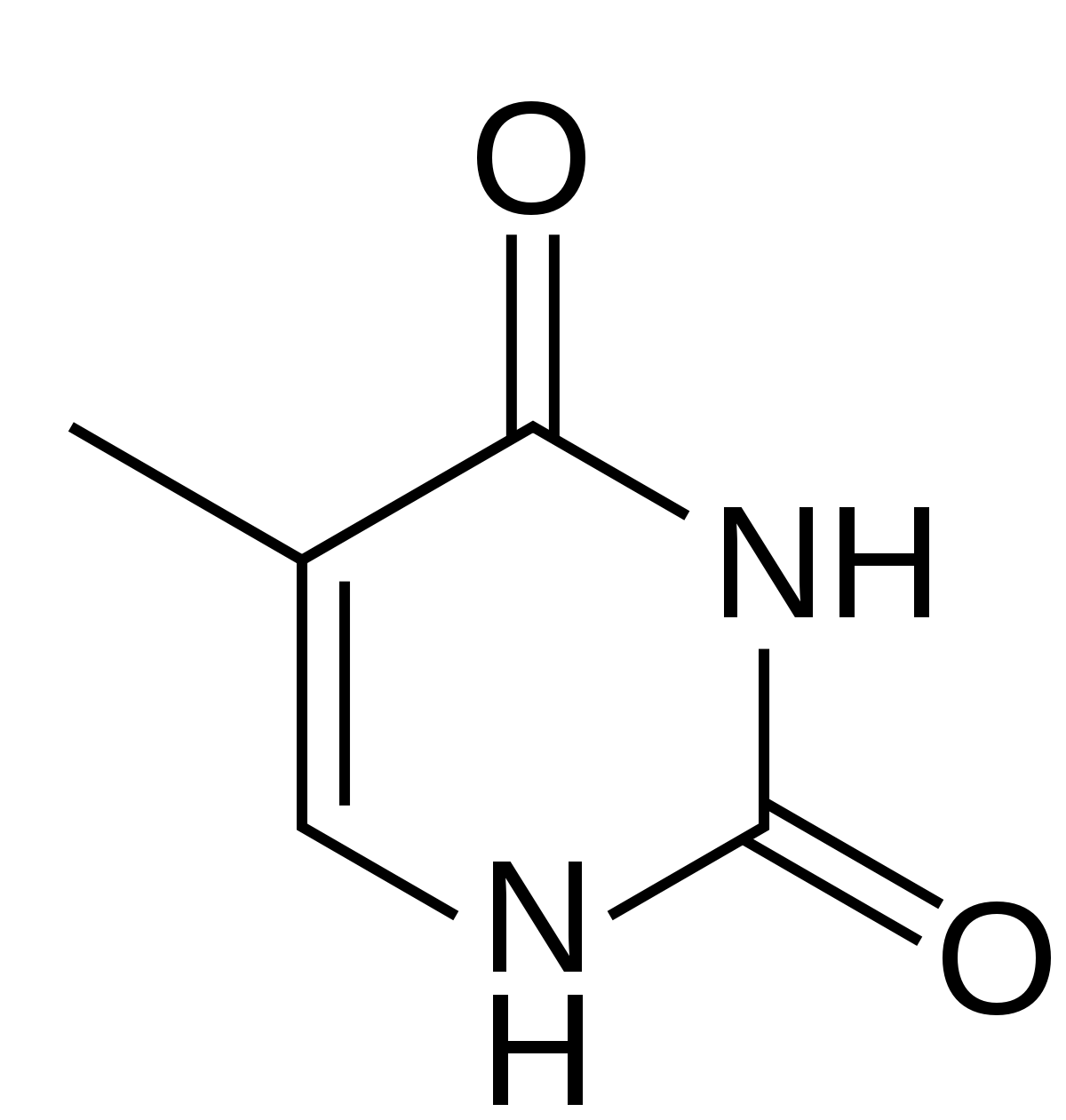
- Athymine
- Bcytosine
- Cadenine
- Dguanine
- Epyrimidine
- Fpurine
17In gene expression, the process of transcription involves the:
- ASynthesis of transfer RNA from a gene
- BSynthesis of eukaryotic ribosomal RNA from a gene
- CSynthesis of prokaryotic ribosomal RNA from a gene
- DSynthesis of messenger RNA from a gene
- EAll of the above
18Which one of these is not part of a chromosome?
- AGenome
- BGene
- COrigin of Replication
- DTelomere
- ECentromere
19In a nucleotide, the phosphate is attached to the [blank_start]5'[blank_end] carbon of the sugar, and
the base is attached to the [blank_start]1'[blank_end] carbon of the sugar.- A5'
- B1'
- C2'
- D3'
- E1'
- F5'
- G3'
20Which one of these is not a protein?
- ACholesterol
- BInsulin
- CAlcohol dehydrogenase
- DRNAse
- EPhotoreceptor
21When we say that DNA replication is semiconservative, we mean that:
- AOnly half of an organism's DNA is replicated during each cell division.
- BAlmost all the linear chromosome is duplicated except at the 3’ ends.
- CWhen DNA is replicated, one double helix contains both parental strands and one
contains two newly synthesized daughter strands. - DWhen DNA is replicated, each double helix contain mixtures of parental and newly
synthesized DNA dispersed in each strand. - EWhen DNA is replicated, each new double helix contains one parental strand and one
newly synthesized daughter strand
22You have isolated and purified various molecules needed for DNA replication. When you
add some DNA to the mixture, replication occurs but the DNA molecules formed are
defective: each molecule consists of a normal DNA strand paired with segments of DNA
that are a few hundred nucleotides long. What have you likely left out of the mixture?- ADNA polymerase
- BPrimase
- CTopoisomerase
- DOkazaki fragments
- ELigase
23The leading strand is the daughter strand that has its [blank_start]3'[blank_end] end pointed toward the
replication fork and is therefore synthesized [blank_start]continuously[blank_end].- A3'
- B5'
- Ccontinuously
- Din a series of segments
24During DNA replication, an origin of replication produces a [blank_start]replication bubble[blank_end] with a [blank_start]replication fork[blank_end] on each side that contains a [blank_start]leading strand and a lagging strand.[blank_end]
- Areplication bubble
- Breplication fork
- Cfork
- Dbubble
- Eleading strand and a lagging strand.
- Ftwo leading strands
- Gtwo lagging strands
25Why are telomeres a necessary component of linear chromosomes?
- AThey direct where DNA synthesis will begin at each origin of replication
- BThey are involved in repairing base mispairing that occur during DNA replication
- CThey extend the life of cells because DNA is shortened after each round of replication
- DThey ensure that each chromosome is faithfully segregated to each daughter cell
- EThey ensure that each chromosome is duplicated only once prior to cell division
26In contrast to linear DNA, circular DNA replication typically:
- AOccurs only at a single replication fork.
- BDoes not produce a replication bubble.
- CHas a single origin of replication.
- DDoes not produce Okazaki fragments.
- EDoes not require single-strand binding proteins.
27A person has a mutation that inactivates the gene encoding DNA uracil glycosylase.
What is the most likely result of this mutation?- AShorter telomeres after each round of DNA replication
- BGreater rate of mutations in the genome.
- CThe inability to produce RNA that has uracil in it
- DThe inability to produce RNA that has cytosine in it
- EThe inability to produce DNA that has cytosine in it.
28Below is a DNA template with a bound RNA primer. The first base that will be added in
the synthesis of the daughter strand is [blank_start]thymine.[blank_end]
5’-TCGAGCATGTACACTGGTAA-3’
ACAU- Athymine.
- Badenine.
- Ccytosine.
- Dguanine.
- Euracil.
29A template DNA sequence is 3'-GAACGGTAT-5'. What is the mRNA sequence? [blank_start]5'-CUUGCCAUA-3'[blank_end]
- A5'-CUUGCCAUA-3'
30Which of the following enzymes is responsible for initiating the proofreading repair
mechanism?- ADNA ligase
- BDNA polymerase
- CAP endonuclease
- DDNA uracil glycosylase
- EDNA helicase
31Since DNA is synthesized in the 5’ to 3’ direction, which of the following is true?
- AThe template must be read in the 5’ to 3’ direction
- BPolymerase must add successive nucleotides to the 3’-OH end of the newly forming
chain - CPrimase must add RNA nucleotides to the growing 5’ end.
- DBoth new strands in each replication fork is synthesized continuously in a 5’ to 3’
direction - EEach nucleotide is added to the 5’-phosphate of the previous nucleotide during synthesis
32Only one of the DNA strands known as the template strand in a gene is read by RNA
polymerase to synthesize mRNA. Which is true of the other DNA strand known as the
non-template strand or coding strand in a gene?- AHas the same sequence as mRNA except uracil has been replaced with thymine
- BHas complementary sequence of mRNA except uracil has been replaced with thymine
- CHas complementary sequence of mRNA except uracil has been replaced with adenine
- DRNA polymerase travels along the coding strand in a 5’-3’ direction
- ERNA polymerase travels along the coding strand in a 3’-5’ direction
33Suppose you add fluorescent ribonucleotides to a cell undergoing DNA replication so that the RNA primers used in DNA synthesis glow when viewed with a fluorescent microscope. You notice that, near each replication fork, one strand glows more than the other. Which strand is it that glows more, and why?
- AThe leading strand glows more because RNA primers are added in the 5’-3’ direction.
- BThe leading strand glows more because RNA primers are added more frequently during
DNA synthesis of the daughter strand. - CThe leading strand glows more because DNA synthesis occurs continuously in the 5’-3’
direction. - DThe lagging strand glows more because its RNA primer is mainly localized at telomeres.
- EThe lagging strand glows more because its RNA primer is nearer the replication fork.
34During DNA replication in a cell, RNA primase synthesizes a primer that is
complementary to the region in the sequence below shown in bold.
5'–CACAGCAGAAACCTACAACTCATG–3'
What is the primer sequence?
[blank_start]5'–GUUGUAGGUUUC–3'[blank_end]- A5'–GUUGUAGGUUUC–3'
35You culture bacteriophages in the presence of “heavy” nitrogen until both DNA strands
of its genome are “heavy.” Then, you allow the bacteriophages to undergo two complete
rounds of DNA replication in the presence of “light” nitrogen. What ratio of “heavy” to
“light” viral DNA would you expect to find at the end of two complete rounds of
replication? [blank_start]1:3[blank_end]- A1:3
- B0:4
- C2:2
- D3:1
- E4:0
36The following enzymes play important roles in DNA replication: DNA polymerase,
primase, ligase, helicase. In what order do they work during replication?
[blank_start]Helicase[blank_end], [blank_start]primase[blank_end], [blank_start]DNA polymerase[blank_end], [blank_start]ligase[blank_end]- AHelicase
- BDNA Polymerase
- CPrimase
- Dprimase
- Ehelicase
- FDNA polymerase
- GRNA polymerase
- Hligase
- Ipolymerase
37What is the order of processes that support the central dogma?
[blank_start]DNA replication[blank_end], [blank_start]transcription[blank_end], [blank_start]translation[blank_end]- ADNA replication
- BRNA replication
- Ctranscription
- Dreverse transcription
- Etranslation
- Ftranscribing
38Translation is the process by which:
- AInformation in DNA is used to synthesize an exact copy of that DNA.
- BRibosomes synthesize protein from information in an RNA molecule.
- CA section of DNA is used as information to generate an RNA molecule.
- DAn RNA molecule is used to repair damage to a related DNA molecule.
- ERibosomes read the information in a DNA molecule and use it to synthesize protein.
39Which one of the following activities would least likely be found in a topoisomerase?
- ACutting a phosphodiester linkage
- BInducing or relaxing twists in double-stranded DNA
- CAdding nucleotides to the end of a DNA strand
- DReforming phosphodiester linkages
- ETopoisomerases are equally likely to perform all of these functions.
40Which of these apply to the central dogma in prokaryotes?
- ATranscription and translation occur simultaneously.
- BTranscription and translation occur in different cellular compartments.
- CTranslation only occurs when transcription of mRNA has been completed.
- DReverse transcription only occurs when translation is inhibited.
- EReverse transcription only occurs when DNA replication is inhibited.
41RNA polymerase can do which one of the following?
- AAllow RNA-DNA hybrids to form
- BRelease a finished RNA transcript from a DNA strand
- CSeparate DNA strands
- DRestore the original DNA strand
- ERNA Polymerase is capable of all these activities
42 The human body contains approximately 200 major cell types. They look and function
differently from one another because:- AEach cell type has a slightly different genome.
- BEach cell type expresses a different set of genes.
- CEach cell type’s genome changes depending on the external environment.
- DEach cell type expresses the same set of genes, but in different orders at different times.
- EEach cell type has a slightly different genome and each expresses a different set of genes.
43Alternative splicing allows for:
- ATwo or more different proteins to be made from a single processed mRNA
- BEnhanced recognition of an mRNA by a ribosome
- CIncreased stability of a mature mRNA
- DDifferent polypeptides to be made from a single gene
- EMultiple genes to be used to encode for a single polypeptide
44Which of the following functions as a “stop” signal for a prokaryotic RNA polymerase?
- AFusion of two transcription bubbles
- BAddition of a long chain of adenine nucleotides to the 3’ end
- CFormation of a GC hairpin
- DEnhancer sequences downstream of the stop codon
- EAn intron located in the 5’-untranslated region
45 In eukaryotes, transcriptional activator proteins bind to _____________; generalized
transcription factors bind to ________________- Apromoters; terminators
- BDNA polymerases; RNA polymerases
- Cenhancers; promoters
- Dterminators; RNA polymerases
- Epromoters; enhancers
46The coding strand is:
- AThe single-stranded RNA molecule that is transcribed from DNA in the 5’ to 3’ direction
- BThe single-stranded RNA molecule that is transcribed from DNA in the 3’ to 5’ direction
- CThe single DNA strand that is read by RNA polymerase in a 3’ to 5’ direction
- DThe single DNA strand that has the same sequence as RNA except for the presence of thymine
- EComplementary to RNA
47 The poly-A tail is added to the [blank_start]3’ untranslated region[blank_end] of eukaryotic mRNAs
- A3’ untranslated region
- B5’ untranslated region
- C5’ end of the first exon
- D3’ end of the first intron
- EStop codon
48In eukaryotes, where do general transcription factors bind?
- A5’ UTR
- BPromoter
- CDonor splice site
- DNear the start codon
- E5’ cap
49A regulatory protein called Pumilio binds to the 3’UTR of an mRNA. The Pumilio protein
most likely regulates the expression of its target gene at the [blank_start]transcriptional[blank_end] level.- Atranscriptional
- Bposttranscriptional
- Cepigenetic
- Dtranslational
- Eposttranslational
50Which of these is not part of an mRNA molecule?
- AIntrons
- BExons
- C5' CAP
- D3’ untranslated region
- E5’-polyadenylated tail
51Which is not true about the transcriptional unit of a gene?
- ALocated downstream of the promoter on the coding strand.
- BPart of the gene that is transcribed into RNA.
- CBordered by the transcriptional start and transcriptional terminator sites.
- DOnly encodes the Open Reading Frame
- EIs read by RNA polymerase in a 3’ to 5’ direction on the template strand.
52Which one of the following statements about RNA is incorrect?
- AThe nucleotide at the 5' end of an RNA molecule is typically a nucleoside triphosphate.
- BRNA is usually found in double-stranded form
- CRNA molecules are typically shorter than DNA molecules.
- DRNA molecules can form base pairs within a single strand
- ERNA molecules are capable of evolving their enzymatic activity over time.
53Which of the following molecules is made during the process of transcription?
- AmRNA
- BtRNA
- CrRNA
- DmicroRNA
- EAll of the choices
54A messenger RNA lacking a poly-A tail is likely to be:
- ARetained in the nucleus.
- BExported outside the cell
- CRemoved of introns
- DExceptionally sensitive to degradation.
- ETranslated into a polypeptide.
55The image below shows a pre-mRNA transcript that contains four exons and three introns. The splicing pattern of this pre-mRNA transcript would generate a mature mRNA containing the exons:
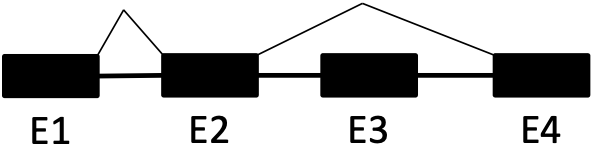
- AE1-E2-E3-E4
- BE2-E3-E4
- CE1-E3-E4
- DE1-E2-E4
- EE1-E2-E3
56The gene for skin colour encodes a pigment molecule called melanin. An albino individual shows a mutation in this gene that does not result in the synthesis of mRNA. The absence of gene expression caused by the mutation is a result of a defect in:
- ATATA box
- BPolyadenylation
- CCapping
- DIntron removal
- EEnhancer
57An intron is:
- APart of a RNA that is synthesized in the cytoplasm.
- BAn RNA sequence that is removed during the processing of an RNA molecule in the nucleus.
- CPart of an intact, mature mRNA that leaves the nucleus.
- DPart of an RNA transcript that is not present in the DNA template.
- EA type of transfer RNA.
58An exon is:
- AA RNA that is clipped out post-transcriptionally
- BRNA that is removed during the processing of an RNA molecule and remains inside the
nucleus. - CPart of an intact, mature mRNA that leaves the nucleus.
- DTransfer RNA that binds to the codon.
- EAttached to the 5’-end of the mRNA molecule
59RNA processing occurs in:
- AProkaryotes only
- BEukaryotes only
- CViruses only.
- DBoth prokaryotes and eukaryotes
- EBoth prokaryotes and viruses.
60Transcription of RNA from DNA in eukaryotes requires:
- ATranscription factors
- BActivator proteins
- CA promoter sequence
- DRNA polymerase
- EAll of these choices are correct
61Which of the following steps in translation is not part of the elongation phase?
- AMovement of the ribosome three bases closer to the 3’ end of the mRNA
- BEjection of an uncharged tRNA from the E site of the ribosome
- CBinding of initiator tRNA to AUG start codon
- DPeptide bond formation
- EIntroduction of a charged tRNA into an unoccupied A site of the ribosome
62How many different types of aminoacyl tRNA synthetases are there? [blank_start]20[blank_end]
- A20
63What is an anticodon?
- AThe part of an mRNA that signals translational termination
- BThe part of an mRNA that signals the start of translation
- CThe part of an mRNA that is not part of the open reading frame
- DThe part of tRNA that binds to a codon in mRNA
- EThe part of a tRNA that accepts an amino acid, via a reaction catalyzed by tRNA
64How does a peptide bond form between amino acids?
- Athrough the interaction between amino groups and carboxyl groups of adjacent amino acids
- Bthrough the interaction between hydrogen atoms of adjacent amino acids
- Cthrough the interaction between amino groups and r groups of adjacent amino acids
- Dthrough the interaction between water molecules and carboxyl groups of adjacent amino acids
- EA peptide bond can form between any chemical groups of adjacent amino acids.
65Arrange the steps in translation in order from earliest to latest.
A) Movement of the ribosome three bases closer to the 3' end of the mRNA
B) Peptide bond formation
C) Identification of initiator codon and joining of large and small ribosomal subunits
D) Release of the polypeptide from the ribosome and dissociation of ribosomal subunits
E) Binding of a charged tRNA to a codon in the A site of ribosome- AC, B, E, A, D
- BC, E, B, A, D
- CE, B, A, C, D
- DE, A, B, C, D
- EE, B, C, A, D
66Which one of these is not post-translational regulation?
- ARegulation of protein phosphorylation
- BRegulation of protein degredation
- CRegulation of protein synthesis
- DRegulation of protein methylation
- ERegulation of protein localization in the cell
67A mutation in the 9th nucleotide from the 5’ end of the coding sequence: 5’-GGATGCCGCAATTTACAGCCTGA-3’ has changed the cytosine into a thymine. The consequence of this mutation is:
- AThe entire amino acid sequence of the polypeptide is different compared to a non-mutated
polypeptide. - BThe polypeptide is two amino acids long.
- CThe polypeptide is no longer expressed.
- DThe third amino acid is now a different amino acid compared to a non-mutated polypeptide.
- EThe third amino acid is the same amino acid in a non-mutated polypeptide.
- AThe entire amino acid sequence of the polypeptide is different compared to a non-mutated
68Beta-mercaptoethanol is a chemical that disrupts disulfide bonds between two cysteines. Treatment of hemoglobin with this chemical will have the greatest effect on the ____ structure of the protein.
- AAlpha Helical
- BPrimary
- CSecondary
- DTertiary
- EQuaternary
69The function of tRNA is to
- AProvide a site for polypeptide synthesis
- BTransport amino acids to the ribosome.
- CAssemble the translational initiation factors on the mRNA
- DAssemble the small and large subunits of the ribosome
- EFacilitate 5’-scanning of the mRNA
70 In the formation of an initiation complex, a [blank_start]Met-tRNA[blank_end] is positioned first.
- AMet-tRNA
- BSer-tRNA
- CTyr-rRNA
- DVal-tRNA
- EVal-rRNA
71In messenger RNA, the nucleotide UAG specifies:
- AArginine
- BSerine
- CStop
- DProline
- EAspartate
72The proteasome is a large protein complex that regulates gene expression at the level of:
- ATranscription
- BPost-transcription
- CTranslation
- DPost-translation
- EEpigenetics
73In what order does a charged tRNA move through the sites of a ribosome?
- AThe tRNA binds to the A site, then moved to the P site, then the E site as the ribosome shifts.
- BThe tRNA binds to the A site, then moved to the E site, then the P site as the ribosome shifts.
- CThe tRNA binds to the P site, then moved to the A site, then the E site as the ribosome shifts.
- DThe tRNA binds to the P site, then moved to the E site, then the A site as the ribosome shifts.
- EThe tRNA binds to the E site, then moved to the P site, then the A site as the ribosome shifts.
74Which of the following is a critical region of a tRNA molecule?
- AAmino acid attachment site and start codon
- BAnticodon loop and ribosome binding site
- CStop codon and Shine-Dalgarno sequence
- DAmino acid attachment site and anticodon loop
- ERibosome binding site and 5′-Cap
75Referring to the following mRNA sequence, 5’AUGAGACUUACCGAA3’, what would the
anti-codon look like if the second nucleotide of the fourth codon was mutated to “U”?- A3′-TAG-5′
- B3′-UAG-5′
- C3′-AAC-5′
- D3′-AUG-5′
- E3′-AUC-5
76Imagine that a primary RNA transcript from your favorite eukaryotic gene was processed
incorrectly, such that it has no 5' cap. What would be the result?- ATranslation would proceed normally.
- BTermination would be affected, as release factors would be unable to bind to ribosomes.
- CTranslation would commence at an AUG site in the middle of the RNA sequence.
- DThe initiation complex would fail to form properly, and translation would not occur.
- ETranslation would commence properly, but elongation would be severely affected.
77 The gene that encodes for actin is highly transcribed in muscle cells. Which is most likely
true for the actin gene in muscle cells?- AHigh nucleosome density in the actin promoter.
- BHigh trimethylation of histones
- CHigh methylation of CpG islands.
- DHigh acetylation of histones.
- EHigh transcription rates during metaphase.
78The histone code is the:
- ANucleotide sequence of an individual histone protein’s gene
- BPattern of chemical modification of the DNA wrapped around an individual histone.
- CPattern of chemical modification of the histone tails
- DNumber of amino acids in an individual histone that are methylated.
- ENumber of methylated nucleotides in the promoter
79Proteins that prevent inappropriate folding of newly synthesized proteins are called:
- AChaperones
- BInitiation factors
- CPolymerases
- DRibosomes
- ESynthetases
80You are studying a protein that you call Protein X. There is an aspartic acid at a key position in Protein X that is important in the folding and stabilization of that protein. If this aspartic acid is changed to a different amino acid, which one of the following amino acid substitutions is most
likely to allow the protein to fold normally?- AThreonine
- BGlycine
- CGlutamic acid
- DPhenylalanine
- EAlanine
81In their experiments to determine the transforming principle, Avery,
MacLeod, and McCarty used enzymes that break down:- Aprotein, DNA, and RNA.
- Bprotein and RNA.
- CDNA.
- Dprotein, lipids, and RNA.
82Each DNA nucleotide is made up of:
- Aa six-carbon sugar, a phosphate group, and one of twenty
amino acids. - Ba five-carbon sugar, a nitrogenous base, and one of twenty
amino acids. - Ca five-carbon sugar, a phosphate group, and one of four
nitrogenous bases. - Da six-carbon sugar, a nitrogenous base, and one of four amino
acids. - Ea five-carbon sugar, a phosphate group, and one of four amino
acids.
- Aa six-carbon sugar, a phosphate group, and one of twenty
83Based on the chemical structure, this nucleotide is [blank_start]adenine[blank_end], and is a [blank_start]purine[blank_end].
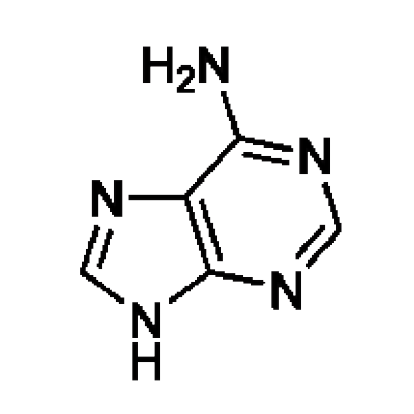
- Aadenine
- Bpurine
84The DNA of an organism is studied and found to contain 14% guanine. This
organism should have [blank_start]36%[blank_end] thymine and [blank_start]14%[blank_end] cytosine in its DNA.- A36%
- B14
- C14%
- D36
- E86
85Which of the following nucleotide sequences represents the complementary
sequence that would bind to the DNA strand 5'-GACGTT-3'?- A5'−TCATGG−3'
- B3'−TCATGG−5'
- C3'−CTGCAA−5'
- D3'−AGTACC−5’
- E5’-CUGCAA-3’
86The energy to form the new bond when a nucleotide is
added to a growing DNA strand is provided primarily by:- Aunwinding of the DNA double helix.
- Bhydrolysis of pyrophosphate.
- Cbreaking hydrogen bonds between
base pairs. - DDNA polymerase.
- EEnergon
87Label the letters on the image with their appropriate replication enzymes.
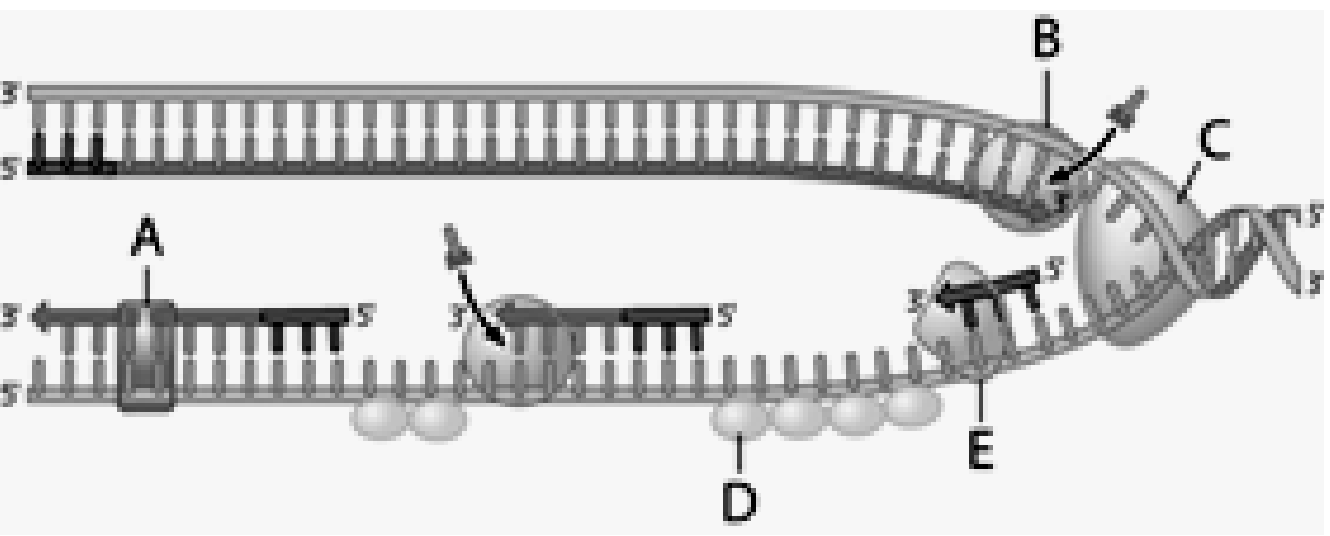
- ADNA Polymerase (III)
- BHelicase
- CRNA Primase
- DSingle Stranded Binding Proteins
- ETopoisomerase
- FSliding Clamp
- GA mutation
- HLigase
- IDNA Polymerase III
- JDNA Polymerase I
88Adding nucleotides onto a growing DNA strand during DNA replication in
cells occurs in:- Athe 5' → 3' direction for the leading strand and the 3' → 5' direction on the
lagging strand. - Beither the 5' → 3' direction or the 3' → 5' direction on both strands,
depending on where replication begins. - Cthe 5' → 3' direction only.
- Dthe 3' → 5' direction for the leading strand and the 5' → 3' direction on the
lagging strand. - EIt depends….
- Athe 5' → 3' direction for the leading strand and the 3' → 5' direction on the
89Lack of telomerase activity limits:
- Athe rate of DNA replication
- Bthe number of replication bubbles that
form during replication - Cthe number of times a cell can divide
- Dthe number of Okazaki fragments that
can be linked together - Ethe rate of meiosis
90So…..which of the following molecules is NOT involved
in transcription?- ADNA, 5'-3' strand
- BDNA, 3'-5' strand
- CRNA polymerase
- DtRNA
- EDNA, 5'-3' strand and tRNA
91The place where RNA polymerase first associates with DNA so that transcription
can begin is called the [blank_start]promoter[blank_end] and is located [blank_start]upstream[blank_end] of the transcribed region.- Apromoter
- Binitiator
- Cupstream
- Ddownstream
- Eoperon
- Factivator
- Genhancer
92Proteins called transcription factors are involved in [blank_start]initiation[blank_end] of transcription.
- Ainitiation
- Belongation
- Ctermination
- Dstabilization
93What would happen if an enhancer sequence was mutated so that its binding
partner was constitutively bound?- ANo transcription would occur as the site is now blocked to other proteins.
- BTranscription would not change.
- CNo transcription would occur because the mediator complex could not
form. - DTranscription would continuously occur.
94How is it possible that an mRNA
could have the correct sequence
yet still not be translated
appropriately?- AThe 5’ cap was not added.
- BThe DNA sequence was incorrect.
- CThe poly-A tail was not formed.
- DNone of the options
95In translation the reading frame is established by
- Aremoval of the cap from mRNA.
- Bpairing of initiator tRNA with the start codon.
- Cthe first base in the mRNA molecule.
- Dthe first tRNA to bind a codon at the A site.
96Which is the type of RNA that is typically found as a strand about 75−90 bases
long that folds into a structure with four double-helical segments?- AsnRNA
- BsiRNA
- CrRNA
- DtRNA
- EmRNA
97Assume that an mRNA molecule is made beginning complementary to this DNA
sequence: 3'−CTTACATGGCATCC−5’ The third codon (counting the start codon
as the first codon) directs incorporation of which amino acid in the polypeptide?- Acysteine
- Bhistidine
- Cthreonine
- Darginine
98Individuals with the genetic condition sickle cell anemia have hemoglobin β
chains with the amino acid valine where normal hemoglobin β chain has
glutamic acid. This is the result of a ____ mutation.- Amissense
- Bchromosomal
- Cframeshift
- Dsilent
- Etwo of the options
99The consequence of a hemoglobin β chain with valine is a:
- ANew phenotype
- BNew allele
- CIncreased genetic diversity
100The advantage of sexual reproduction over asexual reproduction is that:
- Asexual reproduction requires an interaction between two individuals.
- Bthere is a mixing of genetic information into a new combination in the next
generation. - Cit ensures a greater number of progeny
- Dit keeps the number of chromosomes constant more effectively.
101A homologous chromosome pair is best described as two chromosomes having:
- Athe same genes in the same order but having different alleles.
- Bthe same alleles of the same genes in the same order.
- Cdifferent genes in the same order and possibly having different alleles of some
genes. - Ddifferent alleles of the same genes arranged in a different order.
102Sister chromatids are best described as two chromosomes having:
- Adifferent alleles of the same genes arranged in a different order.
- Bthe same genes in the same order but having different alleles.
- Cthe same alleles of the same genes in a different order.
- Dan identical DNA sequence.
Información
- Descripción
- Has lecture quiz questions in a mix
- Autor
- Natasha Gidluck
- Idioma
- English
- Visitas
- 37
- Etiquetas
- Valoración
- Aún sin valoraciones Valora este test