
Test
2a Web application vulnerabilities
Este test tiene tipos de pregunta que se abren en el reproductor de siempre.
Preguntas del test (16)
1For each risk on OWASP top 10, it describes:
> [blank_start]threat[blank_end] [blank_start]agent[blank_end]: who carry out the attack
> [blank_start]vulnerability[blank_end]: how is it possible
>[blank_start]impact[blank_end] : what can happen
> how to d[blank_start]etect[blank_end]
>how to p[blank_start]revent[blank_end]- Arevent
- Betect
- Cimpact
- Dvulnerability
- Ethreat
- Fagent
2A1 Injections:
> Examples: S[blank_start]QL[blank_end], L[blank_start]DAP[blank_end]
> Vulnerability: S[blank_start]pecial[blank_end] character sequences in user inputs can trigger an a[blank_start]ction[blank_end] in the context
> Impact: The [blank_start]meaning[blank_end] of a request can be modified- Ameaning
- Bpecial
- Cction
- DQL
- EDAP
3A1 - Injection - [blank_start]SQL[blank_end] injection
> [blank_start]Blind[blank_end] injection: When there is no [blank_start]error[blank_end] message and no other output we can get feedback by inserting an operation that takes [blank_start]time[blank_end] to execute
>> catid = 2 union select
if([blank_start]substring[blank_end](user_password,1,1)=char(50), [blank_start]waitfor[blank_end](50),null) from users where user_id=1;
>>> "%' AND LENGTH ((SELECT password FROM users WHERE name = 'inspector_derrick')) = {} [blank_start]AND[blank_end] '1' = '[blank_start]1[blank_end]"
> [blank_start]OR[blank_end] '1' = '1' > return all rows
> url: /personalities[blank_start]?[blank_end]id=2[blank_start]'[blank_end] UNION SELECT name, message FROM contact_messages WHERE mail = 'james@bond.mi5"- ASQL
- BBlind
- Ctime
- Derror
- Esubstring
- Fwaitfor
- GAND
- H1
- IOR
- J?
- K'
4A1 Injection - [blank_start]LDAP[blank_end] injection
LDAP is the lightweight directory access protocol to [blank_start]query[blank_end] directories to..
> verify a user's password
> read a user's attribute
>> & = and, | = or, [blank_start]*[blank_end] = wildcard
eg. (&(name=admin)([blank_start]&[blank_end]))(pwd=...))
> (&) is always [blank_start]true[blank_end] and pwd=... is [blank_start]ignor[blank_end]ed
> In 2017, Joomla bug: using a [blank_start]wildcard[blank_end] we can guess one character at a time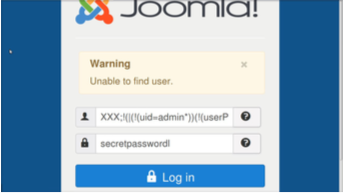
- ALDAP
- Bquery
- C*
- D&
- Etrue
- Fignor
- Gwildcard
5A1 - Injection - [blank_start]command[blank_end] injection:
Runtime runtime = Runtime.getRuntime();
String[] cmd = new String[3];
cmd[0] = "cmd.exe" ;
cmd[1] = "/C";
cmd[2] = "dir " + *chosen_dir*;
Process proc = runtime.exec(cmd);
> If [blank_start]chosen_dir[blank_end] is ’photo & rmdir /s /q photo’ u'll remove photo!- Acommand
- Bchosen_dir
6A1 Injection protection:
> [blank_start]Input[blank_end] [blank_start]validation[blank_end] : refuse the characters u don't want with a regex
> Encode data: [blank_start]escape[blank_end] special characters
>> in SQL: ' becomes \'
>> in HTML: < becomes <
>> in LDAP: ( becomes \28
> use [blank_start]prepared[blank_end] [blank_start]statement[blank_end] in SQL:
PreparedStatement pstmt =
con.prepareStatement(
"SELECT pwhash FROM table WHERE name = ? and
pass = ?"
);
pstmt.setString(1, name_received);
pstmt.setString(2, pass_received);- AInput
- Bvalidation
- Cescape
- Dprepared
- Estatement
7A4 - XML External entities:
> XML = markup language
> elements are delimited by start and stop tags : <name> peter </name>
> [blank_start]Document[blank_end] type [blank_start]definition[blank_end] (DTD): h[blank_start]eader[blank_end] of a XML files tat declares the type of data, which can contain MACROS ( [external] [blank_start]entities[blank_end])
>> Billion laugh attack
>>
<!ENTITY xxe SYSTEM "file:///etc/passwd" >]>
<foo>&xxe;</foo>
The server will replac &xxe by the content of [blank_start]passwd[blank_end] file.
The user can submit the above XML and have its content returned in a response >> access to any f[blank_start]ile[blank_end] on the system.
Solution: Do not accept XML that contains [blank_start]DTD[blank_end] specifications!
setFeature("http://apache.org/xml/features/[blank_start]dis[blank_end]allow-[blank_start]doctype[blank_end]decl",true);- Adoctype
- Bdis
- CDTD
- DDocument
- Edefinition
- Feader
- Gentities
- Hpasswd
- Iile
8A5 - Broken access control
> Access control = [blank_start]direct[blank_end] [blank_start]reference[blank_end]s
> when a u[blank_start]ser[blank_end]-submitted parameter = direct reference to a r[blank_start]esource[blank_end], a user may try to change to access to other resources
Having:
http://bad.com/display_photos?template=css/p.css
POST /users {"action":"unsubscribe", "user":"100293"}
>> What if I tried
http://bad.com/display_transactions?account=100299- Adirect
- Breference
- Cser
- Desource
9A5 - [blank_start]Broken[blank_end] access [blank_start]control[blank_end] Protection:
> Use an [blank_start]indirect[blank_end] reference, eg:
https://bad.com/display_transactions?account=savings
> Protect reference with a Hash-[blank_start]Mac[blank_end]:
/display_transaction?employee_id=100293&HMAC=434A345B0
>> if you change employee_id you will need to change the [blank_start]HMAC[blank_end] also, but you don't know the secret key- AHMAC
- BMac
- Cindirect
- DBroken
- Econtrol
10A5 - Broken access control Protection:
> For every URL, verify if the user has the [blank_start]right[blank_end]s to access it!
ex.
https://example.com/welcome ← anybody
https://example.com/myprofile ← only logged-in users
https://example.com/add_user ← only admins- Aright
11A7 - [blank_start]Cross[blank_end] site [blank_start]Scripting[blank_end] (XSS) = [blank_start]Injection[blank_end] in web pages:
> H[blank_start]TML[blank_end] and J[blank_start]avascrip[blank_end]t
> Impact:
>> Steal [blank_start]session[blank_end] [blank_start]cookie[blank_end]s
>> Display [blank_start]forged[blank_end] forms : trick the user to do unwanted actions, eg. transfer money
>> Complete control over browser
eg
//acme.com/search?q=+<script>alert('hacked')</script>
//acme.com/search?q=+<script src="hacker.com/a.js">- Aforged
- Bsession
- Ccookie
- DInjection
- EScripting
- FCross
- Gavascrip
- HTML
12A7 XSS Types:
> [blank_start]Reflexive[blank_end]: The attack is sent with the request and reflected in the response. You must convince a victim to [blank_start]click[blank_end] on a [blank_start]link[blank_end]
> [blank_start]Persistent[blank_end]: You can insert the attack into a page (e.g. comments). All f[blank_start]ollow[blank_end]ing visitors of the page will be attacked
> [blank_start]DOM[blank_end] based: The attack happens completely in the browser
e.g. JavaScript accesses a part of the URL that contains the attack- AReflexive
- Bclick
- Clink
- DPersistent
- Eollow
- FDOM
13A7 XSS Protection:
> Va[blank_start]lidat[blank_end]e inputs when receiving them
> En[blank_start]code[blank_end] characters when putting them into an HTML page
> Use a fr[blank_start]amework[blank_end]
> Use Content Security Policy in the HTTP headers: [blank_start]Content[blank_end]-Security-[blank_start]Policy[blank_end]: default-src '[blank_start]self[blank_end]';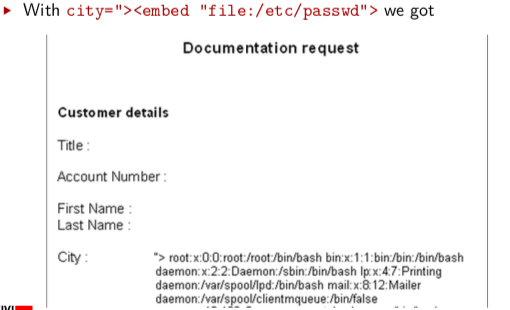
- Alidat
- Bcode
- Camework
- DContent
- EPolicy
- Fself
14public class GuestBook extends HttpServlet {
String name;
protected void doPost (HttpServletRequest req, HttpServletResponse res) {
name = req.getParameter("name");
...
out.println([blank_start]encodeForHTML[blank_end](name) + ", thanks for visiting!");
} }- AencodeForHTML
15XSS prevention:
public String preventXSS(String input, String mask) {
return input.replaceAll("script", mask);
}
We need to prevent all combinations of [blank_start]case[blank_end]s: ScriPt, scRIpt- Acase
16OSCommand injection protection:
String btype = request.getParameter("backuptype");
String cmd = new String("cmd.exe /K \"
c:\\util\\rmanDB.bat "
+[blank_start]encodeForOSCommand[blank_end](btype)+
"&&c:\\utl\\cleanup.bat\"")
System.Runtime.getRuntime().exec(cmd);- AencodeForOSCommand
Información
- Descripción
- - (2 Web app & Software vulnerabilities) Information security Test sobre 2a Web application vulnerabilities, creado por Yawen Hou el 08/06/2019.
- Autor
- Yawen Hou
- Idioma
- English
- Visitas
- 1
- Etiquetas
- Valoración
- Aún sin valoraciones Valora este test