
Test
PHYS 105 - Test 3
Crea una cuenta gratis para terminar este test
Guarda tu progreso y consulta tu resultado final.
¿Ya tienes cuenta? Inicia sesión
Preguntas del test (43)
1What type of object could be associated with both a nova and a supernova?
- Aprotostar
- Bwhite dwarf
- Cpulsar
- Dneutron star
- Eblack hole
2Which of the following is NOT relevant to the process of a supernova?
- Aelectron degeneracy pressure suddenly stiffness the collapsing core
- Bneutrons form from protons and electrons releasing neutrinos
- Cheat and radiation breaks up the iron core
- Dthe stellar envelope is hit by the bouncing core
- Enone of the above
3Ultimately, a white dwarf star is a -
- Aremnant carbon/oxygen core of a low-mass star
- Bstage before the asymptotic giant branch
- Ccore helium burning star
- Dresult of a type I supernova
- Eresult of a type II supernova
4What is the basic condition for the supernova distance measure?
- Aa white dwarf exceeds the Chandrasekhar limit
- Ba high-mass star explodes
- Ca black hole and neutron star collide
- Da neutron star collapses
- Ea black hole stops spinning
5Supernova saints measures are most valuable because -
- Athey occur so often
- Bthey are so reliable
- Care detectable at vast distances
- Dthey occur for the lowest mass stars
- Enone of the above
6What happens to the rotation rate (speed) of a molecular cloud as it collapses to form a star?
- Athe rotation rate slows, so the star will rotate very slowly
- Bthe rotation rate remains the same at all times
- Cthe rotation rate increases and the gas flattens into a disk around a protostar
7Elements beyond iron which exist in nature were probably created through the process of -
- Aneutrino emission
- Bpair annihilation
- Cnuclear fission
- Dnucleosynthesis
- Enone of the above
8You discover a binary star system in which one member is a 15Msun main-sequence star and the other star is a 10Msun giant. Why should you be surprised, at least at first?
- AThe two stars in a binary system should both be at the same point in stellar evolution; that is, they should either be main-sequence stars or both be giants.
- BIt doesn't make sense to find a giant in a binary star system
- CThe offs of ever finding two such massive stars in the same binary system are so small as to make it inconceivable that such a system could be discovered.
- DThe two stars should be the same age, so the more massive one should have become a giant first
- EA star with a mass of 15Msun is too big to be a main-sequence star.
9The heaviest chemical elements are produced in -
- Ablack holes
- Bnovae
- Cstellar fusion
- Dplanetary nebula mass loss
- Esupernovae
10When a star is at the Horizontal branch, what element is being fused in the core?
- Ahydrogen
- Bhelium
- Ccarbon
- Doxygen
- Eiron
11By mass, the interstellar medium in our region of the Milky Way consists of
- A70% Hydrogen, 30% Helium
- B50% Hydrogen, 50% Helium
- C50% Hydrogen, 30% Helium, 20% heavier elements
- D70% Hydrogen, 20% Helium, 10% heavier elements
- E70% Hydrogen, 28%helium, 2% heavier elements
12Which of the following statements about degeneracy pressure is NOT true?
- ADegeneracy pressure varies with the temperature of the star
- BDegeneracy pressure can halt gravitational contraction of a star even when no fusion is occurring in the core
- CDegeneracy pressure arises out of the ideas of quantum mechanics
- DDegeneracy pressure supports white dwarfs against gravity
- EDegeneracy pressure keeps any protostar less than 0.08 solar mass from becoming a true, hydrogen-fusing star.
13Which is the correct sequence for the following end points of stellar evolution, in order of increasing mass (smallest to largest)?
- AWhite dwarf, black hole, neutron star
- BWhite dwarf, neutron star, black hole
- CNeutron star, black hole, white dwarf
- DBlack hole, neutron star, white dwarf
14Every stage of a star's evolution is ultimately a reaction to -
- Aelectric forces
- Bfusion
- Crotation
- Dgravity
- Ebad sushi
15A star undergoing a nova has to be -
- Anear the center of a galaxy
- Bin a binary orbit
- Cin a supernova remnant
- Dmore than 8 solar masses
- Enone of the above
16The boundary inside of which light does not escape from a black hole is called the -
- Asingularity
- Bdark zone
- Cturn-off point
- Dnucleus
- Eevent horizon
17Which of the main sub-types of supernova remnants has the most distinctive origin (which one is fundamentally different from the others)?
- A1a
- B1b
- C1c
- DII
- EIII
18When does a protostar become a true star?
- Awhen the star is 1 million years old
- Bwhen the stellar winds and jets blow away the surrounding material
- Cwhen the central temperature reaches 1 million Kelvin
- Dwhen the thermal energy becomes trapped in the center
- Ewhen nuclear fusion begins in the core
19The upper limit to the mass of a neutron star is called the -
- ASchwarzchild limit
- BChandrasekhar limit
- CKerr limit
- DOppenheimer-Volkoff limit
- ESmirnov limit
20What is photodisentigration?
- AThe heating and ejection of mass from the surface of a normal star
- BThe destruction of a star by the pressure of the radiation inside it
- CThe splitting apart of atomic nuclei by gamma rays
- DThe ejection of a neutron or proton from an atomic nucleus
21How do we categorize various supernova types?
- Amass of the original star
- Bmembership in a binary
- Cby spectral lines
- Dage of the original star
- Espatial location of the supernova
22The pulses seen from a radio pulsar are caused by
- Athe star's radius expanding and contracting as it burns iron in its core
- Bthe star's rapid rotation sweeping beams of radiation across the viewer's line of sight
- Cglobs of hot gas from an accretion disk falling rhythmically onto the star's surface
- Da dark companion periodically eclipsing the bright "pulsar" itself
- Estarquakes
23No stars have been found with masses greater than 300 times our Sun because
- Amolecular clouds do not have enough material to form such massive stars
- Bthey would generate so much power that they would blow themselves apart
- Cthey shine exclusively at X-ray wavelengths and become difficult to detect
- DThey would fragment into binary stars because of their rapid rotation
- Ethey are not bright enough to be seen nearby
24What do astronomers mean when they say that we are all "star stuff"?
- Athat life would be impossible without energy from the sun
- Bthat the Sun formed from the interstellar medium: the "stuff" between the stars
- Cthat the Universe contains billions of stars
- Dthat Earth formed at the same time as the Sun
- Ethat the carbon, oxygen, and many elements essential to life were created by nucleosynthesis in stellar cores
25The supernova explosion of high-mass star appears to leave behind
- Aa rapidly rotating shell of gas, dust, and radiation, but no central object
- Ba rapidly expanding shell of gas and a compact white dwarf at its center
- Cnothing; the explosion changes all the matter completely into energy, which then radiates into space at the speed of light
- Da rapidly expanding shell of gas and a central neutron star
26When a star is on the asymptotic giant branch of the HR diagram it is
- Acontracting, cooling, and hence becoming less luminous
- Bexpanding, heating up, and becoming more luminous
- Ccontracting, becoming hotter, and becoming much less luminous
- Dexpanding, cooling, and becoming more luminous
27As the mass of a white dwarf increases the radius ______, and as the mass of a black hole increases the Schwarzschild radius ______.
- Aincreases, increases
- Bincreases, decreases
- Cdecreases, decreases
- Ddecreases, increases
- Eboth stay the same
28Which of the following stars will become hot enough to fuse elements heavier than oxygen?
- AA star that is half the mass of the Sun
- BA star having the same mass as the Sun
- CA star that is twice as massive as our Sun
- DA star that is nine times more massive than our Sun
29Why aren't all neutron stars seen as pulsars?
- Ait takes a long time for a neutron star to turn into a pulsar
- Btheir beam of radiation is not along our line of sight
- Cmost neutron stars are hidden by dense nebulae
- Dthey are
30Compared to low mass stars, high mass stars -
- Ahave longer lifetimes
- Bhave final states with less mass
- Cfuse more elements in the core
- Dare not as likely to undergo a supernova
- Eall of the above
31In astronomical terms, planetary nebulae are
- Avery long-lived objects, having been in existence since just after the Big Bang
- Brelatively short-lived, existing around a white dwarf star for millions of years
- Crelatively long-lived since they form when the original stars form
- Dvery short-lived with lifetimes of about 50,000 years due to the cooled gases
32All the distance-measuring methods we have discussed so far have relied on the distance-modulus method except
- Astellar parallax
- Bspectroscopic parallax
- Cvariable stars
- Dtype 1a supernova
- Eall have utilized this method
33Which of the following will a high-mass star (say, 20 times the mass of the Sun) NOT do at or near the end of its life?
- AEject its outer layers and become a neutron star
- BConvert silicon into iron in its core
- CEmit copious amounts of neutrinos
- DEject its outer layers and become a white dwarf
34What is the Crab Nebula?
- Aa star that is right now undergoing a supernova explosion
- Ba classic example of a planetary nebula
- Ca star forming cloud that will eventually give birth to hundreds of stars
- Dan expanding clouds of remains from a star that died in a supernova
35The light from an object close to, but outside, a black hole event horizon is (will) -
- Ablueshifted
- Bredshifted
- Cunaffected
- Dhave zero speed
36The particle who's properties are responsible for the stability of a white dwarf is a(n) -
- Aproton
- Bneutron
- Canti-electron
- Dneutrino
- Eelectron
37The thermal pressure of gas depends on
- ATemperature only
- BComposition
- CDensity and temperature
- DDensity only
- EGravity
38What is the minimum mass, in solar masses, for a main sequence star to end up as a black hole?
- A0.08
- B1
- C8
- D25
- E100
39As a star makes its way up the Asymptotic Giant Branch, the energy source is -
- AH core only
- BH shell only
- CHe core and H shell
- DHe shell and H shell
- Enone of the above
40The image shows the evolutionary path of a star after leaving the main sequence, which is the straight line from upper left to lower right. Which of the following could be a likely mass of the star in question, in until of solar masses?
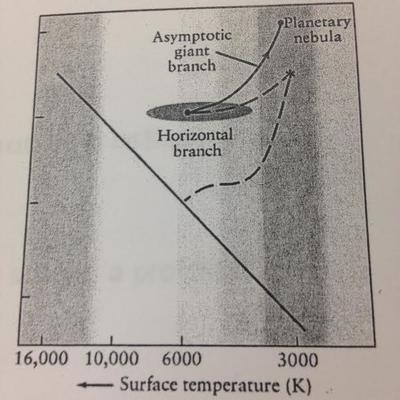
- A1
- B10
- C25
- D50
- E100
41The star tracked in the image will probably end up as a -
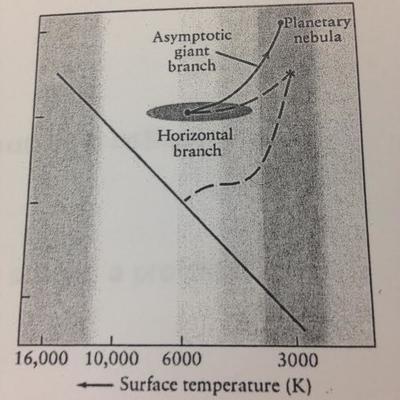
- Aprotostar
- Bneutron star
- Cblack hole
- Dred dwarf
- Ewhite dwarf
42The particle who's properties are responsible for the stability of a neutron star is a(n) -
- Aproton
- Bneutron
- Canti-electron
- Dneutrino
- Eelectron
43Which element has the lowest mass per nuclear particle and therefore cannot release energy by either fusion or fission?
- AOxygen
- BUranium
- CIron
- DSilicon
- EFlubber
Información
- Descripción
- Test sobre PHYS 105 - Test 3, creado por Amelia Newton el 04/05/2015.
- Autor
- Amelia Newton
- Idioma
- English
- Visitas
- 0
- Valoración
- Aún sin valoraciones Valora este test