
Test
Exam 70-410: Installing and Configuring Windows Server 2012 R2
Preguntas del test (76)
1Your network contains an Active Directory domain named contoso.com. You have a Group Policy Object (GPO) named GP1 that is linked to the domain. GP1 contains a software restriction policy that blocks an application named App1. You have a workgroup computer named Computer1 that runs Windows 8. A local Group Policy on Computer1 contains an application control policy that allows App1. You Join Computer1 to the domain. You need to prevent App1 from running on Computer1. What should you do?
- AFrom Group Policy Management, add an Application control policy to GP1.
- BIn the local Group Policy of Computer1, configure a software restriction policy.
- CFrom Group Policy Management, enable the Enforced option on GP1
- DFrom Computer1, run gpupdate /force.
2Your network contains an Active Directory domain named contoso.com. The domain contains a file server named Server1 that runs Windows Server 2012. Server1 contains a shared folder named Share1,. Share1 contains the home folder of each user. All users have the necessary permissions to access only their home folder. The users report that when they access Share1, they can see the home folders of all the users. You need to ensure that the users see only their home folder when they access Share1. What should you do from Server1?
- AFrom Windows Explorer, modify the properties of the volume that contains Share1.
- BFrom Server Manager, modify the properties of the volume that contains Share1.
- CFrom Windows Explorer, modify the properties of Share1.
- DFrom Server Manager, modify the properties of Share1.
3Your network contains an Active Directory forest named contoso.com. The forest contains a single domain. The domain contains two domain controllers named DC1 and DC2 that run Windows Server 2012. The domain contains a user named User1 and a Global Security Group named Group1. You reconfigure DC2 as a member server in the domain. You need to add DC2 as the first domain controller in a new domain in the forest. Which cmdlet should you run?
- ASet-AdAccountControl
- BRename-AdObject
- CSet-User
- DInstall-AddsDomain
- EInstall-AddsDomainController
- FAdd-AdPrincipalGroupMembership
- GSet-AdGroup
- HInstall-WindowsFeature
4Your network contains an Active Directory domain named contoso.com. The domain contains two servers named Server1 and Server2. Server1 and Server2 run a Server with a GUI installation of Windows Server 2012. You remove the Graphical Management Tools and Infrastructure feature on Server2. You need to restart Server2. What should you do? (choose two)
- AYou can restart Server2 locally using Netsh
- BYou can restart Server2 from Server 1 using Netsh
- CYou can restart Server2 locally using Sconfig
- DYou can restart Server2 from Server 1 using Sconfig
- EYou can restart Server2 locally using Server Manager
- FYou can restart Server2 from Server 1 using Server Manager
5You have two servers named Server1 and Server2 that run Windows Server 2012. Server1 has a Hyper-V server role installed. Server1 hosts a virtual machine named VM1. VM1 is currently running. VM1 has a snapshot that was created 2 weeks ago. You plan to use Server2 to perform a forensic analysis of the contents of the disk of VM1 from 2 weeks ago. You need to ensure you can view the contents of the disk of VM1 from 2 weeks ago from Server2. What 3 actions should you perform? (choose 3)
- AOn Server1, right-click VM1, and then click Shutdown.
- BOn Server1, right-click VM1, and then click Export...
- COn Server1, right-click VM1, and then click Save.
- DOn Server1, right-click the snapshot of VM1 and then click Export....
- EOn Server2, run the dism.exe command and specify the /Append-Image parameter
- FOn Server2, run the Mount-Vhd cmdlet
6Your network contains an Active Directory domain named contoso.com. The domain contains 100 user accounts that reside in an organizational unit (OU) named OU1. You need to ensure that a user named User1 can link and unlink Group Policy objects (GPOs) to OU1. The solution must minimize the number of permissions assigned to User1. What should you do?
- ARun the Delegation of Control Wizard on OU1.
- BModify the permission on the \\Contoso.com\sysvol\contoso.com\policies folder.
- CAdd User1 to the Group Policy Creator Owners group.
- DRun the Set-GPPermission cmdlet.
7Your company has an Active Directory forest. Not all domain controllers in the forest are configured as Global Catalog Servers. Your domain structure contains one root domain and one child domain. You modify the folder permissions on a file server that is in the child domain. You discover that some Access Control entities start with S-1-5-21....and that no account name is listed. You need to list the account names. What should you do?
- AModify the schema to enable replication of the friendlynames attribute to the Global Catalog.
- BMove the RID master role in the child domain to a domain conroller that holds the Global Catalog.
- CMove the RID master role in the child domain to a domain controller that does not hold the Global Catalog.
- DMove the infrastructure master rolve in the child domain to a domain controller that does not hold the Global Catalog.
8Your network contains an Active Directory domain named contoso.com. Your company hires 500 employees for the summer. The human resources department gives you a Microsoft Excel document that contains a list of temporary employees. You need to automate the creation of user accounts for the 500 temporary empoyees. Which tool or tools should you use?
- AADSI Edit
- BThe Set-ADUser cmdlet and the Add-Member cmdlet
- CActive Directory Users and Computers
- DThe Import-CSV cmdlet and the New-ADUser cmdlet
9You have 3 servers named Server1, Server2, and Server 3. Server1 runs a Server Core installation of Windows Server 2012. The local area connection on Server1 has the following configuration:
IP Address: 10.1.1.1
Subnet Mask: 255.255.240.0
Default Gateway: 10.1.1.254
Preferred DNS Server: <none>
The network contains a DNS server that has an IPv4 Address of 10.1.1.200. You need to configure Server1 to use 10.1.1.200 as the preferred DNS server. The solution must not change any other settings on Server1. Which command should you run?- Anetsh.exe
- Bnet.exe
- CSet-NetIPInterface
- Dsconfig.cmd
10Your network contains an Active Directory domain named contoso.com. The domain contains a member server named Hyperv1 and a domain controller named DC1. Hyperv1 has the Hyper-V server role installed. DC1 is a virtual machine on Hyperv1. Users report that the time on their client computer is incorrect. You log on to DC1 and verify that the time services are configured correctly. You need to prevent time conflicts between the time provided by DC1 and other potential time sources. What should you configure?
- ABIOS Settings for DC1 on HYPERV1
- BMemory Settings for DC1 on HYPERV1
- CNetwork Adapter Settings for DC1 on HYPERV1
- DIntegration Services Settings for DC1 on HYPERV1
- EAutomatic Start Action Settings for DC1 on HYPERV1
- FAutomatic Stop Action Settings for DC1 on HYPERV1
11Your network contains an Active Directory forest named contoso.com. The forest contains a single domain. The domain contains two domain controllers named DC1 and DC2 that run Windows Server 2012. The domain contains a user named User1 and a global security group named Group1. You need to prevent User1 from changing his password. The solution must minimize administrative effort. Which cmdlet should you run?
- AInstall-WindowsFeature
- BSet-AdAccountControl
- CSet-User
- DInstall-AddsDomain
- EInstall-AddsDomainController
- FSet-AdGroup
- GAdd-AdPrinicpalGroupMembership
- HRename-AdObject
12Your network contains an Active Directory forest named contoso.com. The forest contains a single domain. The domain contains two domain controllers named DC1 and DC2 that run Windows Server 2012. The domain contains a user named User1 and a global security group named Group1. You need to modify the SAM account name of Group1. Which cmdlet should you run?
- ASet-AdGroup
- BRename-AdObject
- CAdd-AdPrincipalGroupMembership
- DSet-User
- EInstall-AddsDomain
- FInstall-AddsDomainController
- GInstall-WindowsFeature
- HSet-AdAccountControl
13You have an Active Directory domain named contoso.com. You have a domain controller named Server1 that is configured as a DNS server. Server1 hosts a standard primary zone for contoso.com. The DNS configuration of Server1 is shown in the exhibit. You discover that stale resource records are not automatically removed from the contoso.com zone. You need to ensure that stale resource records are automatically removed from the contoso.com zone. What should you do?
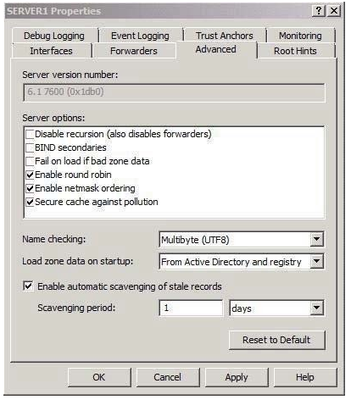
- AConvert the contoso.com zone to an Active Directory-Integrated Zone
- BModify the Server Aging/Scavenging properties
- CConfigure the aging properties for the contoso.com zone
- DSet the scavenging period of Server1 to 0 days.
14Your network contains an Active Directory domain named contoso.com. The domain contains a user account named User1 that resides in Organizational Unit (OU) named OU1. A Group Policy object (GPO) named GPO1 is linked to OU1. GPO1 is used to publish several applications to a user named User1. In the Users container, you create a new user named User2. You need to ensure that the same applications are published to User2. What should you do?
- AModify the security of GPO1.
- BModify the settings in GPO1.
- CLink a WMI filter to GPO1.
- DMove User2 to OU1.
15Your network contains an active directory domain named Contoso.com. The domain contains a server named Server1 that runs Windows server 2012. You create a group Managed Service Account named gservice1. You need to configure a service named service1 to run as the gservice1 account. How should you configure service1?
- AFrom Services Console configure the recovery settings
- BFrom a command prompt ,run sc.exe and specify the config parameter
- CFrom Windows PowerShell,run Set-Service and specify the -PassThrough parameter
- DFrom a command prompt ,run sc.exe and specify the sdset parameter
16You have a server named Server1 that runs Windows Server 2012. You promote Server1 to domain controller. You need to view the service location (SVR) records that Server1 registers on DNS. What should you do on Server1?
- AOpen the Srv.sys file
- BOpen the Netlogon.dns file
- CRun ipconfig/displaydns
- DRun Get-DnsServerDiagnostics
17Your network contains an Active Directory domain named contoso.com. The domain contains a server named Windows Server 2012. You create a group Managed Service Account named gservice1. You need to configure a service named Service1 to run as the gservice1 account. How should you configure Service1?
- AFrom the Services console, configure the General settings.
- BFrom Windows PowerShell, run Set-Service and specify the -PassThrough parameter.
- CFrom a command prompt, run sc.exe and specify the config parameter.
- DFrom the Services console, configure the Recovery settings.
18Your network contains an Active Directory domain named contoso.com. The network contains 500 client computers that run Windows 8. All of the client computers connect to the Internet by using a web proxy. You deploy a server named Server1 that runs Windows Server 2012. Server1 has the DNS Server server role installed. You configure all of the client computers to use Server1 as their primary DNS server. You need to prevent Server1 from attempting to resolve Internet host names for the client computers. What should you do on Server1? (choose 2)
- AConfigure the Security settings of the contoso.com zone.
- BRemove all root hints.
- CCreate a primary zone named ".".
- DCreate a primary zone named "root".
- ECreate a primary zone named "GlobalNames".
- FCreate a forwarder that points to 169.254.0.1.
- GCreate a stub zone named "root".
- HCreate a zone delegation for GlobalNames.contoso.com.
19Your network contains an Active Directory domain named contoso.com. The domain contains two domain controllers. The domain controllers are configured as shown below:
DC1 - Operating System: Windows Server 2012 - Operation Master Role: Domain Naming Master and Schema Master
and
DC2 - Operating System: Windows Server 2008 R2 - Operation Master Role: PDC Emulator, RID Master, Infrastructure Master
In the perimeter network, you install a new server named Server1 that runs Windows Server 2012. Server1 is in a workgroup. You need to perform an offline domain join of Server1 to the contoso.com domain. What should you do first?- ATransfer the PDC emulator role to Dc1.
- BRun the djoin.exe command.
- CRun the dsadd.exe command.
- DTransfer the infrastructure master role to DC1.
20You have a file server named Server1 that runs Windows Server 2012. Server1 has following hardware configurations:
· 16GB of RAM
· A single quad-core CPU
· Three network teams that have two network adapters each
You add additional CPUs and RAM to Server1. You repurpose Server1 as a virtualization host. You install the Hyper-V server role on Server1. You need to create four external virtual switches in Hyper-V. Which cmdlet should you run first?- AAdd-VMNetworkAdapter
- BAdd-NetLbfoTeamNic
- CRemove-NetLbfoTeam
- DSet-NetAdapter
21You perform a Server Core Installation of Windows Server 2012 on a server named Server1. You need to add a graphical user interface (GUI) to Server1. Which tool should you use?
- AThe setup.exe command
- BThe dism.exe command
- CThe imagex.exe command
- DAdd-WindowsPackage cmdlet
22Your network contains an Active Directory domain named contoso.com. The domain contains two servers named Server2 runs Windows Server 2012. You create a security template named Template1 by using the Security Templates snap-in. You need to apply Template1 to Server2. Which tool should you use?
- ASecurity Templates.
- BComputer Management.
- CSecurity Configuration and Analysis.
- DSystem Configuration.
23You have a server named Server 2 that runs Windows Server 2012. Server 2 has the Hyper-V server role installed. The disks on Server2 are configured as shown in the exhibit. You create a virtual machine on Server2 named VM1. You need to ensure that you can configure a pass-through disk for VM1. What should you do?
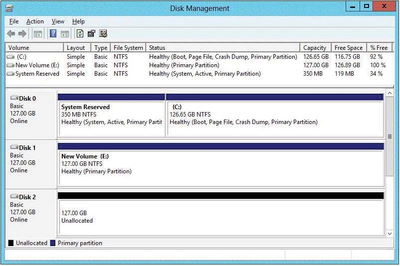
- AConvert Disk 1 to a MBR disk.
- BConvert Disk 1 to a basic disk.
- CTake Disk 1 offline.
- DCreate a partition on Disk 1.
24Your network contains an Active Directory domain named contoso.com. The domain contains two servers that run Windows Server 2012, Server1 and Server2. You create a security template named Template1 by using the Security Templates snap-in. You need to apply Template1 to Server2. Which tool should you use?
- ASystem Configuration
- BSecurity Templates
- CServer Manager
- DSecurity Configuration and Analysis
25Your network contains an Active Directory domain named contoso.com. The network contains 500 client computers that run Windows 8. All of the client computers connect to the Internet by using a web proxy. You deploy a server named Server1 that runs Windows Server 2012. Server1 has the DNS Server server role installed. You configure all of the client computers to use Server1 as their primary DNS server. You need to prevent Server1 from attempting to resolve Internet host names for the client computers. What should you do on Server1?
- ACreate a primary zone named ".".
- BConfigure the Security settings of the contoso.com zone.
- CCreate a zone delegation for GlobalNames.contoso.com.
- DCreate a stub zone named "root".
26Your network contains an Active Directory domain named contoso.com. The domain contains 100 user accounts that reside in an organizational unit (OU) named 0U1. You need to ensure that a user named User1 can link and unlink Group Policy objects (GPOs) to OU1. What should you do?
- AModify the permissions on OU1.
- BRun the Set-GPPermission cmdlet.
- CAdd User1 to the Group Policy Creator Owners group.
- DModify the permissions on the User1 account.
27Your network contains an Active Directory domain named contoso.com. The domain contains two servers named Server1 and Server2. Server1 runs Windows Server 2012. Server2 runs Windows Server 2008 R2 Service Pack 1 (SP1) and has the DHCP Server server role installed. You need to manage DHCP on Server2 by using the DHCP console on Server1. What should you do first?
- AFrom the Microsoft Management Console on Server1, add a snap-in.
- BFrom Windows PowerShell on Server1, run Install-WindowsFeature.
- CFrom Windows Firewall with Advanced Security on Server2, create an inbound rule.
- DFrom Internet Explorer on Server2, download and install Windows Management Framework 3.0.
28Your network contains an Active Directory domain named contoso.com. The domain contains a server named Server1 that runs Windows Server 2012. Server1 has the Hyper-V server role installed. Server1 has a virtual switch named "RDS Virtual". You replace all of the network adapters on Server1 with new network adapters that support single- root I/O virtualization (SR-IOV). You need to enable SR-IOV for all of the virtual machines on Server1. Which two actions should you perform? (Each correct answer presents part of the solution. (Choose two.)
- AOn each virtual machine, modify the Advanced Features settings of the network adapter.
- BModify the settings of the RDS Virtual virtual switch.
- COn each virtual machine, modify the BIOS settings.
- DDelete, and then recreate the RDS Virtual virtual switch.
- EOn each virtual machine, modify the Hardware Acceleration settings of the network adapter.
29Your network contains an Active Directory domain named contoso.com. The domain contains a server named Server1. Server1 runs Windows Server 2012. You need to create 3-TB virtual hard disk (VHD) on Server1. Which tool should you use?
- AServer Manager
- BDiskpart
- CNew-StoragePool
- DNew-VirtualDisk
30Your network contains an Active Directory domain named contoso.com. The domain contains a server named Server1 that runs Windows Server 2012. Server1 has the Hyper- V server role installed. The domain contains a virtual machine named VM1. A developer wants to attach a debugger to VM1. You need to ensure that the developer can connect to VM1 by using a named pipe. Which virtual machine setting should you configure?
- ANetwork Adapter
- BBIOS
- CProcessor
- DCOM 1
31Your network contains two subnets, LAN1 with Network IP Address 172.23.1.0/24 and LAN2 with Network IP Address 172.23.2.0/24. You have a server named Server2 that runs Windows Server 2012. Server2 is connected to LAN1. You run the route print command as shown in the exhibit. You need to ensure that Server2 can communicate with the client computers on LAN2. What should you do?
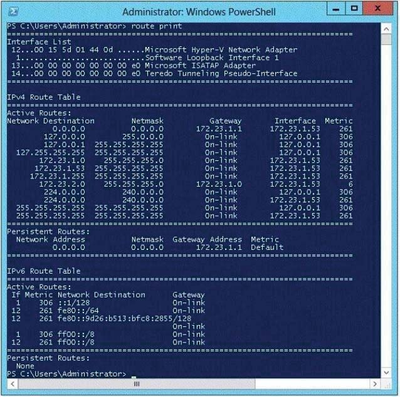
- AChange the metric of the 10.10.1.0 route.
- BSet the state of the Teredo interface to disable.
- CSet the state of the Microsoft ISATAP Adapter #2 interface to disable.
- DRun route delete 172.23.2.0.
32You have a server named Server1 that runs a Server Core installation of Windows Server 2012. Server1 is configured to obtain an IPv4 address by using DHCP. You need to configure the IPv4 settings of the network connection on Server1 as follows:
IP address: 10.1.1.1
Subnet mask: 255.255.240.0
Default gateway: 10.1.1.254
What should you run?- Anetsh.exe
- Bnetcfg.exe
- Cmsconfig.exe
- Dipconfig.exe
33You have an existing Active Directory site named Site1. You create a new Active Directory site and name it Site2. You need to configure Active Directory replication between Site1 and Site2. You install a new domain controller. You create the site link between Site1 and Site2. What should you do next?
- AUse the Active Directory Sites and Services console to configure a new site link bridge object.
- BUse the Active Directory Sites and Services console to decrease the site link cost between Site1 and Site2.
- CUse the Active Directory Sites and Services console to assign a new IP subnet to Site2. Move the new domain controller object to Site2.
- DUse the Active Directory Sites and Services console to configure the new domain controller as a preferred bridgehead server for Site1.
34Your company has an Active Directory domain. You log on to the domain controller. The Active Directory Schema snap-in is not available in the Microsoft Management Console (MMC). You need to access the Active Directory Schema snap-in. What should you do?
- ARegister Schmmgmt.dll.
- BLog off and log on again by using an account that is a member of the Schema Admins group.
- CUse the Ntdsutil.exe command to connect to the schema master operations master and open the schema for writing.
- DAdd the Active Directory Lightweight Directory Services (AD/LDS) role to the domain controller by using Server Manager.
35Your network contains a domain controller that is configured as a DNS server. The server hosts an Active Directory-integrated zone for the domain. You need to reduce how long it takes until stale records are deleted from the zone. What should you do?
- AFrom the configuration directory partition of the forest, modify the tombstone lifetime.
- BFrom the configuration directory partition of the forest, modify the garbage collection interval.
- CFrom the aging properties of the zone, modify the no-refresh interval and the refresh interval.
- DFrom the start of authority (SOA) record of the zone, modify the refresh interval and the expire interval.
36You have an Active Directory domain named contoso.com. You have a domain controller named Server1 that is configured as a DNS server. Server1 hosts a standard primary zone for contoso.com. The DNS configuration of Server1 is shown in the exhibit. You discover that stale resource records are not automatically removed from the contoso.com zone. You need to ensure that the from the contoso.com zone.
What should you do?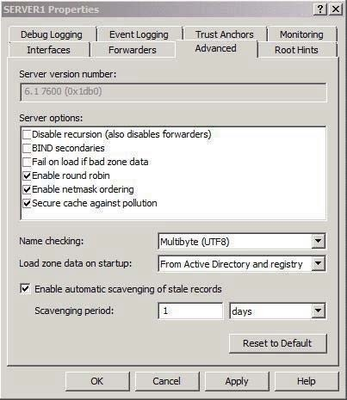
- ASet the scavenging period of Server1 to 0 days.
- BModify the Server Aging/Scavenging properties.
- CConfigure the aging properties for the contoso.com zone.
- DConvert the contoso.com zone to an Active Directory-integrated zone.
37You have a server that runs Windows Server 2012. The server contains the disks configured as shown in the following table. You need to create a volume that can store up to 3 TB of user files. The solution must ensure that the user files are available if one of the disks in the volume fails. What should you create?
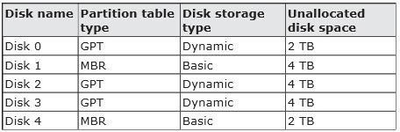
- Aa storage pool on Disk 2 and Disk 3
- Ba spanned volume on Disk 2 and Disk 3
- Ca mirrored volume on Disk 1 and Disk 3
- Da mirrored volume on Disk 2 and Disk 3
- Ea RAID-5 volume on Disk 1, Disk 2, and Disk 3
- Fa storage pool on Disk 1 and Disk 3
- Ga spanned volume on Disk 0 and Disk 4
- Ha mirrored volume on Disk 1 and Disk 4
38Your network contains an Active Directory domain named contoso.com. The domain contains a print server named Server1 that runs Windows Server 2012. Server1 contains a local group named Group1. You share a printer named Printer1 on Server1. You need to configure Printer1 to meet the following requirements:
Ensure that the members of Group1, the Server Operators group, the Administrators group, and the Print Operators group can send print jobs to Printer1.
Prevent other users from sending print jobs to Printer1.
Which two actions should you perform? (Each correct answer presents part of the solution. Choose two.)- AAssign the Print permission to the Server Operators group
- BRemove the permissions for the Creator Owner group.
- CRemove the permissions for the Everyone group.
- DAssign the Print permission to Group1.
- EAssign the Print permission to the Administrators group.
39You have a new server named Server1 that runs Windows Server 2012. Server1 has two dual-core processors and 32 GB of RAM. You install the Hyper-V server role on Server1. You create two virtual machines on Server1 that each have 8 GB of memory. You need to minimize the amount of time it takes for both virtual machines to access memory. What should you configure on each virtual machine?
- AResource control
- BDynamic Memory
- CNUMA topology
- DMemory weight
40Your network contains an Active Directory domain named contoso.com. The domain contains 20 computer accounts that reside in an organizational unit (OU) named OU1. A Group Policy object (GPO) named GPO1 is linked to OU1. GPO1 is used to assign several user rights to a user named User1. In the Users container, you create a new user named User2. You need to ensure that User2 is assigned the same user rights as User1 on all of the client computers in OU1. What should you do?
- AMove User2 to OU1.
- BModify the settings in GPO1.
- CModify the link of GPO1.
- DLink a WMI filter to GPO1.
41You have a server named Server1 that runs Windows Server 2012. Server1 has the Hyper-V server role installed. You need to configure storage for a virtual machine to meet the following requirements:
- Support up to 3 TB of data on a single hard disk.
- Allocate disk space as needed.
- Use a portable storage format.
What should you configure?- AA pass-through disk
- BA fixed-size VHD
- CA dynamically expanding VHD
- DA fixed-size VHDX
- EA dynamically expanding VHDX
42You have a virtual machine named VM1. You install Windows Server 2012 on VM1. You plan to use VM1 as an image that will be distributed to sales users to demonstrate the features of a custom application. The custom application only requires the Web Server (IIS) server role to be installed. You need to ensure that the VHD file for VM1 only contains the required Windows Server 2012 source files. Which tool should you use?
- Adism.exe
- Bocsetup.exe
- Cimagex.exe
- Dservermanagercmd.exe
43Your network contains an Active Directory domain named contoso.com. The domain contains an organizational unit (OU) named OU1. You need to ensure that when new client computers join the domain, their computer accounts are created in OU1 by default. What should you do?
- AFrom a command prompt, run the redircmp.exe command.
- BFrom Windows PowerShell, run the Move-ADObject cmdlet.
- CFrom Ldp, configure the properties of the Computers container.
- DFrom ADSI Edit, configure the properties of the OU1 object.
44Your network contains an Active Directory domain named contoso.com. The domain contains a server named Server1. Server1 runs Windows Server 2012. You need to create 3-TB virtual hard disk (VHD) on Server1. Which tool should you use?
- AStorageSubsytemVirtualDisk
- BFile Server Resource Manager (FSRM)
- CServer Manager
- DComputer Management
45Your network contains two Hyper-V hosts that run Windows Server 2012. The Hyper-V hosts contains several virtual machines that run Windows Server 2012. You install the Network Load Balancing feature on the virtual machines. You need to configure the virtual machines to support Network Load Balancing (NLB). Which virtual machine settings should you configure?
- APort mirroring
- BDHCP guard
- CRouter guard
- DMAC address
46Your network contains an Active Directory domain named contoso.com. The domain contains a server named Server1 that runs Windows Server 2012. You create a new inbound rule by using Windows Firewall with Advanced Security. You need to configure the rule to allow Server1 to accept unsolicited inbound packets that are received through a network address translation (NAT) device on the network. Which setting in the rule should you configure?
- AEdge traversal
- BAuthorized computers
- CInterface types
- DRemote IP address
47You have a server named Server1 that runs a Server Core installation of Windows Server 2012. Server1 is configured to obtain an IPv4 address by using DHCP. You need to configure the IPv4 settings of the network connection on Server1 as follows:
IP address: 10.1.1.1
Subnet mask: 255.255.240.0
Default gateway: 10.1.1.254
What should you run?- ASet-NetlPInterface
- Bnetcfg.exe
- CNew-NetlPAddress
- Dmsconfig.exe
48Your network contains an Active Directory domain named adatum.com. The domain contains the servers shown in the table. You need to ensure that you can use Server Manager on DC1 to manage DC2. Which two tasks should you perform? (Each correct answer presents part of the solution. Choose two.)
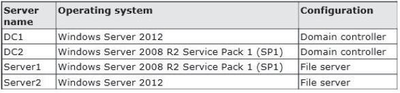
- AInstall Microsoft .NET Framework 4 on DC2.
- BInstall Remote Server Administration Tools on DC1.
- CInstall Remote Server Administration Tools on DC2.
- DInstall Windows Management Framework 3.0 on DC2.
49Your network contains an Active Directory domain named contoso.com. The domain contains two servers named Server1 and Server2. Server1 runs Windows Server 2012. Server2 runs Windows Server 2008 R2 Service Pack 1 (SP1) and has the DHCP Server server role installed. You need to manage DHCP on Server2 by using the DHCP console on Server1. What should you do first?
- AFrom Server Manager on Server2, enable Windows Remote Management.
- BFrom a command prompt on Server2, run winrm.exe.
- CFrom Server Manager on Server1, install a feature.
- DFrom the Microsoft Management Console on Server1, add a snap-in.
50You have a server named Server1 that runs Windows Server 2012. You plan to enable Hyper-V Network Visualization on Server1. You need to install the Windows Network Virtualization Filter Driver on Server1. Which Windows PowerShell cmdlet should you run?
- ASet-NetVirtualizationGlobal
- BSet-NetAdapterVmq
- CAdd-WindowsFeature
- DEnable-NetAdapterBinding
51Your network contains an Active Directory domain named contoso.com. The domain contains a server named Server1. Server1 runs Windows Server 2012 and has the HyperV server role installed. You need to log the amount of system resources used by each virtual machine. What should you do?
- AFrom Windows PowerShell, run the Enable-VMResourceMetering cmdlet.
- BFrom Windows System Resource Manager, enable Accounting.
- CFrom Windows System Resource Manager, add a resource allocation policy.
- DFrom Windows PowerShell, run the Measure-VM cmdlet.
52You have two servers named Server1 and Server2 that run Windows Server 2012. Server1 and Server2 are part of a workgroup. On Server1, you add Server2 to Server Manager. When you attempt to connect to Server2 from Server Manager, you receive the following error message:
"Credentials not valid."
You need to ensure that you can manage Server2 from Server1 by using Server Manager on Server1. What should you do?- AOn Server 2, run the Configure-SmRemoting cmdlet.
- BOn Server 1, run the Set-NetFirewallRule cmdlet.
- COn Server 1, run the Set-Item cmdlet.
- DOn Server 2, install the Remote Server Administration Tools (RSAT).
53You have a server named Server1 that runs a Server Core installation of Windows Server 2012 Standard. You establish a Remote Desktop session to Server1.
You need to identify which task can be performed on Server1 from within the Remote Desktop session.
What should you identify?- AModify the network settings by using Sconfig.
- BJoin a domain by using the System Properties.
- CDisable services by using Msconfig.
- DInstall a feature by using Server Manger.
54You have a server named Server1. Server1 runs Windows Server 2012 and is located in a perimeter network.
You need to configure a custom connection security rule on Server1. The rule must encrypt network communications across the Internet to a computer at another company.
Which authentication method should you configure in the connection security rule?- AAdvanced
- BUser (Kerberos V5)
- CComputer (Kerberos V5)
- DComputer and user (Kerberos V5)
- EDefault
55Your network contains two Active Directory forests named contoso.com and adatum.com.
All servers run Windows Server 2012. A one-way external trust exists between contoso.com and adatum.com.
Adatum.com contains a universal group named Group1.
You need to prevent Group1 from being used to provide access to the resources in contoso.com.
What should you do?- AModify the Managed By settings of Group1.
- BModify the Allowed to Authenticate permissions in adatum.com.
- CChange the type of Group1 to distribution.
- DModify the name of Group1.
56Your network contains an Active Directory forest named contoso.com. The forest contains a child domain named corp.contoso.com. The network has Microsoft Exchange Server 2010 deployed. You need to create a mail-enabled distribution group. Which type of group should you create?
- ADomain local
- BGlobal
- CLocal
- DUniversal
57Your network contains an Active Directory forest named contoso.com. The forest contains a single domain. The domain contains two domain controllers named DC1 and DC2 that run Windows Server 2012. The domain contains a user named User1 and a global security group named Group1. You need to add a new domain controller to the domain. You install Windows Server 2012 on a new server named DC3. Which cmdlet should you run next?
- AAdd-AdPrincipalGroupMembership
- BInstall-AddsDomainController
- CInstall-WindowsFeature
- DInstall-AddsDomain
- ERename-AdObject
- FSet-AdGroup
- GSet-User
- HSet-AdAccountControl
58Your network contains an Active Directory forest named contoso.com. The forest contains a single domain. The domain contains two domain controllers named DC1 and DC2 that run Windows Server 2012. The domain contains a user named User1 and a global security group named Group1. User1 logs on to a client computer named Computer1. You need to disable the computer account of Computer1. Which cmdlet should you run?
- AAdd-AdPrincipalGroupMembership
- BInstall-AddsDomainController
- CInstall-WindowsFeature
- DInstall-AddsDomain
- ERename-AdObject
- FSet-AdAccountControl
- GSet-AdGroup
- HSet-User
59Your network contains an Active Directory domain named contoso.com. The domain contains a member server named Server1. Server1 runs Windows Server 2012 and has the Hyper-V server role installed. You create an external virtual switch named Switch1. Switch1 has the following configurations:
Connection type: External network
Single-root I/O visualization (SR-IOV): Enabled
Ten virtual machines connect to Switch1.
You need to ensure that all of the virtual machines that connect to Switch1 are isolated from the external network and can connect to each other only. The solution must minimize network downtime for the virtual machines. What should you do?- AChange the Connection type of Switch1 to Internal network.
- BChange the Connection type of Switch1 to Private network.
- CRemove Switch1 and recreate Switch1 as an internal network.
- DRemove Switch1 and recreate Switch1 as a private network.
60You have a Hyper-V host named Server1 that runs Windows Server 2012. Server1 hosts a virtual machine named VM1 that runs Windows Server 2012. VM1 has several snapshots. You need to modify the snapshot file location of VM1. What should you do?
- ARight-click VM1, and then click Export...
- BModify the Hyper-V settings.
- CDelete the existing snapshots, and then modify the settings of VM1.
- DShut down VM1, and then modify the settings of VM1.
61You have a server that runs a Server Core installation of Windows Server 2012. You need to change the DNS server used by IPv6. What should you do?
- AFrom Windows PowerShell, run the Set-NetIpv6Protocol cmdlet.
- BFrom Sconfig, configure the Network Settings.
- CFrom Windows PowerShell, run the Set-DnsClientServerAddress cmdlet.
- DRun the sc.exe command and specify the config parameter.
62You have a server named Server1 that runs Windows Server 2012. You plan to create a storage pool that will contain a new volume. You need to create a new 600-GB volume by using thin provisioning. The new volume must use the parity layout. What is the minimum number of 256-GB disks required for the storage pool?
- A2
- B3
- C4
- D5
63You have a server named Server1 that runs Windows Server 2012. You try to install the Microsoft .NET Framework 3.5 Features feature on Server1, but the installation fails repeatedly. You need to ensure that the feature can be installed on Server1. What should you do?
- AInstall the Web Server (IIS) server role.
- BRun the Add-WindowsPackage cmdlet.
- CRun the Add-AppxProvisionedPackage cmdlet.
- DConnect Server1 to the Internet.
64Your network contains an Active Directory forest named contoso.com. The forest contains two domains named contoso.com and child.contoso.com. The forest contains two domain controllers DC1 for contoso.com and DC2 for child.contoso.com. DC1 is a DNS server but DC2 is not. You need to ensure that DC2 can provide authoritative responses for queries to the contoso.com namespace. What should you do?
- AOn DC1, create a delegation.
- BOn DC1, change the replication scope of the contoso.com zone.
- COn DC2, create a forwarder.
- DOn DC2, modify the Zone Transfers settings.
65You are configuring the IPv6 network infrastructure for a branch office. The corporate network administrator allocates the 2001:DB8:0:C000::/58 address space for use in the branch office. You need to identify the maximum number of IPv6 subnets you can create. How many IPv6 subnets should you identify?
- A32
- B64
- C128
- D1024
- ENormally, an IPv6 address is 128-bits. It is divided in half to separate the host and network portions of the address, so typically would be a /64. However, since it's a /58 we can see that 6 bits have been borrowed from the host portion to allow us to create sub-networks. 6 bits in in binary can be expressed as a range from 000000-111111 or in decimal would be 0-63. and since 0 is usable 64 total sub-networks could be created.
66You have a server named Server1 that runs Windows Server 2012. Server1 has the Hyper-V server role installed. The disks on Server1 are configured as shown below. You create a virtual machine on Server1. You need to ensure that you can configure a pass-through disk for the virtual machine. What should you do?
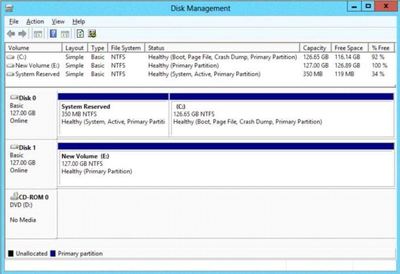
- ADelete partition E
- BConvert Disk 1 to a GPT disk
- CConvert Disk 1 to a dynamic disk.
- DTake Disk 1 offline.
67You have a server named Server1 that runs Windows Server 2012. Server1 has the Hyper-V server role installed. You have fixed-size VHD named Files.vhd.
You need to make the contents in Files.vhd available to several virtual machines.
The solution must meet the following requirements:
· Ensure that if the contents are changed on any virtual machine, the changes are not reflected on the other virtual machines.
· Minimize the amount of disk space used.
What should you do?- ACreate a dynamically expanding VHDX. Transfer the information from Files.vhd to the new VHDX file
- BCreate a fixed-size VHDX. Transfer the information from Files.vhd to the new VHDX file.
- CConvert Files.vhd to a dynamically expanding VHD.
- DCreate differencing VHD5 that use Files.vhd as the parent disk
68You have a server named Server1 that runs Windows Server 2012. Server1 has the Hyper-V server role installed. On Server1, you create a virtual machine named VM1. VM1 has a legacy network adapter.
You need to assign a specific amount of available network bandwidth to VM1.
What should you do first?- ARemove the legacy network adapter, and then run the Set-VMNetworkAdaptercmdlet.
- BAdd a second legacy network adapter, and then run the Set-VMNetworkAdoptercmdlet
- CRemove the legacy network adapter, and then add a network adapter
- DAdd a second legacy network adapter, and then configure network adapter teaming.
69Your network contains an Active Directory domain named adatum.com. The domain contains a server named Server1 that runs Windows Server 2012. On a server named Core1, you perform a Server Core Installation of Windows Server 2012. You join Core1 to the adatum.com domain. You need to ensure that you can use Event Viewer on Server1 to view the event logs on Core1. What should you do on Core1?
- ARun the Enable-NetFirewallRulecmdlet.
- BRun sconfig.exeand configure remote management
- CRun the Disable-NetFirewallRulecmdlet.
- DRun sconfiq.exeand configure the network settings.
70Your network contains a file server named Server1 that runs Windows Server 2012. All client computers run Windows 8. You need to ensure that when users are connected to the network, they always use local offline files that are cached from Server1. Which Group Policy setting should you configure?
- AConfigure slow-link mode.
- BConfigure Slow link speed
- CEnable file synchronization on costed networks
- DTurn on economical application of Administratively assigned Offline Files.
71You have a server named Server1 that runs Windows Server 2012 R2. Server 1 has the Hyper-V role installed. An iSCSI SAN is available on the network. Server1 hosts four virtual machines named VM1, VM2, VM3, and VM4. You create a LUN on the SAN to host the virtual hard drive files for the virtual machines. You need to create a 3TB virtual disk for VM1 on the LUN. The solution must prevent VM1 from being paused if the LUN runs out of disk space. Which type of virtual hard disk should you create on the LUN?
- AFixed-size VHD
- BDynamically expanding VHD
- CFixed-size VHDX
- DDynamically expanding VHDX
72Your network contains an Active Directory domain named adatum.com. The domain contains a member server named Host1. Host1 runs Windows Server 2012 R2 and has the Hyper-V server role installed. Host1 has two virtual machines named VM5 and VM6. Both virtual machines connect to a virtual switch named Virtual1. On VM5, you install a network monitoring application named Monitor1. You need to capture all of the inbound and outbound traffic to VM6 by using Monitor1. Which two commands should you run from Windows Powershell? (Each correct answer presents part of the solution. Choose two)
- AGet-VM "VM6" | Set-VMNetworkAdapter -IovWeight 1
- BGet-VM "VM5" | Set-VMNetworkAdapter -IovWeight 0
- CGet-VM "VM6" | Set-VMNetworkAdapter -AllowTeamingOn
- DGet-VM "VM6" | Set-VMNetworkAdapter -PortMirroring Source
- EGet-VM "VM5" | Set-VMNetworkAdapter -AllowTeamingOn
- FGet-VM "VM5" | Set-VMNetworkAdapter -PortMirroring Destination
73You have a Hyper-V host named Server1 that runs Windows Server 2012 R2. Server1 has two physical network adapters named NIC1 and NIC2. Server1 has two virtual switches named vSwitch1 and vSwitch2. vSwitch1 is an External Virtual Switch associated with physical network adapter NIC1. vSwitch2 is an External Virtual Switch associated with physical network adapter NIC2.
You create a virtual machine named VM1. VM1 has two network adapters. One network adapter connects to vSwitch1. The other network adapter connects to vSwitch2. You configure NIC teaming on VM1. You need to ensure that if a physical NIC fails on Server1, VM1 remains connected to the network. What should you do on Server1.- ARun the Set-VMNetworkAdapter cmdlet.
- BAdd a new network adapter to VM1.
- CCreate a new virtual switch on Server1.
- DModify the properties of vSwitch1 and vSwitch2.
74Your network contains two Hyper-V hosts that run Windows Server 2012 R2. The Hyper-V hosts contain several virtual machines that run Windows Server 2012 R2. You install the Network Load Balancing Feature on the virtual machines. You need to configure the virtual machines to support Network Load Balancing. Which virtual machine settings should you configure?
- ADHCP Guard
- BRouter Guard
- CPort Mirroring
- DMac Address
75You have a server named Server1 that runs Windows Server 2012 R2. Server1 has the Hyper-V server role installed. Server1 has four host bus adapters (HBAs) named HBA1, HBA2, HBA3, and HBA4. HBA1 and HBA3 are connected to a Fibre Channel SAN named SAN1. HBA2 and HBA4 are connected to a Fibre Channel SAN named SAN2. Server1 has a Virtual Machine named VM1. You need to configure VM1 to connect to SAN1. What should you do first?
- ACreate a Virtual Fibre Channel SAN
- BCreate a Hyper-V Virtual Switch
- CAdd one HBA
- DConfigure Network Adapter Teaming
76Your network contains an active directory domain named contoso.com. The domain contains a server named Server1. Server1 runs Windows Server 2012 R2 and has the Hyper-V Role installed. On Server1, you create and start a Virtual Machine named VM1. VM1 has a fixed virtual hard disk with a size of 100GB named Disk1.vhd. You need to recommend a solution that would minimize the amount of disk space used for a checkpoint of VM1. What should you do before you create the checkpoint?
- ARun the Convert-VHD cmdlet
- BRun the Resize-VHD cmdlet
- CConvert Disk1.vhd to a dynamically expanding disk
- DShut down VM1
Información
- Descripción
- This exam includes updates that relate to Windows Server 2012 R2 task which include installing and configuring servers, configuring server roles and features, configuring Hyper-V, deploying and configuring core network services, installing and administering Active Directory, and creating and managing Group Policy. I've done as much research as I can on each question to ensure they're accurate, but please let me know if any questions need to be revised.
- Autor
- Mike M
- Idioma
- English
- Visitas
- 13.807
- Etiquetas
- Valoración
- 4,0 de 5 · 1 valoración Valora este test