
Test
AQA A-Level Physics Astrophysics Course
Crea una cuenta gratis para terminar este test
Guarda tu progreso y consulta tu resultado final.
¿Ya tienes cuenta? Inicia sesión
Preguntas del test (16)
1What type of lens is used for observing the night sky?
- AConverging
- BDiverging
- CConcatonating
- DDiffracting
2What happens to light when it passes from air into a lens?
- AIt slows down
- BIt speeds up
- CIt bends towards the normal
- DIt bends away from the normal
- EIt is reflected off
3A convex lens is a type of converging lens
- AVerdadero
- BFalso
4What are components of a ray diagram?
- APrincipal Axis
- BThe Singularity
- CThe Focal Length
- DThe Principal Focus
- EThe Headline
- FThe Lens Cap
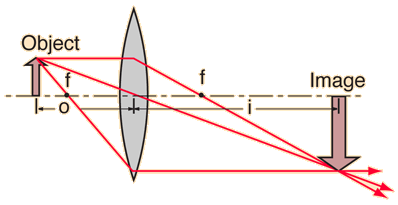
5True or False - This ray diagram shows an object between F and 2F
- AVerdadero
- BFalso
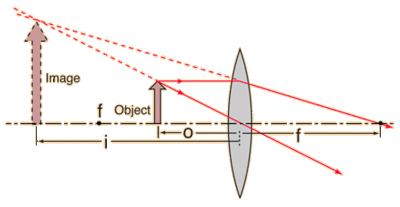
6True or False - This image shows a ray diagram of an object at 2F
- AVerdadero
- BFalso
7What are the 3 properties of an image on a ray diagram?
- AMagnification
- BDirection
- COrientation
- DNature
- EShape
- FCurvature
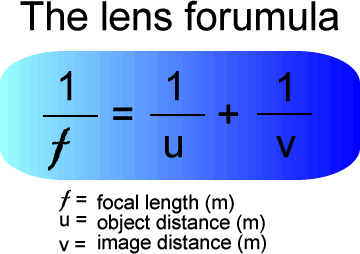
8True or False - The image shows The Lens Formula
- AVerdadero
- BFalso
9True or False - Converging lenses must have positive focal lengths, and diverging lenses must have negative focal lengths for the formula to work.
- AVerdadero
- BFalso
10True or False - For the formula to work, distances to real images should be negative and those to virtual images should be positive
- AVerdadero
- BFalso
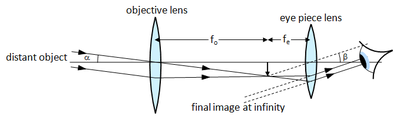
11True or False - this diagram shows an Astronomical Telescope in normal adjustment
- AVerdadero
- BFalso
12The units for the Small Angle Approximation are:
- Aangle = radians
height = centimetres
distance = meters - Bangle = radians
height = metres
distance = parsecs - Cangle = radians
height = metres
distance = metres - Dangle = degrees
height = metres
distance = metres
- Aangle = radians
13The formula for Angular Magnificatio = fe/f0
- AVerdadero
- BFalso
14Select features which define a reflecting telescope
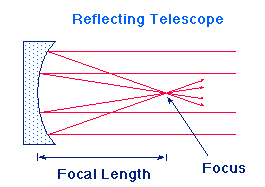
- AThey use a spherical mirror
- BThey can suffer from spherical aberration
- CThey feature a principal axis
- DThey use the idea of angle of incidence = angle of refraction
- EA parabolic mirror is used
- FThey suffer from chromatic aberration
15What are the differences and similarities between reflecting telescopes and Cassegrain Telescopes?
- AThey both use elliptical mirrors
- BThey both suffer from spherical aberration
- CA reflecting telescope has only one mirror, while a cassegrain telescope has two - a primary mirror and a secondary mirror
- DBoth mirrors have holes in them
16A Cassegrain reflector uses a secondary mirror to direct light rays reflected by the primary mirror through a hole in the primary mirror towards the observer
- AVerdadero
- BFalso
Información
- Descripción
- A Quiz for testing knowledge on the whole astrophysics course
- Autor
- Tom Frampton
- Idioma
- English
- Visitas
- 389
- Etiquetas
- Valoración
- 4,0 de 5 · 1 valoración Valora este test