
Test
Chapter 5
Este test tiene tipos de pregunta que se abren en el reproductor de siempre.
Preguntas del test (41)
1What happens to runt frames received by a Cisco Ethernet switch?
- AThe frame is dropped.
- BThe frame is returned to the originating network device.
- CThe frame is broadcast to all other devices on the same network.
- DThe frame is sent to the default gateway.
2What are the two sizes (minimum and maximum) of an Ethernet frame? (Choose two.)
- A56 bytes
- B64 bytes
- C128 bytes
- D1024 bytes
- E1518 bytes
3What statement describes Ethernet?
- AIt defines the most common LAN type in the world.
- BIt is the required Layer 1 and 2 standard for Internet communication.
- CIt defines a standard model used to describe how networking works.
- DIt connects multiple sites such as routers located in different countries.
4Which two statements describe features or functions of the logical link control sublayer in Ethernet standards? (Choose two.)
- ALogical link control is implemented in software.
- BLogical link control is specified in the IEEE 802.3 standard.
- CThe LLC sublayer adds a header and a trailer to the data.
- DThe data link layer uses LLC to communicate with the upper layers of the protocol suite.
- EThe LLC sublayer is responsible for the placement and retrieval of frames on and off the media.
5What statement describes a characteristic of MAC addresses?
- AThey must be globally unique.
- BThey are only routable within the private network.
- CThey are added as part of a Layer 3 PDU.
- DThey have a 32-bit binary value.
6Which statement is true about MAC addresses?
- AMAC addresses are implemented by software.
- BA NIC only needs a MAC address if connected to a WAN.
- CThe first three bytes are used by the vendor assigned OUI.
- DThe ISO is responsible for MAC addresses regulations.
7Which destination address is used in an ARP request frame?
- A0.0.0.0
- B255.255.255.255
- CFFFF.FFFF.FFFF
- D127.0.0.1
- E01-00-5E-00-AA-23
8What addressing information is recorded by a switch to build its MAC address table?
- Athe destination Layer 3 address of incoming packets
- Bthe destination Layer 2 address of outgoing frames
- Cthe source Layer 3 address of outgoing packets
- Dthe source Layer 2 address of incoming frames
9Refer to the exhibit. The exhibit shows a small switched network and the contents of the MAC address table of the switch. PC1 has sent a frame addressed to PC3. What will the switch do with the frame?
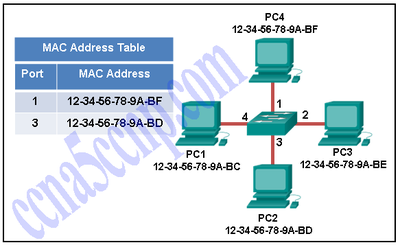
- AThe switch will discard the frame.
- BThe switch will forward the frame only to port 2.
- CThe switch will forward the frame to all ports except port 4.
- DThe switch will forward the frame to all ports.
- EThe switch will forward the frame only to ports 1 and 3.
10Which switching method uses the CRC value in a frame?
- Acut-through
- Bfast-forward
- Cfragment-free
- Dstore-and-forward
11What is auto-MDIX?
- Aa type of Cisco switch
- Ban Ethernet connector type
- Ca type of port on a Cisco switch
- Da feature that detects Ethernet cable type
12Refer to the exhibit. PC1 issues an ARP request because it needs to send a packet to PC2. In this scenario, what will happen next?
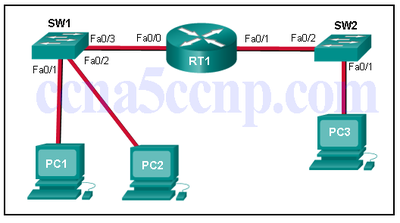
- APC2 will send an ARP reply with its MAC address
- BRT1 will send an ARP reply with its Fa0/0 MAC address.
- CRT1 will send an ARP reply with the PC2 MAC address.
- DSW1 will send an ARP reply with the PC2 MAC address.
- ESW1 will send an ARP reply with its Fa0/1 MAC address.
13What are two potential network problems that can result from ARP operation? (Choose two.)
- AManually configuring static ARP associations could facilitate ARP poisoning or MAC address spoofing.
- BOn large networks with low bandwidth, multiple ARP broadcasts could cause data communication delays.
- CNetwork attackers could manipulate MAC address and IP address mappings in ARP messages with the intent of intercepting network traffic.
- DLarge numbers of ARP request broadcasts could cause the host MAC address table to overflow and prevent the host from communicating on the network.
- EMultiple ARP replies result in the switch MAC address table containing entries that match the MAC addresses of hosts that are connected to the relevant switch port.
14A collision fragment, also known as a [blank_start]RUNT[blank_end] frame, is a frame of fewer than 64 bytes in length.
- ARUNT
15On a Cisco switch, [blank_start]port-based[blank_end] memory buffering is used to buffer frames in queues linked to specific incoming and outgoing ports.
- Aport-based
16ARP [blank_start]spoofing[blank_end] is a technique that is used to send fake ARP messages to other hosts in the LAN. The aim is to associate IP addresses to the wrong MAC addresses.
- Aspoofing
1718. What is a characteristic of a contention-based access method?
- AIt processes more overhead than the controlled access methods do.
- BIt has mechanisms to track the turns to access the media.
- CIt is a nondeterministic method.
- DIt scales very well under heavy media use.
1819. What is the purpose of the preamble in an Ethernet frame?
- Ais used as a padding for data
- Bis used for timing synchronization
- Cis used to identify the source address
- Dis used to identify the destination address
1920. What is the Layer 2 multicast MAC address that corresponds to the Layer 3 IPv4 multicast address 224.139.34.56?
- A00-00-00-0B-22-38
- B01-00-5E-0B-22-38
- C01-5E-00-0B-22-38
- DFE-80-00-0B-22-38
- EFF-FF-FF-0B-22-38
2021. Which two statements are correct about MAC and IP addresses during data transmission if NAT is not involved? (Choose two.)
- AA packet that has crossed four routers has changed the destination IP address four times.
- BDestination MAC addresses will never change in a frame that goes across seven routers.
- CDestination and source MAC addresses have local significance and change every time a frame goes from one LAN to another.
- DDestination IP addresses in a packet header remain constant along the entire path to a target host.
- EEvery time a frame is encapsulated with a new destination MAC address, a new destination IP address is needed.
2122. What are two features of ARP? (Choose two.)
- AIf a host is ready to send a packet to a local destination device and it has the IP address but not the MAC address of the destination, it generates an ARP broadcast.
- BAn ARP request is sent to all devices on the Ethernet LAN and contains the IP address of the destination host and its multicast MAC address.
- CWhen a host is encapsulating a packet into a frame, it refers to the MAC address table to determine the mapping of IP addresses to MAC addresses.
- DIf no device responds to the ARP request, then the originating node will broadcast the data packet to all devices on the network segment.
- EIf a device receiving an ARP request has the destination IPv4 address, it responds with an ARP reply.
2223. A host is trying to send a packet to a device on a remote LAN segment, but there are currently no mappings in its ARP cache. How will the device obtain a destination MAC address?
- AIt will send an ARP request for the MAC address of the destination device.
- BIt will send an ARP request for the MAC address of the default gateway.
- CIt will send the frame and use its own MAC address as the destination.
- DIt will send the frame with a broadcast MAC address.
- EIt will send a request to the DNS server for the destination MAC address.
2324. A network administrator is connecting two modern switches using a straight-through cable. The switches are new and have never been configured. Which three statements are correct about the final result of the connection? (Choose three.)
- AThe link between the switches will work at the fastest speed that is supported by both switches.
- BThe link between switches will work as full-duplex.
- CIf both switches support different speeds, they will each work at their own fastest speed.
- DThe auto-MDIX feature will configure the interfaces eliminating the need for a crossover cable.
- EThe connection will not be possible unless the administrator changes the cable to a crossover cable.
- FThe duplex capability has to be manually configured because it cannot be negotiated.
2425. A Layer 2 switch is used to switch incoming frames from a 1000BASE-T port to a port connected to a 100Base-T network. Which method of memory buffering would work best for this task?
- Aport-based buffering
- Blevel 1 cache buffering
- Cshared memory buffering
- Dfixed configuration buffering
2526. When would a switch record multiple entries for a single switch port in its MAC address table?
- Awhen a router is connected to the switch port
- Bwhen multiple ARP broadcasts have been forwarded
- Cwhen another switch is connected to the switch port
- Dwhen the switch is configured for Layer 3 switching
2627. Which two statements describe a fixed configuration Ethernet switch? (Choose two.)
- AThe switch cannot be configured with multiple VLANs.
- BAn SVI cannot be configured on the switch.
- CA fixed configuration switch may be stackable.
- DThe number of ports on the switch cannot be increased.
- EThe port density of the switch is determined by the Cisco IOS.
2728. How does adding an Ethernet line card affect the form factor of a switch?
- Aby increasing the back plane switching speed
- Bby expanding the port density
- Cby making the switch stackable
- Dby expanding the NVRAM capacity
2829. Which address or combination of addresses does a Layer 3 switch use to make forwarding decisions?
- AIP address only
- Bport address only
- CMAC address only
- DMAC and port addresses
- EMAC and IP addresses
2930. What statement illustrates a drawback of the CSMA/CD access method?
- ADeterministic media access protocols slow network performance.
- BIt is more complex than non-deterministic protocols.
- CCollisions can decrease network performance.
- DCSMA/CD LAN technologies are only available at slower speeds than other LAN technologies.
3031. Open the PT Activity. Perform the tasks in the activity instruction and then answer the question.
What destination address will PC1 include in the destination address field of the Ethernet frame that it sends to PC2?- A192.168.0.17
- B192.168.0.34
- C0030.a3e5.0401
- D00e0.b0be.8014
- E0007.ec35.a5c6
31Cut-through characteristics
- Ahas low latency
- Balways stores the entire frame
- Cmay forward runt frames
- Dchecks the CRC before forwarding
- Echecks the frame length before forwarding
- Fbegins forwarding when the destination address is recieved
- Gdoes not forward broadcasts
32store-and-forward characteristics
- Ahas low latency
- Bmay forward runt frames
- Cchecks the frame length before forwarding
- Dchecks the CRC before forwarding
- Ealways stores the entire frame
- Fbegins forwarding when the destination address is received
- Gdoes not forward broadcast
3335. How does adding an Ethernet line card affect the form factor of a switch?
- Aby increasing the back plane switching speed
- Bby expanding the port density
- Cby expanding the NVRAM capacity
- Dby making the switch stackable
3436. What statement illustrates a drawback of the CSMA/CD access method?
- ACollisions can decrease network performance.
- BDeterministic media access protocols slow network performance.
- CCSMA/CD LAN technologies are only available at slower speeds than other LAN technologies.
- DIt is more complex than non-deterministic protocols.
35A network administrator issues the following commands on a Layer 3 switch:
DLS1(config)# interface f0/3
DLS1(config-if)# no switchport
DLS1(config-if)# ip address 172.16.0.1 255.255.255.0
DLS1(config-if)# no shutdown
DLS1(config-if)# end
38. What is the administrator configuring?- Aa Cisco Express Forwarding instance
- Ba routed port
- Ca trunk interface
- Da switched virtual interface
36The binary number 0000 1010 can be expressed as “[blank_start]A[blank_end]” in hexadecimal.
- AA
37When a device is sending data to another device on a remote network, the Ethernet frame is sent to the MAC address of the default gateway.
- AVerdadero
- BFalso
3842. The ARP table in a switch maps which two types of address together?
- ALayer 3 address to a Layer 2 address
- BLayer 3 address to a Layer 4 address
- CLayer 4 address to a Layer 2 address
- DLayer 2 address to a Layer 4 address
39A switch with a default configuration connects four hosts. The ARP table for host A is shown. What happens when host A wants to send an IP packet to host D?
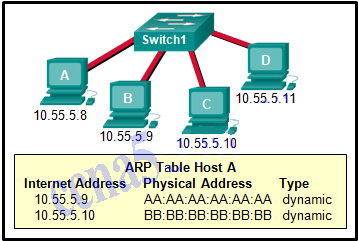
- AHost A sends an ARP request to the MAC address of host D.
- BHost D sends an ARP request to host A.
- CHost A sends out the packet to the switch. The switch sends the packet only to the host D, which in turn responds.
- DHost A sends out a broadcast of FF:FF:FF:FF:FF:FF. Every other host connected to the switch receives the broadcast and host D responds with its MAC address.
40The switches are in their default configuration. Host A needs to communicate with host D, but host A does not have the MAC address for its default gateway. Which network hosts will receive the ARP request sent by host A?
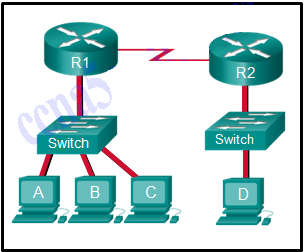
- Aonly host D
- Bonly router R1
- Conly hosts B, C, and router R1
- Donly hosts A, B, and C
- Eonly hosts A, B, C, and D
- Fonly hosts B and C
4145. Which statement describes the treatment of ARP requests on the local link?
- AThey must be forwarded by all routers on the local network.
- BThey are received and processed by every device on the local network.
- CThey are dropped by all switches on the local network.
- DThey are received and processed only by the target device.
Información
- Descripción
- Computer Science Test sobre Chapter 5 , creado por Daniel Wygoda el 25/03/2017.
- Autor
- Daniel Wygoda
- Idioma
- English
- Visitas
- 0
- Etiquetas
- Valoración
- Aún sin valoraciones Valora este test