
Test
P7 Ultimate Test
Este test tiene tipos de pregunta que se abren en el reproductor de siempre.
Preguntas del test (8)
1The [blank_start]observed brightness[blank_end] of a star depends on it's [blank_start]luminosity[blank_end] and how [blank_start]faraway[blank_end] it is from Earth, the [blank_start]luminosity[blank_end] of a star being the [blank_start]energy[blank_end] it gives out in the form of [blank_start]radiation[blank_end]. The luminosity of a star depends on the [blank_start]size[blank_end] and [blank_start]temperature[blank_end] of the star - the [blank_start]bigger[blank_end]/[blank_start]hotter[blank_end] it is, the the [blank_start]greater[blank_end] it's luminosity.
If a star is further away, it will appear dimmer.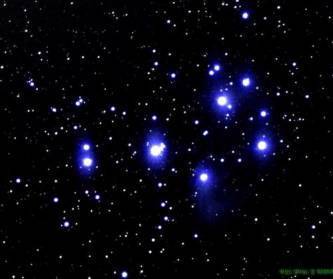
- Aobserved brightness
- Bluminosity
- Cfaraway
- Dluminosity
- Eenergy
- Fradiation
- Gsize, temperature
- Htemperature, size
- Ibigger
- Jhotter
- Kgreater, bigger, better
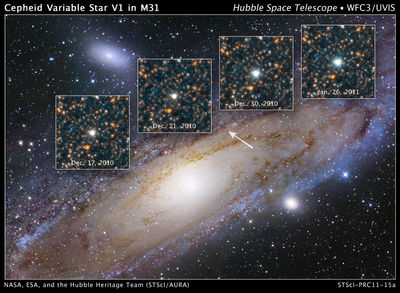
2Cepheid Variables are [blank_start]groups of stars[blank_end] which [blank_start]pulse in brightness[blank_end]. They get [blank_start]brighter[blank_end] and [blank_start]dimmer[blank_end] over the course of [blank_start]several days[blank_end].
- Agroups of stars
- Bpulse in brightness
- Cbrighter
- Ddimmer
- Eseveral days
3Tick the correct statements about Cepheid Variables:
- AHow quickly they pulse is inversely proportional to their luminosity
- BHow quickly they pulse is directly linked to their luminosity
- CThe greater the luminosity, the longer the time between pulses
- DThe lower the luminosity, the less time there will be between pulses
4Astronomers can work out the [blank_start]distance[blank_end] to a star by comparing it's [blank_start]luminosity[blank_end] with it's [blank_start]observed brightness[blank_end].
- Adistance
- Bluminosity
- Cobserved brightness
5Curtis believed that:
• The [blank_start]Universe[blank_end] was made-up of [blank_start]multiple galaxies[blank_end]
• The [blank_start]Sun[blank_end] was at the [blank_start]centre[blank_end] of our galaxy
• Our galaxy was [blank_start]10,000pc across[blank_end]
• [blank_start]Spiral Nebulae[blank_end] were [blank_start]distant[blank_end] galaxies, [blank_start]not a part of[blank_end] the Milky Way- AUniverse
- Bmultiple galaxies
- CSun
- DMoon
- EEarth
- Fcentre
- Gouter edges
- H10,000pc across
- I100,000pc across
- JSpiral Nebulae
- KNebulae
- Ldistant
- Mnot a part of
6Shapley believed that:
• The Universe was [blank_start]one big galaxy[blank_end], [blank_start]100,000pc[blank_end] across
• He also believed that the [blank_start]Sun[blank_end] and the [blank_start]Solar System[blank_end] were [blank_start]faraway[blank_end] from the centre of the Universe.
• He believed that nebulae were [blank_start]huge clouds of dust and gas[blank_end] and that these clouds were [blank_start]nearby[blank_end] and [blank_start]a part[blank_end] of the Milky Way.- Aone big galaxy
- Bmultiple galaxies
- C100,000pc
- D10,000pc
- ESun
- FSolar System
- GGalaxy
- HSpiral Nebulae
- Irelatively close
- Jfaraway
- Kdistant clusters of Cepheid Variables
- LRed shift stars
- Mhuge clouds of dust and gas
- Nnearby
- Odistant
- Pa part
- Qfaraway from
7With cepheid variables, the greater the luminosity, the longer the time between pulses.
- AVerdadero
- BFalso
8Scientists can work out the [blank_start]distance[blank_end] to a star by comparing [blank_start]luminosity[blank_end] and [blank_start]observed brightness[blank_end]. Luminosity is worked out using the [blank_start]time between pulses[blank_end].
- Atime between pulses
- Bdistance
- Cluminosity
- Dobserved brightness
Información
- Descripción
- Test sobre P7 Ultimate Test, creado por Matthew Reid el 06/04/2017.
- Autor
- Matthew Reid
- Idioma
- English
- Visitas
- 37
- Historial
- Creado el 6 abr 2017 · actualizado el 6 abr 2017
- Etiquetas
- Valoración
- Aún sin valoraciones Valora este test