
Test
Amino Acids 1A (BC/OC)
Crea una cuenta gratis para terminar este test
Guarda tu progreso y consulta tu resultado final.
¿Ya tienes cuenta? Inicia sesión
Preguntas del test (13)
1What is an amino acid?
- Aa simple organic compound containing both a carboxyl (—COO-) and an amino (—NH3+) group.
- Ba simple organic compound containing both a carboxylic acid (—COOH) and nitrile (—CN) group.
- Ca simple organic compound containing both a carboxyl (—COO) and an ester (—COOR) group.
2Is the image shown the correct basic structure for an amino acid?
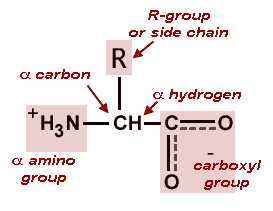
- AYes
- BNo
- CMaybe
3There are 21 essential amino acids that the body utilizes, some books say 20 because the 21st was recently discovered. Why are amino acids so important?
- AThey serve as the most basic building blocks to proteins?
- BThey are comprised of proteins?
- CThey fight diseases in an immune response?
- DWho really knows?
4All 21 eukaryotic proteinogenic amino acids share a common backbone structure, since this structure is common, what is it that makes each amino acid unique?
- AThe -R group that is attached to the alpha carbon?
- BHow each amino acid bonds to another amino acid when forming a protein?
- CIt's Pka value?
5What is the significance of the alpha carbon on proteinogenic amino acids?
- AThe alpha carbon is where the amino acid connects to other amino acids in order to form polymers (Proteins)?
- BThe alpha carbon is a chiral carbon (with the exception of leucine) that attaches to the -R group?
- CThe alpha carbon is a chiral carbon that attaches to the -R group, the amino group, a hydrogen and a carboxylic acid?
6What does chirality mean?
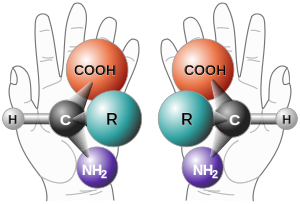
- AChirality means that a molecule can rotate polarized light and has optical activity because it is attached to four different functional groups. It also refers to its symmetry on a chiral carbon and that if a 3D version is reflected in a mirror, its image in non superimposable.
- BChirality means that the chiral carbon is the most important carbon in reactiveness for the molecule and that its mirror image is superimposable.
- CChirality means that a molecule only has one alpha carbon.
7What is the conjugate base for Carboxylic acid? -COOH
- A-CO
- B-OOH
- C-COO (-)
8What do the horizontal lines represent? what do the vertical lines represent? what does the "L" and "D" represent?
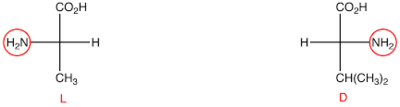
- AThe horizontal lines represent constituent bonds that are coming out of the plane of the page towards the viewer. The vertical lines represent bonds between carbon atoms that are going into the plane of the page away from the viewer. The "L" and "D" stand for levorotatory (Left) and dextrorotatory (Right).
- BThe horizontal lines represent constituent bonds that are going into the plane of the page away from the viewer. The vertical lines represent bonds between carbon atoms that are coming out of the plane of the page towards the viewer. The "L" and "D" stand for levorotatory (Left) and dextrorotatory (Right).
9Of all of the proteinogenic amino acids that the human body utilizes, which amino acid is not chiral?
- AGlycine
- BL-Alanine
- CL-Lysine
- DL-Valine
- EL-Glycine
10What do the "L" and "D" designation of amino acids represent? Why is this designation significant?
- AThe "L" means levorotary and stands for left. Molecules that are of the L designation means that they will rotate a beam of polarized light to the left if projected into solution of L molecules. The "R" designation means dextrorotary and stand for right. Molecules that are of the R designation will turn a beam of polarized light to the right if projected into a solution of R molecules. The L and D designation is significant in protein synthesis because the body only uses "L" AA's.
- BThe "L" means levorotary and stands for left. Molecules that are of the L designation means that they will rotate a beam of polarized light to the left if projected into solution of L molecules. The "R" designation means dextrorotary and stand for right. Molecules that are of the R designation will turn a beam of polarized light to the right if projected into a solution of R molecules. The L and D designation is significant in protein synthesis because the body only uses "D" AA's.
11Review: Looking at the photo of C6H14, what are structural isomers (aka: constitutional isomers)?
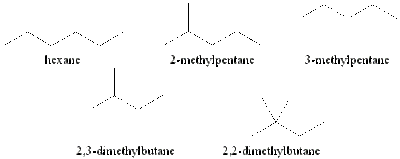
- AA structural isomer is the least similar of all isomerism. They only share the same molecular formula and therefor have the same molecular weight of other structural isomers. Aside from that, there spatial arrangement and connectivity are completely different from molecule to molecule.
- BA structural isomer is the most similar of all isomerism. They share the same molecular formula and therefor have the same molecular weight of other structural isomers. This means they also have similar chemical properties that will be common in how they react with other molecules.
- CA structural isomer is the written representation of a molecule in line form.
- DA structural isomer is the least similar of all isomerism. They share the same molecular formula and therefor have the same molecular weight of other structural isomers. This means that they have the same physical properties such as boiling point and melting point.
12Re: What are isomers?
- ASame molecular formula, same molecular weight, different structure?
- BDifferent molecular formula, same molecular weight, same structure?
- CSame molecular formula, same molecular weight, same structure?
- DSame molecular formula, different molecular weight, same structure?
13Review: Looking at the photo, what is Stereoisomerism?
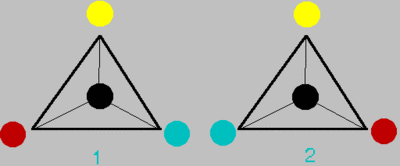
- AStereoisomers are isomeric molecules that have the same molecular formula and sequence of bonded atoms (constitution), that also have the same three-dimensional orientations of their atoms in space.
- BTwo molecules are described as stereoisomers of each other if they are made of the same atoms, connected in the same sequence, but the atoms are positioned differently in space. The difference between two stereoisomers can only be seen when the three dimensional arrangement of the molecules is considered.
Información
- Descripción
- These Topics are from the AAMC outline for the new 2015 MCAT. They are designed to be study aids in memorization and recall. One should review these questions frequently no matter what stage of study.
- Autor
- mcatpracticum
- Idioma
- English
- Visitas
- 114
- Etiquetas
- Valoración
- 4,0 de 5 · 1 valoración Valora este test