
Test
CISCO 2 - Chapter 5 bis Chapter 9
Preguntas del test (107)
1Which statement describes the port speed LED on the Cisco Catalyst 2960 switch?
- AIf the LED is amber, the port is operating at 1000 Mb/s.
- BIf the LED is blinking green, the port is operating at 10 Mb/s.
- CIf the LED is off, the port is not operating.
- DIf the LED is green, the port is operating at 100 Mb/s.
2Which command is used to set the BOOT environment variable that defines where to find the IOS image file on a switch?
- Aconfreg
- Bboot loader
- Cboot system
- Dconfig-register
3What is a function of the switch boot loader?
- Ato provide an environment to operate in when the switch operating system cannot be found
- Bto control how much RAM is available to the switch during the boot process
- Cto provide security for the vulnerable state when the switch is booting
- Dto speed up the boot process
4Which interface is the default location that would contain the IP address used to manage a 24-port Ethernet switch?
- AVLAN 99
- Binterface connected to the default gateway
- CFa0/1
- DFa0/0
- EVLAN 1
5 A production switch is reloaded and finishes with a Switch> prompt. What two facts can be determined? (Choose two.)
- AThe switch did not locate the Cisco IOS in flash, so it defaulted to ROM.
- BA full version of the Cisco IOS was located and loaded.
- CThere is not enough RAM or flash on this router.
- DThe boot process was interrupted.
- EPOST occurred normally.
6Which two statements are true about using full-duplex Fast Ethernet? (Choose two.)
- AFull-duplex Fast Ethernet offers 100 percent efficiency in both directions.
- BPerformance is improved because the NIC is able to detect collisions.
- CNodes operate in full-duplex with unidirectional data flow.
- DLatency is reduced because the NIC processes frames faster.
- EPerformance is improved with bidirectional data flow.
7In which situation would a technician use the show interfaces switch command?
- Ato determine the MAC address of a directly attached network device on a particular interface
- Bwhen an end device can reach local devices, but not remote devices
- Cwhen packets are being dropped from a particular directly attached host
- Dto determine if remote access is enabled
8Refer to the exhibit. A network technician is troubleshooting connectivity issues in an Ethernet network with the command show interfaces fastEthernet 0/0. What conclusion can be drawn based on the partial output in the exhibit?
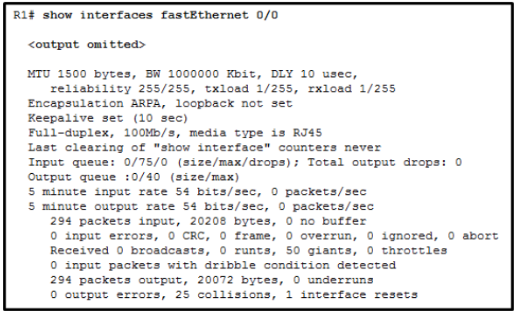
- AAll hosts on this network communicate in full-duplex mode.
- BA malfunctioning NIC can cause frames to be transmitted that are longer than the allowed maximum length.
- CThere are collisions in the network that cause frames to occur that are less than 64 bytes in length.
- DSome workstations might use an incorrect cabling type to connect to the network.
9Refer to the exhibit. What media issue might exist on the link connected to Fa0/1 based on the show interface command?
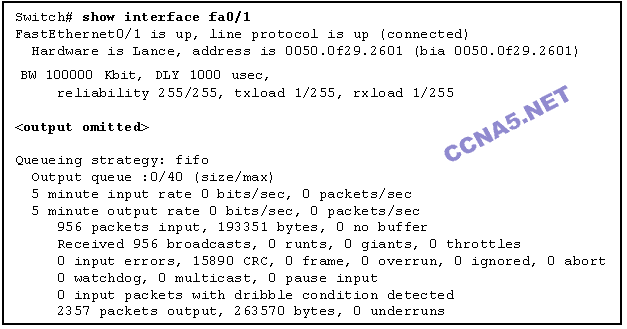
- AThe bandwidth parameter on the interface might be too high.
- BThe interface might be configured as half-duplex.
- CThe cable attaching the host to port Fa0/1 might be too long.
- DThere could be too much electrical interference and noise on the link.
- EThere could be an issue with a faulty NIC.
10If one end of an Ethernet connection is configured for full duplex and the other end of the connection is configured for half duplex, where would late collisions be observed?
- Aon the half-duplex end of the connection
- Bonly on serial interfaces
- Con the full-duplex end of the connection
- Don both ends of the connection
11What is one difference between using Telnet or SSH to connect to a network device for management purposes?
- ATelnet sends a username and password in plain text, whereas SSH encrypts the username and password.
- BTelnet supports a host GUI whereas SSH only supports a host CLI.
- CTelnet does not provide authentication whereas SSH provides authentication.
- DTelnet uses UDP as the transport protocol whereas SSH uses TCP.
12Refer to the exhibit. The network administrator wants to configure Switch1 to allow SSH connections and prohibit Telnet connections. How should the network administrator change the displayed configuration to satisfy the requirement?
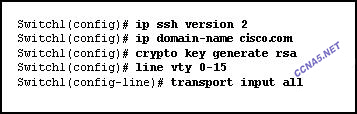
- AUse SSH version 1.
- BModify the transport input command.
- CConfigure SSH on a different line.
- DReconfigure the RSA key.
13What is the effect of using the switchport port-security command?
- Adetects the first MAC address in a frame that comes into a port and places that MAC address in the MAC address table
- Bautomatically shuts an interface down if applied to a trunk port
- Cenables port security globally on the switch
- Denables port security on an interface
14Where are dynamically learned MAC addresses stored when sticky learning is enabled with the switchport port-security mac-address sticky command?
- Aflash
- BNVRAM
- CRAM
- DROM
15A network administrator configures the port security feature on a switch. The security policy specifies that each access port should allow up to two MAC addresses. When the maximum number of MAC addresses is reached, a frame with the unknown source MAC address is dropped and a notification is sent to the syslog server. Which security violation mode should be configured for each access port?
- Ashutdown
- Bwarning
- Cprotect
- Drestrict
16Which two statements are true regarding switch port security? (Choose two.)
- AIf fewer than the maximum number of MAC addresses for a port are configured statically, dynamically learned addresses are added to CAM until the maximum number is reached.
- BAfter entering the sticky parameter, only MAC addresses subsequently learned are converted to secure MAC addresses.
- CThe three configurable violation modes all require user intervention to re-enable ports.
- DDynamically learned secure MAC addresses are lost when the switch reboots.
- EThe three configurable violation modes all log violations via SNMP.
17Which action will bring an error-disabled switch port back to an operational state?
- AIssue the shutdown and then no shutdown interface commands.
- BClear the MAC address table on the switch.
- CIssue the switchport mode access command on the interface.
- DRemove and reconfigure port security on the interface.
18Refer to the exhibit. Port Fa0/2 has already been configured appropriately. The IP phone and PC work properly. Which switch configuration would be most appropriate for port Fa0/2 if the network administrator has the following goals?
No one is allowed to disconnect the IP phone or the PC and connect some other wired device.
If a different device is connected, port Fa0/2 is shut down.
The switch should automatically detect the MAC address of the IP phone and the PC and add those addresses to the running configuration.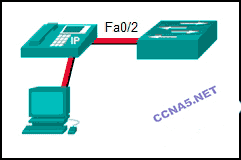
- ASWA(config-if)# switchport port-security
SWA(config-if)# switchport port-security mac-address sticky - BSWA(config-if)# switchport port-security mac-address sticky
SWA(config-if)# switchport port-security maximum 2 - CSWA(config-if)# switchport port-security
SWA(config-if)# switchport port-security maximum 2
SWA(config-if)# switchport port-security mac-address sticky - DSWA(config-if)# switchport port-security
SWA(config-if)# switchport port-security maximum 2
SWA(config-if)# switchport port-security mac-address sticky
SWA(config-if)# switchport port-security violation restrict
- ASWA(config-if)# switchport port-security
19Refer to the exhibit. What can be determined about port security from the information that is shown?
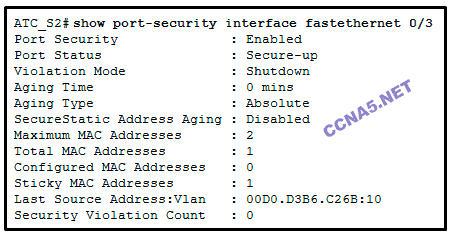
- AThe port has been shut down.
- BThe port has the maximum number of MAC addresses that is supported by a Layer 2 switch port which is configured for port security.
- CThe port violation mode is the default for any port that has port security enabled.
- DThe port has two attached devices.
20Refer to the exhibit. Which event will take place if there is a port security violation on switch S1 interface Fa0/1?
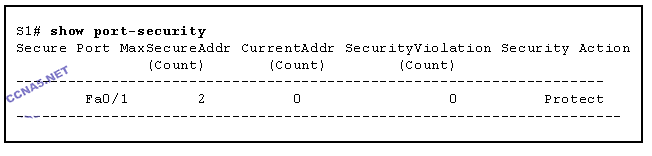
- AA notification is sent.
- BThe interface will go into error-disabled state.
- CPackets with unknown source addresses will be dropped.
- DA syslog message is logged.
21What are three primary benefits of using VLANs? (Choose three.)
- Ano required configuration
- Bimproved IT staff efficiency
- Cend user satisfaction
- Dcost reduction
- Ea reduction in the number of trunk links
- Fsecurity
22Which type of VLAN is used to designate which traffic is untagged when crossing a trunk port?
- Amanagement
- Bnative
- Cdefault
- Ddata
23A network administrator is determining the best placement of VLAN trunk links. Which two types of point-to-point connections utilize VLAN trunking? (Choose two.)
- Abetween two switches that share a common VLAN
- Bbetween a switch and a network printer
- Cbetween a switch and a server that has an 802.1Q NIC
- Dbetween a switch and a client PC
- Ebetween two switches that utilize multiple VLANs
24What must the network administrator do to remove Fast Ethernet port fa0/1 from VLAN 2 and assign it to VLAN 3?
- AEnter the no shutdown command in interface configuration mode to return it to the default configuration and then configure the port for VLAN 3.
- BEnter the switchport trunk native vlan 3 command in interface configuration mode.
- CEnter the switchport access vlan 3 command in interface configuration mode.
- DEnter the no vlan 2 and the vlan 3 commands in global configuration mode.
25When a Cisco switch receives untagged frames on a 802.1Q trunk port, which VLAN ID is the traffic switched to by default?
- Amanagement VLAN ID
- Bdata VLAN ID
- Cnative VLAN ID
- Dunused VLAN ID
26Port Fa0/11 on a switch is assigned to VLAN 30. If the command no switchport access vlan 30 is entered on the Fa0/11 interface, what will happen?
- AVLAN 30 will be deleted.
- BPort Fa0/11 will be returned to VLAN 1.
- CAn error message would be displayed.
- DPort Fa0/11 will be shutdown.
27Which command is used to remove only VLAN 20 from a switch?
- Ano switchport access vlan 20
- Bno vlan 20
- Cdelete flash:vlan.dat
- Ddelete vlan.dat
28What happens to a port that is associated with VLAN 10 when the administrator deletes VLAN 10 from the switch?
- AThe port creates the VLAN again.
- BThe port automatically associates itself with the native VLAN.
- CThe port goes back to the default VLAN.
- DThe port becomes inactive.
29Which two characteristics match extended range VLANs? (Choose two.)
- AThey are commonly used in small networks.
- BVLANs are initialized from flash memory.
- CThey are saved in the running-config file by default.
- DVLAN IDs exist between 1006 to 4094.
- ECDP can be used to learn and store these VLANs.
30A Cisco switch currently allows traffic tagged with VLANs 10 and 20 across trunk port Fa0/5. What is the effect of issuing a switchport trunk allowed vlan 30 command on Fa0/5?
- AIt allows a native VLAN of 30 to be implemented on Fa0/5.
- BIt allows only VLAN 30 on Fa0/5.
- CIt allows VLANs 10, 20, and 30 on Fa0/5.
- DIt allows VLANs 1 to 30 on Fa0/5.
31Refer to the exhibit. PC-A and PC-B are both in VLAN 60. PC-A is unable to communicate with PC-B. What is the problem?
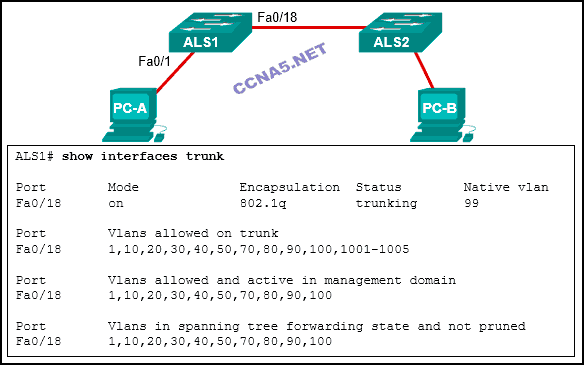
- AThe native VLAN should be VLAN 60.
- BThe VLAN that is used by PC-A is not in the list of allowed VLANs on the trunk.
- CThe trunk has been configured with the switchport nonegotiate command.
- DThe native VLAN is being pruned from the link.
32Refer to the exhibit. DLS1 is connected to another switch, DLS2, via a trunk link. A host that is connected to DLS1 is not able to communicate to a host that is connected to DLS2, even though they are both in VLAN 99. Which command should be added to Fa0/1 on DLS1 to correct the problem?
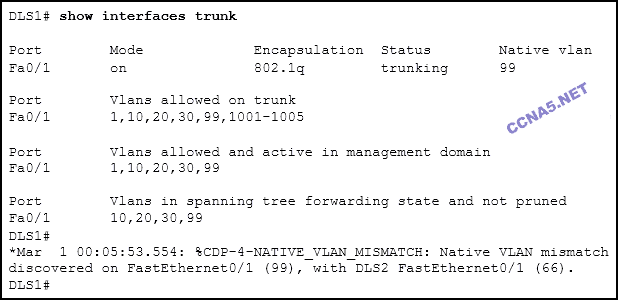
- Aswitchport nonegotiate
- Bswitchport trunk allowed vlan add 99
- Cswitchport trunk native vlan 66
- Dswitchport mode dynamic auto
33What is a characteristic of legacy inter-VLAN routing?
- AInter-VLAN routing must be performed on a switch instead of a router.
- BThe user VLAN must be the same ID number as the management VLAN.
- CThe router requires one Ethernet link for each VLAN.
- DOnly one VLAN can be used in the topology.
34What is a disadvantage of using router-on-a-stick inter-VLAN routing?
- Arequires the use of multiple router interfaces configured to operate as access links
- Bdoes not scale well beyond 50 VLANs
- Crequires the use of more physical interfaces than legacy inter-VLAN routing
- Ddoes not support VLAN-tagged packets
35Refer to the exhibit. Router RA receives a packet with a source address of 192.168.1.35 and a destination address of 192.168.1.85. What will the router do with this packet?
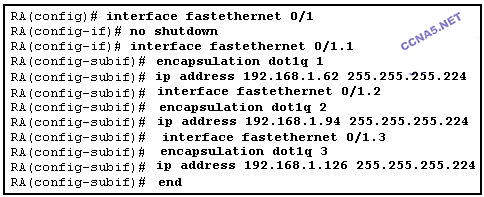
- AThe router will drop the packet.
- BThe router will forward the packet out interface FastEthernet 0/1.2 and interface FastEthernet 0/1.3.
- CThe router will forward the packet out interface FastEthernet 0/1.3.
- DThe router will forward the packet out interface FastEthernet 0/1.2.
- EThe router will forward the packet out interface FastEthernet 0/1.1.
36Refer to the exhibit. In what switch mode should port G0/1 be assigned if Cisco best practices are being used?
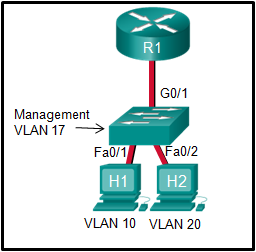
- Aaccess
- Bauto
- Cnative
- Dtrunk
37A small college uses VLAN 10 for the classroom network and VLAN 20 for the office network. What is needed to enable communication between these two VLANs while using legacy inter-VLAN routing?
- AA switch with a port that is configured as trunk is needed to connect to a router.
- BA router with one VLAN interface is needed to connect to the SVI on a switch.
- CTwo groups of switches are needed, each with ports that are configured for one VLAN.
- DA router with at least two LAN interfaces should be used.
38Refer to the exhibit. A network administrator needs to configure router-on-a-stick for the networks that are shown. How many subinterfaces will have to be created on the router if each VLAN that is shown is to be routed and each VLAN has its own subinterface?
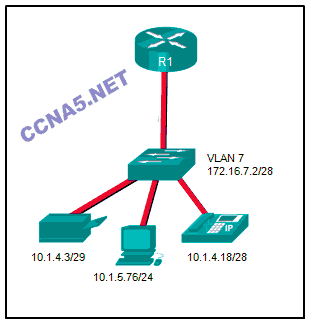
- A1
- B2
- C3
- D4
- E5
39When configuring a router as part of a router-on-a-stick inter-VLAN routing topology, where should the IP address be assigned?
- Ato the VLAN
- Bto the SVI
- Cto the subinterface
- Dto the interface
40A high school uses VLAN15 for the laboratory network and VLAN30 for the faculty network. What is required to enable communication between these two VLANs while using the router-on-a-stick approach?
- AA switch with a port that is configured as a trunk is needed when connecting to the router.
- BTwo groups of switches are needed, each with ports that are configured for one VLAN.
- CA router with at least two LAN interfaces is needed.
- DA multilayer switch is needed.
41Refer to the exhibit. A router-on-a-stick configuration was implemented for VLANs 15, 30, and 45, according to the show running-config command output. PCs on VLAN 45 that are using the 172.16.45.0 /24 network are having trouble connecting to PCs on VLAN 30 in the 172.16.30.0 /24 network. Which error is most likely causing this problem?
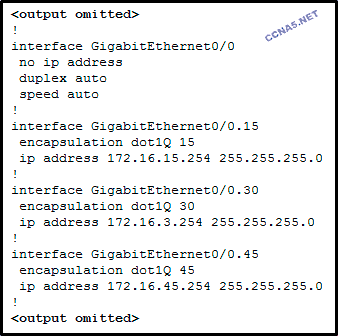
- AThe wrong VLAN has been configured on GigabitEthernet 0/0.45.
- BThere is an incorrect IP address configured on GigabitEthernet 0/0.30.
- CThe GigabitEthernet 0/0 interface is missing an IP address.
- DThe command no shutdown is missing on GigabitEthernet 0/0.30.
42A network administrator issues the show VLAN brief command while troubleshooting a user support ticket. What output will be displayed?
- Athe VLAN assignment and native VLAN
- Bthe VLAN assignment and membership for all switch ports
- Cthe VLAN assignment and trunking encapsulation
- Dthe VLAN assignment and membership for device MAC addresses
43Which four steps are needed to configure a voice VLAN on a switch port? (Choose four).
- AConfigure the interface as an IEEE 802.1Q trunk.
- BConfigure the switch port interface with subinterfaces.
- CEnsure that voice traffic is trusted and tagged with a CoS priority value.
- DActivate spanning-tree PortFast on the interface.
- EAssign the voice VLAN to the switch port.
- FAdd a voice VLAN.
- GAssign a data VLAN to the switch port.
- HConfigure the switch port in access mode.
44In which configuration would an outbound ACL placement be preferred over an inbound ACL placement?
- Awhen an interface is filtered by an outbound ACL and the network attached to the interface is the source network being filtered within the ACL
- Bwhen an outbound ACL is closer to the source of the traffic flow
- Cwhen a router has more than one ACL
- Dwhen the ACL is applied to an outbound interface to filter packets coming from multiple inbound interfaces before the packets exit the interface
45Which address is required in the command syntax of a standard ACL?
- Adestination IP address
- Bsource IP address
- Cdestination MAC address
- Dsource MAC address
46Which statement describes a difference between the operation of inbound and outbound ACLs?
- AOn a network interface, more than one inbound ACL can be configured but only one outbound ACL can be configured.
- BInbound ACLs are processed before the packets are routed while outbound ACLs are processed after the routing is completed.
- CInbound ACLs can be used in both routers and switches but outbound ACLs can be used only on routers.
- DIn contrast to outbound ALCs, inbound ACLs can be used to filter packets with multiple criteria.
47Which three statements describe ACL processing of packets? (Choose three.)
- AEach packet is compared to the conditions of every ACE in the ACL before a forwarding decision is made.
- BEach statement is checked only until a match is detected or until the end of the ACE list.
- CA packet that does not match the conditions of any ACE will be forwarded by default.
- DA packet that has been denied by one ACE can be permitted by a subsequent ACE.
- EA packet can either be rejected or forwarded as directed by the ACE that is matched.
- FAn implicit deny any rejects any packet that does not match any ACE.
48What single access list statement matches all of the following networks?
192.168.16.0
192.168.17.0
192.168.18.0
192.168.19.0- Aaccess-list 10 permit 192.168.16.0 0.0.3.25
- Baccess-list 10 permit 192.168.0.0 0.0.15.255
- Caccess-list 10 permit 192.168.16.0 0.0.15.255
- Daccess-list 10 permit 192.168.16.0 0.0.0.255
49A network administrator needs to configure a standard ACL so that only the workstation of the administrator with the IP address 192.168.15.23 can access the virtual terminal of the main router. Which two configuration commands can achieve the task? (Choose two.)
- ARouter1(config)# access-list 10 permit 192.168.15.23 255.255.255.255
- BRouter1(config)# access-list 10 permit 192.168.15.23 255.255.255.0
- CRouter1(config)# access-list 10 permit 192.168.15.23 0.0.0.255
- DRouter1(config)# access-list 10 permit 192.168.15.23 0.0.0.0
- ERouter1(config)# access-list 10 permit host 192.168.15.23
50If a router has two interfaces and is routing both IPv4 and IPv6 traffic, how many ACLs could be created and applied to it?
- A16
- B12
- C8
- D6
- E4
51Which three statements are generally considered to be best practices in the placement of ACLs? (Choose three.)
- AFor every inbound ACL placed on an interface, there should be a matching outbound ACL.
- BPlace standard ACLs close to the destination IP address of the traffic.
- CPlace extended ACLs close to the source IP address of the traffic.
- DFilter unwanted traffic before it travels onto a low-bandwidth link.
- EPlace extended ACLs close to the destination IP address of the traffic.
- FPlace standard ACLs close to the source IP address of the traffic.
52Refer to the exhibit. Which command would be used in a standard ACL to allow only devices on the network attached to R2 G0/0 interface to access the networks attached to R1?
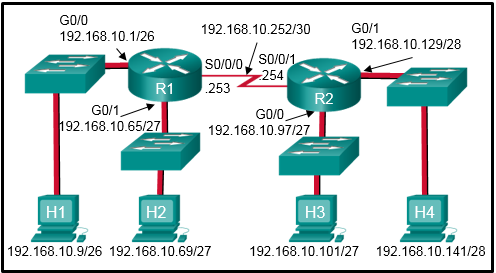
- Aaccess-list 1 permit 192.168.10.0 0.0.0.63
- Baccess-list 1 permit 192.168.10.128 0.0.0.63
- Caccess-list 1 permit 192.168.10.0 0.0.0.255
- Daccess-list 1 permit 192.168.10.96 0.0.0.31
53If the network administrator created a standard ACL that allows only devices that connect to the R2 G0/0 network access to the devices on the R1 G0/1 interface, how should the ACL be applied?
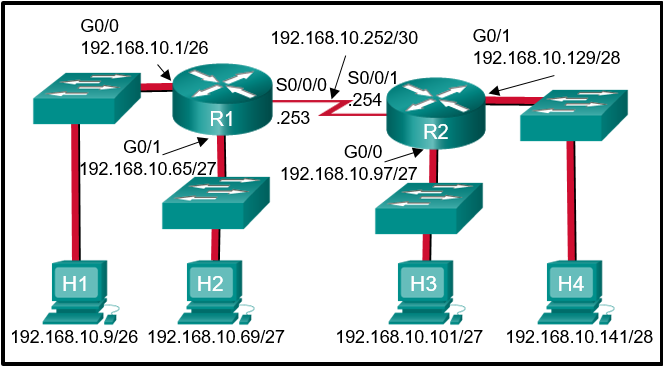
- Aoutbound on the R2 S0/0/1 interface
- Binbound on the R1 G0/1 interface
- Coutbound on the R1 G0/1 interface
- Dinbound on the R2 G0/0 interface
54Refer to the following output. What is the significance of the 4 match(es) statement?
R1# <output omitted>
10 permit 192.168.1.56 0.0.0.7
20 permit 192.168.1.64 0.0.0.63 (4 match(es))
30 deny any (8 match(es))- AFour packets have been denied that have been sourced from any IP address.
- BFour packets have been allowed through the router to reach the destination network of 192.168.1.64/26.
- CFour packets have been allowed through the router from PCs in the network of 192.168.1.64.
- DFour packets have been denied that are destined for the 192.168.1.64 network.
55On which router should the show access-lists command be executed?
- Aon the router that has the ACL configured
- Bon any router through which the packet referenced in the ACL travels
- Con the router that routes the packet referenced in the ACL from the source network
- Don the router that routes the packet referenced in the ACL to the final destination network
56What is the quickest way to remove a single ACE from a named ACL?
- ACreate a new ACL with a different number and apply the new ACL to the router interface.
- BCopy the ACL into a text editor, remove the ACE, then copy the ACL back into the router.
- CUse the no access-list command to remove the entire ACL, then recreate it without the ACE.
- DUse the no keyword and the sequence number of the ACE to be removed.
57Which feature will require the use of a named standard ACL rather than a numbered standard ACL?
- Athe ability to add additional ACEs in the middle of the ACL without deleting and re-creating the list
- Bthe ability to specify source and destination addresses to use when identifying traffic
- Cthe ability to filter traffic based on an entire protocol suite and destination
- Dthe ability to filter traffic based on a specific protocol
58An administrator has configured an access list on R1 to allow SSH administrative access from host 172.16.1.100. Which command correctly applies the ACL?
- AR1(config-line)# access-class 1 out
- BR1(config-line)# access-class 1 in
- CR1(config-if)# ip access-group 1 out
- DR1(config-if)# ip access-group 1 in
59Which type of router connection can be secured by the access-class command?
- AEthernet
- Bserial
- Cconsole
- Dvty
60Consider the following output for an ACL that has been applied to a router via the access-class in command. What can a network administrator determine from the output that is shown?
R1# <output omitted>
Standard IP access list 2
10 permit 192.168.10.0, wildcard bits 0.0.0.255 (2 matches)
20 deny any (1 match)- ATwo devices connected to the router have IP addresses of 192.168.10.x.
- BTraffic from two devices was allowed to enter one router port and be routed outbound to a different router port.
- CTwo devices were able to use SSH or Telnet to gain access to the router.
- DTraffic from one device was not allowed to come into one router port and be routed outbound a different router port.
61Refer to the exhibit. A router has an existing ACL that permits all traffic from the 172.16.0.0 network. The administrator attempts to add a new ACE to the ACL that denies packets from host 172.16.0.1 and receives the error message that is shown in the exhibit. What action can the administrator take to block packets from host 172.16.0.1 while still permitting all other traffic from the 172.16.0.0 network?
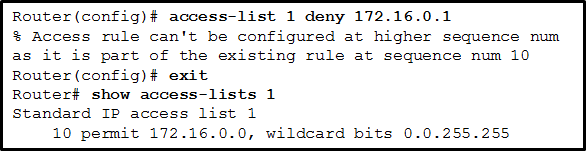
- AManually add the new deny ACE with a sequence number of 5.
- BAdd a deny any any ACE to access-list 1.
- CCreate a second access list denying the host and apply it to the same interface.
- DManually add the new deny ACE with a sequence number of 15.
62Refer to the exhibit. An ACL was configured on R1 with the intention of denying traffic from subnet 172.16.4.0/24 into subnet 172.16.3.0/24. All other traffic into subnet 172.16.3.0/24 should be permitted. This standard ACL was then applied outbound on interface Fa0/0. Which conclusion can be drawn from this configuration?
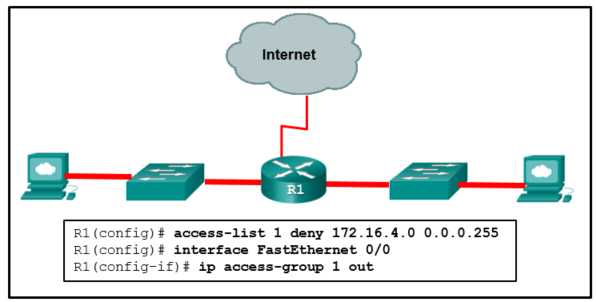
- AOnly traffic from the 172.16.4.0/24 subnet is blocked, and all other traffic is allowed.
- BThe ACL should be applied outbound on all interfaces of R1.
- CAll traffic will be blocked, not just traffic from the 172.16.4.0/24 subnet.
- DAn extended ACL must be used in this situation.
- EThe ACL should be applied to the FastEthernet 0/0 interface of R1 inbound to accomplish the requirements.
63Refer to the exhibit. What will happen to the access list 10 ACEs if the router is rebooted before any other commands are implemented?
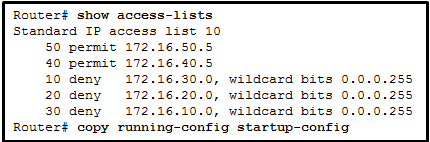
- AThe ACEs of access list 10 will be deleted.
- BThe ACEs of access list 10 wildcard masks will be converted to subnet masks.
- CThe ACEs of access list 10 will be renumbered.
- DThe ACEs of access list 10 will not be affected.
64What is the effect of configuring an ACL with only ACEs that deny traffic?
- AThe ACL must be applied outbound only.
- BThe ACL must be applied inbound only.
- CThe ACL will permit any traffic that is not specifically denied.
- DThe ACL will block all traffic.
65Which type of ACL statements are commonly reordered by the Cisco IOS as the first ACEs?
- Alowest sequence number
- Bpermit any
- Crange
- Dhost
66A network administrator is configuring an ACL to restrict access to certain servers in the data center. The intent is to apply the ACL to the interface connected to the data center LAN. What happens if the ACL is incorrectly applied to an interface in the inbound direction instead of the outbound direction?
- AThe ACL will analyze traffic after it is routed to the outbound interface.
- BThe ACL does not perform as designed.
- CAll traffic is permitted.
- DAll traffic is denied.
67When would a network administrator use the clear access-list counters command?
- Awhen troubleshooting an ACL and needing to know how many packets matched
- Bwhen an ACE is deleted from an ACL
- Cwhen buffer memory is low
- Dwhen obtaining a baseline
68What is the result of a network technician issuing the command ip dhcp excluded-address 10.0.15.1 10.0.15.15 on a Cisco router?
- AThe ip dhcp excluded-address command is followed by the first and the last addresses to be excluded from being leased to DHCP clients.
- BThe Cisco router will exclude 15 IP addresses from being leased to DHCP clients.
- CThe Cisco router will allow only the specified IP addresses to be leased to clients.
- DThe Cisco router will automatically create a DHCP pool using a /28 mask.
- EThe Cisco router will exclude only the 10.0.15.1 and 10.0.15.15 IP addresses from being leased to DHCP clients.
69Which DHCPv4 message will a client send to accept an IPv4 address that is offered by a DHCP server?
- Abroadcast DHCPREQUEST
- Bunicast DHCPREQUEST
- Cbroadcast DHCPACK
- Dunicast DHCPACK
70A company uses DHCP servers to dynamically assign IPv4 addresses to employee workstations. The address lease duration is set as 5 days. An employee returns to the office after an absence of one week. When the employee boots the workstation, it sends a message to obtain an IP address. Which Layer 2 and Layer 3 destination addresses will the message contain?
- AFF-FF-FF-FF-FF-FF and IPv4 address of the DHCP server
- BMAC address of the DHCP server and 255.255.255.255
- Cboth MAC and IPv4 addresses of the DHCP server
- DFF-FF-FF-FF-FF-FF and 255.255.255.255
71Which is a DHCPv4 address allocation method that assigns IPv4 addresses for a limited lease period?
- Adynamic allocation
- Bautomatic allocation
- Cpre-allocation
- Dmanual allocation
72Which address does a DHCPv4 server target when sending a DHCPOFFER message to a client that makes an address request?
- Abroadcast MAC address
- Bgateway IP address
- Cclient hardware address
- Dclient IP address
73As a DHCPv4 client lease is about to expire, what is the message that the client sends the DHCP server?
- ADHCPACK
- BDHCPREQUEST
- CDHCPOFFER
- DDHCPDISCOVER
74What is an advantage of configuring a Cisco router as a relay agent?
- AIt reduces the response time from a DHCP server.
- BIt can provide relay services for multiple UDP services.
- CIt can forward both broadcast and multicast messages on behalf of clients.
- DIt will allow DHCPDISCOVER messages to pass without alteration.
75An administrator issues the commands:
Router(config)# interface g0/1
Router(config-if)# ip address dhcp
What is the administrator trying to achieve?- Aconfiguring the router to resolve IP address conflicts
- Bconfiguring the router to act as a relay agent
- Cconfiguring the router to obtain IP parameters from a DHCPv4 server
- Dconfiguring the router to act as a DHCPv4 server
76Under which two circumstances would a router usually be configured as a DHCPv4 client? (Choose two.)
- AThe router has a fixed IP address.
- BThis is an ISP requirement.
- CThe router is meant to provide IP addresses to the hosts.
- DThe administrator needs the router to act as a relay agent.
- EThe router is intended to be used as a SOHO gateway.
77A company uses the SLAAC method to configure IPv6 addresses for the employee workstations. Which address will a client use as its default gateway?
- Athe global unicast address of the router interface that is attached to the network
- Bthe unique local address of the router interface that is attached to the network
- Cthe all-routers multicast address
- Dthe link-local address of the router interface that is attached to the network
78A network administrator configures a router to send RA messages with M flag as 0 and O flag as 1. Which statement describes the effect of this configuration when a PC tries to configure its IPv6 address?
- AIt should contact a DHCPv6 server for the prefix, the prefix-length information, and an interface ID that is both random and unique.
- BIt should use the information that is contained in the RA message and contact a DHCPv6 server for additional information.
- CIt should contact a DHCPv6 server for all the information that it needs.
- DIt should use the information that is contained in the RA message exclusively.
79A company implements the stateless DHCPv6 method for configuring IPv6 addresses on employee workstations. After a workstation receives messages from multiple DHCPv6 servers to indicate their availability for DHCPv6 service, which message does it send to a server for configuration information?
- ADHCPv6 INFORMATION-REQUEST
- BDHCPv6 ADVERTISE
- CDHCPv6 REQUEST
- DDHCPv6 SOLICIT
80An administrator wants to configure hosts to automatically assign IPv6 addresses to themselves by the use of Router Advertisement messages, but also to obtain the DNS server address from a DHCPv6 server. Which address assignment method should be configured?
- ARA and EUI-64
- Bstateful DHCPv6
- Cstateless DHCPv6
- DSLAAC
81How does an IPv6 client ensure that it has a unique address after it configures its IPv6 address using the SLAAC allocation method?
- AIt sends an ICMPv6 Neighbor Solicitation message with the IPv6 address as the target IPv6 address.
- BIt contacts the DHCPv6 server via a special formed ICMPv6 message.
- CIt sends an ARP message with the IPv6 address as the destination IPv6 address.
- DIt checks with the IPv6 address database that is hosted by the SLAAC server.
82What is used in the EUI-64 process to create an IPv6 interface ID on an IPv6 enabled interface?
- Aan IPv4 address that is configured on the interface
- Ban IPv6 address that is provided by a DHCPv6 server
- Ca randomly generated 64-bit hexadecimal address
- Dthe MAC address of the IPv6 enabled interface
83What two methods can be used to generate an interface ID by an IPv6 host that is using SLAAC? (Choose two.)
- AARP
- BDAD
- Cstateful DHCPv6
- Drandom generation
- EEUI-64
84Refer to the exhibit. Based on the output that is shown, what kind of IPv6 addressing is being configured?
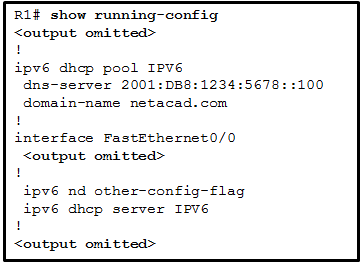
- Astateless DHCPv6
- Bstatic link-local
- Cstateful DHCPv6
- DSLAAC
85Refer to the exhibit. What should be done to allow PC-A to receive an IPv6 address from the DHCPv6 server?
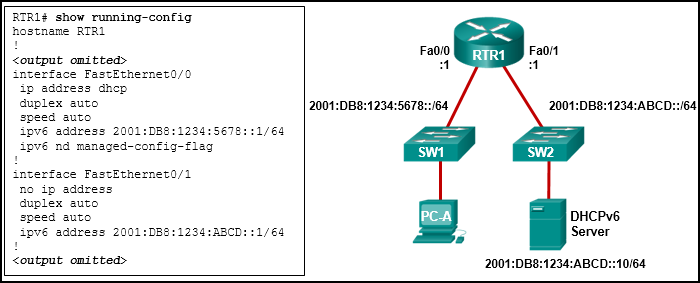
- AConfigure the ipv6 nd managed-config-flag command on interface Fa0/1.
- BAdd the IPv6 address 2001:DB8:1234:5678::10/64 to the interface configuration of the DHCPv6 server.
- CChange the ipv6 nd managed-config-flag command to ipv6 nd other-config-flag.
- DAdd the ipv6 dhcp relay command to interface Fa0/0.
86Refer to the exhibit. A network administrator is implementing stateful DHCPv6 operation for the company. However, the clients are not using the prefix and prefix-length information that is configured in the DHCP pool. The administrator issues a show ipv6 interface command. What could be the cause of the problem?
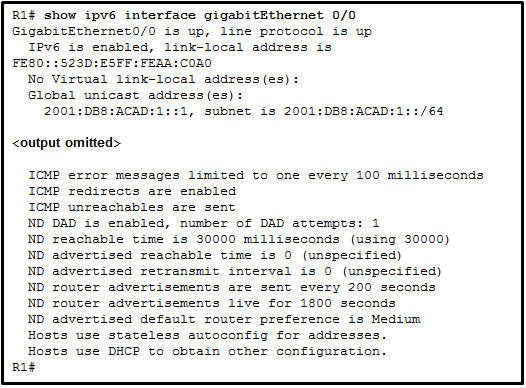
- ANo virtual link-local address is configured.
- BThe router is configured for stateless DHCPv6 operation
- CThe router is configured for SLAAC DHCPv6 operation.
- DThe Duplicate Address Detection feature is disabled.
87Refer to the exhibit. A network administrator is implementing the stateless DHCPv6 operation for the company. Clients are configuring IPv6 addresses as expected. However, the clients are not getting the DNS server address and the domain name information configured in the DHCP pool. What could be the cause of the problem?
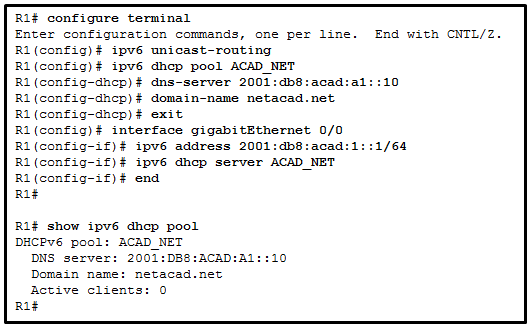
- AThe GigabitEthernet interface is not activated.
- BThe clients cannot communicate with the DHCPv6 server, evidenced by the number of active clients being 0.
- CThe DNS server address is not on the same network as the clients are on.
- DThe router is configured for SLAAC operation.
88Which method is used by a PAT-enabled router to send incoming packets to the correct inside hosts?
- AIt uses the destination TCP or UDP port number on the incoming packet.
- BIt uses the source IP address on the incoming packet.
- CIt uses the source TCP or UDP port number on the incoming packet.
- DIt uses a combination of the source TCP or UDP port number and the destination IP address on the incoming packet
89Refer to the exhibit. Which address or addresses represent the inside global address?
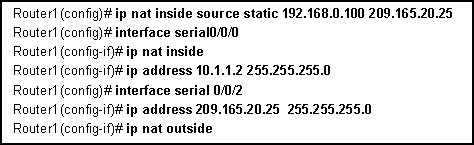
- A10.1.1.2
- B209.165.20.25
- C192.168.0.100
- Dany address in the 10.1.1.0 network
90A network administrator is configuring a static NAT on the border router for a web server located in the DMZ network. The web server is configured to listen on TCP port 8080. The web server is paired with the internal IP address of 192.168.5.25 and the external IP address of 209.165.200.230. For easy access by hosts on the Internet, external users do not need to specify the port when visiting the web server. Which command will configure the static NAT?
- AR1(config)# ip nat inside source static tcp 209.165.200.230 8080 192.168.5.25 80
- BR1(config)# ip nat inside source static tcp 209.165.200.230 80 192.168.5.25 8080
- CR1(config)# ip nat inside source static tcp 192.168.5.25 8080 209.165.200.230 80
- DR1(config)# ip nat inside source static tcp 192.168.5.25 80 209.165.200.230 8080
91What is defined by the ip nat pool command when configuring dynamic NAT?
- Athe pool of global address
- Bthe range of internal IP addresses that are translated
- Cthe range of external IP addresses that internal hosts are permitted to access
- Dthe pool of available NAT servers
92Refer to the exhibit. Based on the output that is shown, what type of NAT has been implemented?

- Adynamic NAT with a pool of two public IP addresses
- Bstatic NAT with a NAT pool
- Cstatic NAT with one entry
- DPAT using an external interface
93What is the primary purpose of NAT?
- Aenhance network performance
- Ballow peer-to-peer file sharing
- Cincrease network security
- Dconserve IPv4 addresses
94What is the major benefit of using NAT with Port Address Translation?
- AIt provides a pool of public addresses that can be assigned to internal hosts.
- BIt allows many internal hosts to share the same public IPv4 address.
- CIt improves network performance for real-time protocols.
- DIt allows external hosts access to internal servers.
95What is a characteristic of unique local addresses?
- AThey are defined in RFC 3927.
- BTheir implementation depends on ISPs providing the service.
- CThey are designed to improve the security of IPv6 networks.
- DThey allow sites to be combined without creating any address conflicts.
96A network administrator configures the border router with the command R1(config)# ip nat inside source list 4 pool corp. What is required to be configured in order for this particular command to be functional?
- Aa VLAN named corp to be enabled and active and routed by R1
- Bip nat outside to be enabled on the interface that connects to the LAN affected by the NAT
- Can access list numbered 4 that defines the starting and ending public IP addresses
- Dan access list named corp that defines the private addresses that are affected by NAT
- Ea NAT pool named corp that defines the starting and ending public IP addresses
97Which statement describes IPv6 ULAs?
- AThey are assigned by an ISP.
- BThey are not routable across the internet.
- CThey begin with the fe80::/10 prefix.
- DThey conserve IPv6 address space.
98What is the purpose of port forwarding?
- APort forwarding allows an internal user to reach a service on a public IPv4 address that is located outside a LAN.
- BPort forwarding allows for translating inside local IP addresses to outside local addresses.
- CPort forwarding allows an external user to reach a service on a private IPv4 address that is located inside a LAN.
- DPort forwarding allows users to reach servers on the Internet that are not using standard port numbers.
99When dynamic NAT without overloading is being used, what happens if seven users attempt to access a public server on the Internet when only six addresses are available in the NAT pool?
- AThe first user gets disconnected when the seventh user makes the request.
- BAll users can access the server.
- CThe request to the server for the seventh user fails.
- DNo users can access the server.
100A network engineer has configured a router with the command ip nat inside source list 4 pool corp overload. Why did the engineer use the overload option?
- AThe company has a small number of servers that should be accessible by clients from the Internet.
- BThe company router must throttle or buffer traffic because the processing power of the router is not enough to handle the normal load of external-bound Internet traffic.
- CThe company needs to have more public IP addresses available to be used on the Internet.
- DThe company has more private IP addresses than available public IP addresses.
101What is a disadvantage of NAT?
- AThe costs of readdressing hosts can be significant for a publicly addressed network.
- BThe internal hosts have to use a single public IPv4 address for external communication.
- CThe router does not need to alter the checksum of the IPv4 packets.
- DThere is no end-to-end addressing.
102Refer to the exhibit. What is the purpose of the command marked with an arrow shown in the partial configuration output of a Cisco broadband router?
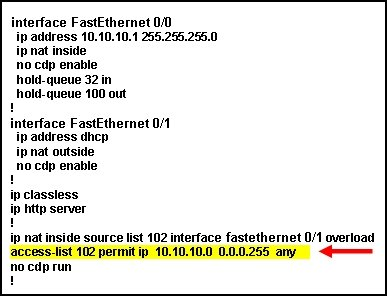
- Adefines which addresses can be translated
- Bdefines which addresses are allowed out of the router
- Cdefines which addresses are assigned to a NAT pool
- Ddefines which addresses are allowed into the router
103 What are two of the required steps to configure PAT? (Choose two.)
- ADefine the hello and interval timers to match the adjacent neighbor router.
- BIdentify the inside interface.
- CDefine the range of source ports to be used.
- DCreate a standard access list to define applications that should be translated.
- EDefine a pool of global addresses to be used for overload translation.
104Refer to the exhibit. A technician is configuring R2 for static NAT to allow the client to access the web server. What is a possible reason that the client PC cannot access the web server?
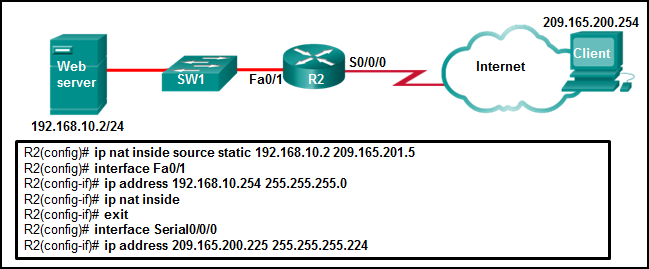
- AInterface S0/0/0 should be identified as the outside NAT interface.
- BThe configuration is missing a valid access control list
- CThe IP NAT statement is incorrect.
- DInterface Fa0/1 should be identified as the outside NAT interface.
105What are two benefits of NAT? (Choose two.)
- AIt makes troubleshooting routing issues easier.
- BIt makes tunneling with IPsec less complicated.
- CIt increases routing performance. It makes troubleshooting routing issues easier.
- DIt adds a degree of privacy and security to a network.
- EIt saves public IP addresses.
106What is an advantage of deploying IPv4 NAT technology for internal hosts in an organization?
- Aenables the easy deployment of applications that require end-to-end traceability
- Bincreases the performance of packet transmission to the Internet
- Cprovides flexibility in designing the IPv4 addressing scheme
- Dmakes internal network access easy for outside hosts using UDP
107A technician is required to configure an edge router to use a different TCP port number for each session with a server on the Internet. What type of Network Address Translation (NAT) should be implemented?
- Aa many-to-one address mapping between local and global addresses
- Ba one-to-many address mapping between local and global addresses
- Ca one-to-one address mapping between local and global addresses
- Da many-to-many address mapping between local and global addresses
Información
- Descripción
- CISCO vom Sommersemester 2020 CSDC
- Autor
- Leona W.
- Idioma
- Deutsch
- Visitas
- 175
- Etiquetas
- Valoración
- Aún sin valoraciones Valora este test