
Test
IE Chapter 6
Preguntas del test (39)
1The meaning of "terms of trade" is
- Athe price of a country's exports divided by the price of its imports.
- Bthe amount of exports sold by a country.
- Cthe price conditions bargained for in international markets.
- Dthe quantities of imports received in free trade.
- Ethe tariffs in place between two trading countries.
2A country cannot produce a mix of products with a higher value than where
- Athe isovalue line is tangent to the production possibility frontier.
- Bthe isovalue line intersects the production possibility frontier.
- Cthe isovalue line is above the production possibility frontier.
- Dthe isovalue line is below the production possibility frontier.
- Ethe isovalue line is tangent with the indifference curve.
3Tastes of individuals are represented by
- Aindifference curves.
- Bproduction possibility frontiers.
- Cisovalue lines.
- Dproduction functions.
- Ethe terms of trade.
4If the ratio of price of cloth (PC) divided by the price of food (PF) increases in the international marketplace, then
- Athe terms of trade of cloth exporters will improve.
- Ball countries would be better off.
- Cthe terms of trade of food exporters will improve.
- Dthe terms of trade of all countries will improve.
- Ethe terms of trade of cloth exporters will worsen.
5If the ratio of price of cloth (PC) divided by the price of food (PF) increases in the international marketplace, then
- Athe cloth exporter will increase the quantity of cloth produced.
- Bthe cloth exporter will increase the quantity of cloth exported.
- Cthe food exporter will increase the quantity of food exported.
- Dthe cloth exporter will decrease the quantity of cloth exported.
- Ethe country would import more cloth.
6If the ratio of price of cloth (PC) divided by the price of food (PF) increases in the international marketplace, then
- Aworld relative quantity of cloth supplied will increase.
- Bworld relative quantity of cloth supplied and demanded will increase.
- Cworld relative quantity of cloth supplied and demanded will decrease.
- Dworld relative quantity of cloth demanded will decrease.
- Eworld relative quantity of food will increase.
7A country will be able to consume a combination of goods that is not attainable solely from domestic production if
- Athe world terms of trade differ from its domestic relative costs.
- Bthe country specializes in one product.
- Cthe country avoids international trade.
- Dthe world terms of trade equal the domestic relative costs.
- Ethe country's domestic production value equals world relative value.
8Terms of trade refers to
- Athe relative price at which trade occurs.
- Bwhat goods are imported.
- Cwhat goods are exported.
- Dthe volume of trade.
- Ethe tariffs applied to trade.
9If points A and B are two locations on a country's production possibility frontiers, then
- Athe country could produce either of the two bundles.
- Bconsumers are indifferent between the two bundles.
- Cproducers are indifferent between the two bundles.
- Dat any point in time, the country could produce both.
- Eboth bundles must have the same relative cost.
10If the economy is producing at point a on its production possibility frontier, then
- Aall of the country's workers are employed.
- Ball of the country's workers are specialized in one product.
- Call of the country's capital is used for one product.
- Dall of its capital is used, but not efficiently.
- Eall of the country's exports are produced in equal amounts.
11Refer to the figure above, which shows a country's possible production possibility frontiers and indifference curves. If the country is producing at ______________, then moving to ______________ will cause utility to ____________.
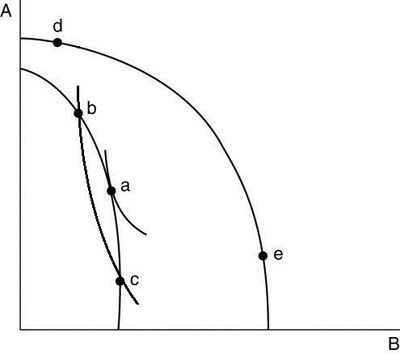
- Apoint b; point c; remain unchanged
- Bpoint a; point b; increase
- Cpoint c; point b; increase
- Dpoint c; point b; decrease
- Epoint a; point c; remain unchanged
12If two countries with diminishing returns and different marginal rates of substitution between two products were to engage in trade, then
- Athe marginal rates of substitution of both would become equal.
- Bthe shapes of their respective production possibility frontiers would change.
- Cthe larger of the two countries would dominate their trade.
- Dthe country with relatively elastic supplies would export more.
- Ethe opportunity costs for the smaller country would increase.
13If a country began exporting product A and importing product B, then, as compared to the autarky (no-trade) situation, the marginal cost of product A will
- Aincrease.
- Bdecrease.
- Cshift outward.
- Dshift inward.
- Eremain the same.
14When the production possibility frontier shifts out relatively more in one direction, we have
- Abiased growth.
- Bunbiased growth.
- Cimmiserizing growth.
- Dbalanced growth.
- Eimbalanced growth.
15Suppose that a country experiences growth strongly biased toward its export, cloth
- Athis will tend to worsen the country's terms of trade.
- Bthis will tend to improve the country's terms of trade.
- Cthis will tend to leave the country's terms of trade unchanged.
- Dthis will tend to worsen the terms of trade for the country's trading partner.
- Ethis will increase the price of cloth relative to the imported good.
16Suppose that a "small country" experiences growth strongly biased toward its export, cloth
- Athis will have no effect on terms of trade for the country's trading partner.
- Bthis will tend to worsen the country's terms of trade.
- Cthis will tend to improve the country's terms of trade.
- Dthis will tend to worsen terms of trade for the country's trading partner.
- Ethis will tend to improve terms of trade for the country's trading partner.
17Refer to the figure above, which shows a country's possible production possibility frontiers and indifference curves. If the country is producing at __________, then moving to ___________ will cause utility to ___________________.
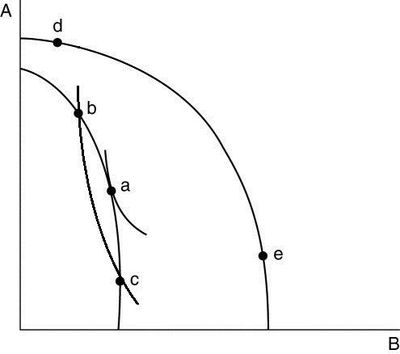
- Apoint c; point b; remain unchanged
- Bpoint a; point b; increase
- Cpoint c; point b; increase
- Dpoint c; point b; decrease
- Epoint a; point c; remain unchanged
18Refer to the figure above, which shows a country's possible production possibility frontiers and indifference curves. If the country is producing at __________, then moving to ___________ will cause utility to ___________________.
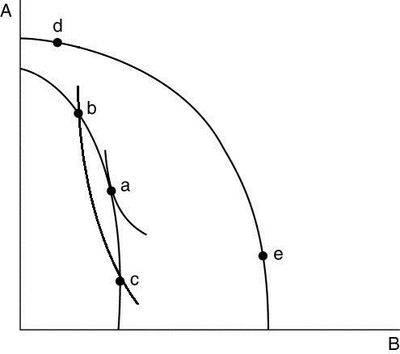
- Apoint b; point a; increase
- Bpoint a; point b; increase
- Cpoint c; point b; increase
- Dpoint c; point b; decrease
- Epoint a; point c; remain unchanged
19If the U.S. (a large country) imposes a tariff on its imported good, this will tend to
- Aimprove the terms of trade of the United States.
- Bhave no effect on terms of trade.
- Cimprove the terms of trade of all countries.
- Dcause a deterioration of U.S. terms of trade.
- Eraise the world price of the good imported by the United States.
20If Slovenia is a small country in world trade terms, then if it imposes a large series of tariffs on many of its imports, this would
- Ahave no effect on its terms of trade.
- Bimprove its terms of trade.
- Cdeteriorate its terms of trade.
- Ddecrease its marginal propensity to consume.
- Eincrease its exports.
21If Slovenia is a large country in world trade, then if it imposes a large set of tariffs on many of its imports, this would
- Aimprove its terms of trade.
- Bhave no effect on its terms of trade.
- Charm its terms of trade.
- Ddecrease its marginal propensity to consume.
- Eincrease its exports.
22If Slovenia were a large country in world trade, then if it imposes a large set of tariffs on its imports, this must
- Adecrease the internal price of imports below the world market rate.
- Bcause retaliation on the part of its trade partners.
- Charm Slovenia's real income.
- Dimprove Slovenia's real income.
- Eimprove the real income of its trade partners.
23If Slovenia were a large country in world trade, then if it instituted a large set of subsidies for its exports, this must
- Aharm its terms of trade.
- Bhave no effect on its terms of trade.
- Cimprove its terms of trade.
- Ddecrease its marginal propensity to consume.
- Eharm world terms of trade.
24If Slovenia were a large country in world trade, then if it instituted a large set of subsidies for its exports, this must
- Aimprove the real income of its trade partners.
- Bcause retaliation on the part of its trade partners.
- Charm Slovenia's real income.
- Dimprove Slovenia's real income.
- Eincrease internal prices above the world market rate.
25If a small country were to levy a tariff on its imports then this would
- Adecrease the country's economic welfare.
- Bhave no effect on that country's economic welfare.
- Cincrease the country's economic welfare.
- Dchange the terms of trade.
- Eraise prices on its exports in other countries.
26An increase in a country's net commodity terms of trade will
- Anot always guarantee positive changes in the country's economy.
- Balways increase the country's economic welfare.
- Calways increase the country's real income.
- Dnever increase the country's quantity of exports.
- Ealways increase the country's production of its import competing good.
27An import tariff will cause the relative demand for ____________ to ________________ and the relative supply for _______________ to ________________.
- Aimports; decrease; imports; increase
- Bimports; increase; imports; decrease
- Cexports; increase; exports; decrease
- Dexports; decrease; exports; increase
- Eexports; increase; imports; decrease
28An export subsidy will cause the relative demand for _______________ to ________________ and the relative supply for ______________ to ______________.
- Aexports; decrease; exports; increase
- Bimports; decrease; imports; increase
- Cimports; increase; imports; decrease
- Dexports; increase; exports; decrease
- Eexports; increase; imports; decrease
29An import tariff will cause the terms of trade of the _______________ country to ______________ and will _______________ the country.
- Aimporting; improve; benefit
- Bexporting; improve; benefit
- Cimporting; suffer; harm
- Dexporting; improve; harm
- Eimporting; improve; harm
30An export subsidy will cause the terms of trade of the ____________ country to ____________ and will ______________ the country.
- Aexporting; suffer; harm
- Bexporting; improve; benefit
- Cimporting; suffer; harm
- Dimporting; suffer; benefit
- Eimporting; improve; harm
31International borrowing and lending may be interpreted as one form of
- Aintertemporal trade.
- Bintermediate trade.
- Ctrade in services.
- Dunrequited international transfers.
- Eaid to offset trade advantages.
32If one observes that Japan was traditionally a net foreign lender, one could conclude that relative to its international trade and financial partners
- AJapan's intertemporal production possibilities are biased toward present consumption.
- BJapan's intertemporal production possibilities are biased toward future consumption.
- CJapan's intertemporal production possibilities are larger than that of the other countries.
- DJapan's intertemporal production possibilities are not biased.
- EJapan preferred to consume beyond its production in the present.
33Rapidly growing developing countries tend to be borrowers on the international capital markets. From this information we may surmise that they have a comparative advantage in
- Afuture income.
- Bcapital goods.
- Cdisposable income.
- Dconsumer goods.
- Epresent income.
34It may be argued that theoretically, international capital movements
- Atend to hurt labor in donor countries.
- Btend to hurt the donor countries.
- Ctend to hurt the recipient countries.
- Dtend to hurt labor in recipient countries.
- Eincrease future production in donor countries.
35The intertemporal tradeoff between present and future consumption is measured by the
- Areal interest rate.
- Binflation rate.
- Cnominal interest rate.
- Dterms of trade.
- Erate of economic growth.
36A fall in the real interest rate, all other things held constant, will cause a country's ___________ to ______________.
- Acurrent consumption; increase
- Bcurrent consumption: decrease
- Cterms of trade; improve
- Dterms of trade; worsen
- Ewelfare level; improve
37An increase in the real interest rate, all other things held constant, will cause a country's ____________ to _______________.
- Acurrent consumption: increase
- Bcurrent consumption; decrease
- Cterms of trade; improve
- Dterms of trade; worsen
- Ewelfare level; improve
38The price of _____________ consumption in terms of _________________ consumption is ____________________.
- Afuture; current; 1/(1+r)
- Bpresent; future; 1/(1 + r)
- Cfuture; current; r
- Dpresent; future; r
- Efuture; current; 1 + r
39The intertemporal budget constraint is defined as:
- ADP + DF/(1+r) = QP + QF/(1+r)
- BV = QP + QF/(1 + r)
- CV = DP + DF/(1 + r)
- DDF + DP/(1 + r) = QF + QP/(1 + r)
- EDP + DF(1 + r) = QP + QF(1 + r)
Información
- Descripción
- Chapter 6
- Autor
- ulckapatel
- Idioma
- English
- Visitas
- 391
- Etiquetas
- Valoración
- Aún sin valoraciones Valora este test