
Test
B2 Quiz
Este test tiene tipos de pregunta que se abren en el reproductor de siempre.
Preguntas del test (21)
1What is a pathogen?
- Aa rapidly-reproducing cell
- BA disease-causing organism
2Bacteria and viruses cause illness in the same way.
- AVerdadero
- BFalso
3Using the graph, choose the correct explanation of each stage of bacterial growth.
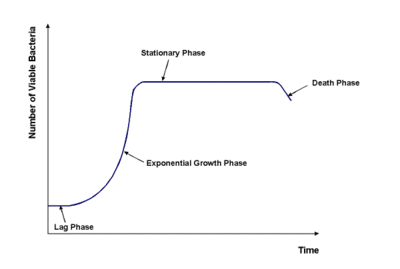
- A'lag phase' - there is no reproduction as the bacteria are copying information within their single cells
- B'lag phase' - resources begin to become scarce and bacteria are dying at the same rate that they are being produced
- C'exponential growth phase' - bacteria are reproducing rapidly
- D'exponential growth phase' - bacteria are being poisoned by their own toxins
- E'stationary phase' - there is no reproduction as the bacteria are copying information within their single cells
- F'stationary phase' - resources begin to become scarce and bacteria are dying at the same rate that they are being produced
- G'death phase' - bacteria are being poisoned by their own toxins
- H'death phase' - there is no reproduction as the bacteria are copying information within their single cells, so they are dying faster than they are being produced.
4If a pathogen gets past the [blank_start]external[blank_end] defences and into our bodies, then the [blank_start]immune[blank_end] system starts to work. This system attacks [blank_start]pathogens[blank_end] by using several different types of [blank_start]white[blank_end] blood cell, made in the bone marrow. Some white blood cells [blank_start]engulf[blank_end] microorganisms and digest them, while another type of white blood cell produces [blank_start]antibodies[blank_end] that recognise and destroy particular microorganisms - a more targeted response.
Pathogens have proteins, called [blank_start]antigens[blank_end], in their cell membranes that our immune systems recognise as [blank_start]foreign[blank_end]. [blank_start]Specific[blank_end] antibodies are made for each antigen by the white blood cells. Antibodies attach to the antigens on the surface of the [blank_start]microorganisms[blank_end]. This inactivates the microbes and makes them [blank_start]clump[blank_end] together, allowing them to be easily engulfed by other white blood cells.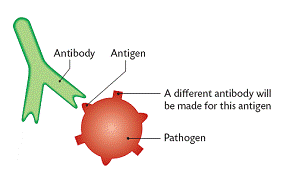
- Aexternal
- Bimmune
- Cpathogens
- Dwhite
- Eengulf
- Fantibodies
- Gantigens
- Hforeign
- ISpecific
- Jmicroorganisms
- Kclump
5A person is said to be immune to a pathogen if their immune system is able to use memory cells to recognise and attack the pathogen before symptoms develop.
- AVerdadero
- BFalso
6A vaccine contains a safe form of the microbe that causes a disease. Once the vaccine is in the body, the immune system attacks it and develops memory cells against the antigens. These memory cells respond quickly if they ever meet the real pathogen.
- AVerdadero
- BFalso
7Bacteria and [blank_start]fungi[blank_end] may develop resistance to antimicrobials. [blank_start]Resistant[blank_end] microorganisms are not easily killed by antimicrobial substances. The normal population of microorganisms contains [blank_start]some[blank_end] that are resistant , however when we use the antimicrobial all those [blank_start]susceptible[blank_end] will be destroyed, leaving the resistant ones. These then [blank_start]reproduce[blank_end], resulting in a more resistant [blank_start]population[blank_end]. the more the antimicrobial is applied, the more resistant the remaining population is. These extremely resistant microbes are known as '[blank_start]superbugs[blank_end]'.
- Afungi
- BResistant
- Csome
- Dsusceptible
- Ereproduce
- Fpopulation
- Gsuperbugs
8The initial resistance in a microbial population is caused by....
- A....mutations
- B....chance
- C....correlation
9Why is the heart called a 'double pump'?
- AIt pumps blood at double the rate.
- BIt pumps blood in different directions independently from one another.
10Correctly label the heart using the words below.
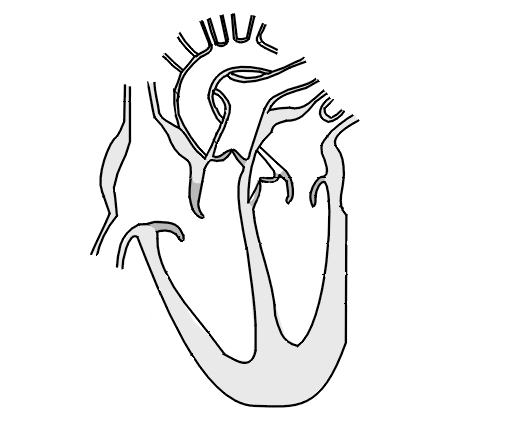
- Aaorta
- Bpulmonary artery
- Cleft atrium
- Dleft ventricle
- Eright ventricle
- Fright atrium
- Gpulmonary veins
- Hsuperior vena cava
- Iinferior vena cava
11How is the structure of an artery adapted to its function?
- AIt has thin walls for maximum transfer of substances
- BValves prevent blood 'pooling' in lower body parts.
- CIts thick, elastic muscular walls allow the vessel to withstand the high pressure which blood is pumped through at.
12Tiny blood vessels called capillaries are so narrow that blood can only just fit through. The blood cells therefore travel very slowly and because they are squashed against the capillary walls, which are very thin, maximum transfer of substances such as oxygen can occur across the capillary walls.
- AVerdadero
- BFalso
13Which of these is not one of the main risk factors of coronary heart disease?
- Asmoking
- Bplenty of exercise
- Cdiets high in saturated fat
- Dexcessive alcohol consumption
- Ehigh levels of stress
14When you exercise, the muscles need [blank_start]more[blank_end] oxygen and nutrients, and create more [blank_start]waste[blank_end] products to take away. In order to provide the [blank_start]muscles[blank_end] with what they need, the heart beats [blank_start]faster[blank_end] and so pumps the blood more quickly around the [blank_start]body[blank_end] when exercise takes place.
- Amore
- Bwaste
- Cmuscles
- Dfaster
- Ebody
15When a person has a lower resting heart rate, they generally have a higher fitness level because...
- A... their heart is pumping more efficiently and so more blood is moved around the body per beat.
- B... their heart is working less
16Homeostasis is the maintenance of a steady internal state.
- AVerdadero
- BFalso
17The system that maintains homeostasis is in three parts: the receptors, the processing centres and the effectors.
Which is in charge of determining how the body systems respond?- Areceptors
- Beffectors
- Cprocessing centres
18An important part of the [blank_start]homeostatic[blank_end] control system is the [blank_start]reversal[blank_end] of changes that have put the body system off balance. This reversal helps the body back to the [blank_start]steady[blank_end] state it should be in. It is called [blank_start]negative[blank_end] feedback.
The body's response to temperature changes is a good example of negative feedback. If the body temperature rises above 37 degrees celsius, the [blank_start]receptors[blank_end] detect this and send a message to the processing centre in the brain. The processing centre then directs the [blank_start]effectors[blank_end], in this case the blood vessels, to [blank_start]vasodilate[blank_end] so that heat can be lost through the skin and the body temperature drops. Once the temperature has dropped back to normal, the receptor would detect this and pass the message to the [blank_start]processing[blank_end] centre, which would direct the effectors to return to their normal [blank_start]diameter[blank_end].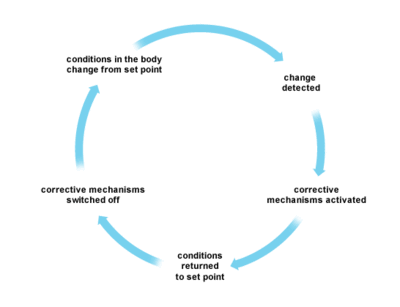
- Ahomeostatic
- Breversal
- Csteady
- Dnegative
- Ereceptors
- Feffectors
- Gvasodilate
- Hprocessing
- Idiameter
19How is water taken into our bodies?
- AEating
- BDrinking
- CRespiration
- DSweat
- EExhalation
- FExcretion of faeces
- GExcretion of Urine
20All the cells in the body are bathed with a fluid called blood [blank_start]plasma[blank_end]. It is important that blood plasma remains at the correct [blank_start]concentration[blank_end] as the enzymes within the cells work best at a particular concentration of water and salts. If the blood plasma is too dilute, the cells will [blank_start]absorb[blank_end] water until they burst. If the blood plasma is too [blank_start]concentrated[blank_end], the cells will [blank_start]lose[blank_end] water until they become dehydrated.
- Aplasma
- Bconcentration
- Cabsorb
- Dconcentrated
- Elose
21How do the kidneys respond to changes in the blood plasma?
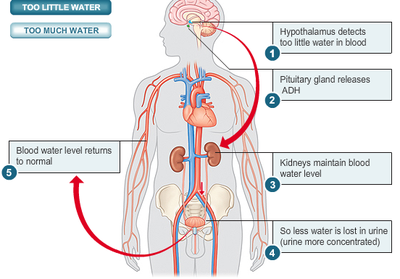
- ABy changing the concentration of the urine that is excreted.
- BBy adding more/less water.
- CThey do nothing.
Información
- Descripción
- GCSE (B2 - Keeping Healthy) Biology Test sobre B2 Quiz, creado por Leah Firmstone el 30/10/2015.
- Autor
- Leah Firmstone
- Idioma
- English
- Visitas
- 83
- Etiquetas
- Valoración
- Aún sin valoraciones Valora este test