
Test
Cells
Crea una cuenta gratis para terminar este test
Guarda tu progreso y consulta tu resultado final.
¿Ya tienes cuenta? Inicia sesión
Preguntas del test (18)
1CYTOPLASM contains ENZYMES that control the CHEMICAL REACTIONS.
- AVerdadero
- BFalso
2What is the function of the cell wall?
- Asupport and strengthen the plant cell
- Bto produce proteins
- Cwhere photosynthesis takes place
3What is the green substance in chloroplasts?
- Achlorophyll
- Bcellulose
- Cenzymes
- Dmitochondria
4What does the permanent vacuole contain?
- Acell sap (weak solution of sugars and salts)
- Bchlorophyll
- Ccellulose
5This is a bacteria cell
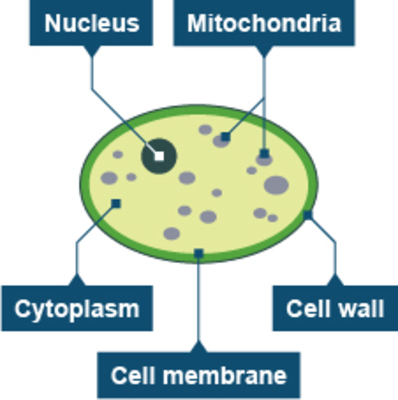
- AVerdadero
- BFalso
6Features of a bacteria cell
- Anucleus
- Bmitochondria
- Ccytoplasm
- Dcell membrane
- Eplasmid DNA
- Fcell wall
- Gvacuole
- Hchloroplasts
- Iflagella
- Jchromosomal DNA (carries most of the genetic information)
7Yeast cells do not contain ribosomes or mitochondria
- AVerdadero
- BFalso
8Both yeast and bacteria are single celled organisms
- AVerdadero
- BFalso
9Diffusion is the spreading of particles from a LOW concentration to a HIGH concentration
- AVerdadero
- BFalso
10Diffusion only happens in liquids
- AVerdadero
- BFalso
11Diffusion only happens in liquids
- AVerdadero
- BFalso
12The BIGGER the DIFFERENCE IN CONCENTRATION the FASTER the diffusion rate
- AVerdadero
- BFalso
13Dissolved substances can move in and out of cells by DIFFUSION. This is called OSMOSIS
- AVerdadero
- BFalso
14Osmosis is the movement of water from a less concentrated solution to a more concentrated solution through a partially permeable membrane.
- AVerdadero
- BFalso
15Particles move about randomly, so they move both ways through a semi permeable mebrane in osmosis. This means there is a NET (overall) movement FROM the HIGHER concentration
- AVerdadero
- BFalso
16Adaptions of the PALISADE CELL or PHOTOSYNTHESIS
- APacked with chloroplasts
- BMore chloroplasts near the top of the cell so they're nearer the light
- CTALL meaning larger SURFACE AREA for ABSORBING CO2 from the air
- DTHIN meaning they can be crammed tightly next to eachother at the top of the leaf
- ESpecial kidney-shape
- FWhen the plant has lots of water, the cells become TURGID so the stomata OPEN and gases can be exchanged
- GWhen the plant is short of water, the cells become FLACCID, making the stomata close, meaning less water vapour escapes.
- HTHIN outer walls and THICKER inner walls make the opening and closing work
- ISENSITIVE TO LIGHT - CLOSE AT NIGHT to save water
17Adaptions of the GUARD CELLS to OPEN and CLOSE PORES (STOMATA)
- APacked with chloroplasts
- BMore chloroplasts near the top of the cell so they're nearer the light
- CTALL meaning larger SURFACE AREA for ABSORBING CO2 from the air
- DTHIN meaning they can be crammed tightly next to eachother at the top of the leaf
- ESpecial kidney-shape
- FWhen the plant has lots of water, the cells become TURGID so the stomata OPEN and gases can be exchanged
- GWhen the plant is short of water, the cells become FLACCID, making the stomata close, meaning less water vapour escapes.
- HTHIN outer walls and THICKER inner walls make the opening and closing work
- ISENSITIVE TO LIGHT - CLOSE AT NIGHT to save water
18Guard cells are grouped together at the top of the leaf where most of the photosynthesis happens
- AVerdadero
- BFalso
Información
- Descripción
- GCSE (Physics) Science Test sobre Cells, creado por mollymalone98 el 06/01/2014.
- Autor
- mollymalone98
- Idioma
- English
- Visitas
- 85
- Etiquetas
- Valoración
- Aún sin valoraciones Valora este test